


Different Types of Resistors Explained Simply

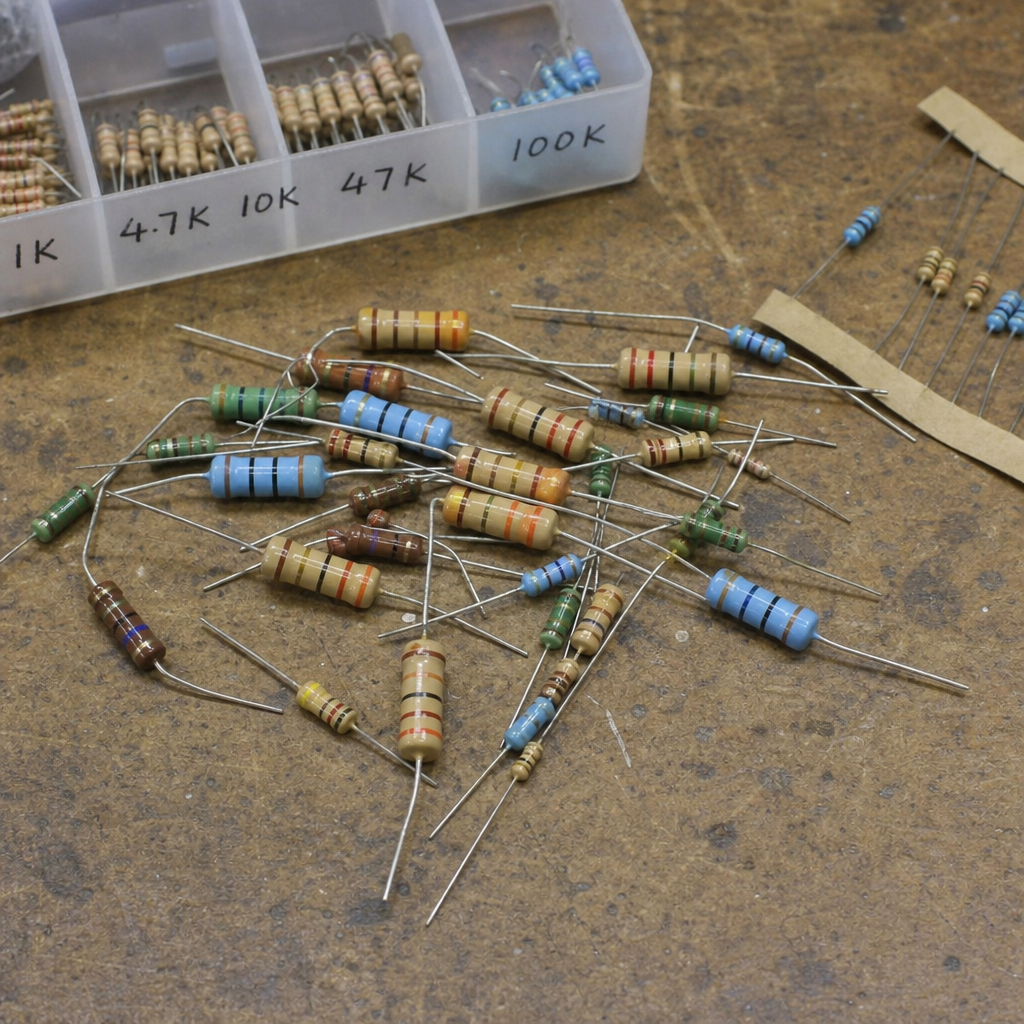
Different Types of Resistors Explained Simply
Resistors are small components with a big job: they control current, divide voltage, set signal levels, and help protect parts of a circuit from damage. Understanding the different types of resistors makes it easier to choose the right part, read a schematic with confidence, and troubleshoot common electronics problems. This guide explains the main resistor types in plain language, with practical examples of where each one is used.
What does a resistor do in a circuit?
A resistor limits the flow of electric current and creates a controlled voltage drop. In simple terms, it adds electrical “resistance” so current does not rush through a circuit unchecked. Designers use resistors to protect LEDs, bias transistors, set amplifier gain, pull digital signals high or low, and shape timing or filtering behavior.
The basic unit of resistance is the ohm, shown with the symbol Ω. A low-value resistor allows more current to pass, while a high-value resistor allows less. The relationship between voltage, current, and resistance is described by Ohm’s law: voltage equals current multiplied by resistance.
Resistors also have practical ratings beyond resistance value. Power rating tells you how much heat the part can safely dissipate, tolerance tells you how close the real value is to the printed value, and temperature behavior tells you how stable it remains as conditions change. These details explain why there are various types of resistors instead of one universal component for every job.

The 2 types of resistors most beginners should know first
The 2 types of resistors most often introduced first are fixed resistors and variable resistors. Fixed resistors have one set resistance value, while variable resistors allow the resistance to be adjusted manually, mechanically, or electronically. Almost every other category is easier to understand once you know this basic split.
Fixed resistors are the common resistors you see in most circuit diagrams. A designer chooses a specific value, such as 220 Ω, 1 kΩ, or 10 kΩ, and the component is expected to stay close to that value during normal operation. These are used when the circuit needs predictable, repeatable behavior.
Variable resistors are used when a circuit needs adjustment. A volume knob, brightness control, calibration screw, or sensor threshold may rely on a resistor whose value can change. Instead of replacing parts to fine-tune the circuit, you can turn a shaft, move a slider, or adjust a small screw.
This fixed-versus-variable distinction is simple, but it is not the whole story. Within those two broad groups, different materials and designs affect accuracy, noise, size, cost, heat handling, and long-term reliability.
Fixed resistors provide stable, predictable resistance
Fixed resistors are designed to maintain one resistance value. They are widely used because most circuits need stable reference points: a current limit here, a voltage divider there, or a pull-up resistor to keep a microcontroller input from floating.
When people search for types of fixed resistors, they are usually trying to understand the materials and construction methods behind these parts. The most important examples include carbon composition, carbon film, metal film, metal oxide film, wirewound, thick film, and thin film resistors. Each one solves the same basic problem in a slightly different way.
Carbon composition resistors
Carbon composition resistors are among the older resistor designs. They are made from a mixture of carbon particles and a binding material, formed into a solid body with leads attached. Their resistance comes from the carbon mixture itself.
These resistors are simple and can handle short pulses reasonably well, but they are not usually the first choice for modern precision circuits. Their value can drift more than newer designs, and they may produce more electrical noise. You may still find them in vintage equipment, restoration projects, and certain circuits where pulse behavior matters more than tight accuracy.
Carbon film resistors
Carbon film resistors use a thin layer of carbon deposited on an insulating core. A spiral cut is often made in the film to adjust the final resistance value. Compared with carbon composition resistors, carbon film parts are generally more stable and more consistent.
They are affordable and still useful in many general-purpose circuits. If you are building simple hobby electronics, basic audio projects, or low-cost devices, carbon film resistors may work perfectly well. However, for precision measurement or low-noise analog circuits, other resistor types are often preferred.
Metal film resistors
Metal film resistors use a thin metallic layer instead of carbon. They are popular because they offer good accuracy, low noise, and stable performance in many everyday designs. If you buy a modern resistor kit for electronics work, many of the parts are likely to be metal film resistors.
These are often a strong default choice when you want dependable performance without overcomplicating the design. They work well in signal circuits, timing networks, voltage dividers, and many microcontroller projects. For beginners, metal film resistors are one of the easiest recommendations because they combine practical cost with reliable behavior.
Metal oxide film resistors
Metal oxide film resistors are similar in concept to metal film resistors, but they use a metal oxide layer. They are valued for handling higher temperatures and tougher operating conditions better than many ordinary film resistors.
You may see them in power supplies, industrial electronics, and circuits where heat or surge tolerance is important. They are not automatically the right choice for every project, but they are helpful when durability matters. If a circuit may face voltage spikes, heat, or demanding service, metal oxide film is worth considering.
Wirewound resistors
Wirewound resistors are made by winding resistance wire around a ceramic or insulating core. Because the wire can be chosen and wound carefully, these resistors can be accurate and can also handle higher power levels. They are common in power electronics, test equipment, and load applications.
The main tradeoff is that the winding can add inductance. In low-frequency power circuits, this may not matter. In high-frequency circuits, inductance can affect performance, so designers may choose a different resistor construction or a special non-inductive wirewound style.
Thick film and thin film resistors
Thick film and thin film resistors are especially common in surface-mount electronics. Thick film resistors are widely used because they are compact, economical, and suitable for many general applications. Thin film resistors are typically chosen when better precision, lower noise, or improved stability is needed.
You will often encounter these in modern devices where components are mounted directly onto a printed circuit board. In practice, thick film parts are common in everyday digital and consumer electronics, while thin film parts may appear in more demanding analog, measurement, or precision circuits.
Name three types of fixed resistors used most often
If you need to name three types of fixed resistors, start with carbon film, metal film, and wirewound resistors. Carbon film resistors are useful for general low-cost circuits, metal film resistors are a reliable choice for stable and low-noise work, and wirewound resistors are used when higher power handling is needed. These three examples give a beginner a practical overview of how material and construction affect performance.
That said, the “best” three depend on the setting. In modern compact electronics, thick film surface-mount resistors are extremely common. In precision analog work, thin film and metal film resistors may be more relevant. In high-power circuits, wirewound or metal oxide resistors may be the better examples.
A helpful way to remember the difference is to connect each type to a practical use:
- Carbon film: general-purpose circuits where cost matters and extreme precision is not required.
- Metal film: cleaner, more stable circuits such as voltage dividers, sensor interfaces, and audio signal paths.
- Wirewound: higher-power jobs such as loads, current sensing, braking circuits, or power supply sections.
- Metal oxide film: circuits exposed to heat, surges, or rougher conditions.
- Thick film surface-mount: compact circuit boards in everyday modern electronics.
- Thin film surface-mount: precision circuits where stability and accuracy matter more.
This is why a parts list rarely says only “resistor.” A complete specification usually includes value, tolerance, wattage, package size, and sometimes material or technology.
Variable resistors allow adjustment and control
Variable resistors change resistance instead of staying at one fixed value. They are used whenever the circuit needs tuning, user control, calibration, or position-based feedback. The adjustment may be something a person changes often, like a volume knob, or something set once during manufacturing or repair.
Variable resistors usually have three terminals when used as a voltage divider and two terminals when used as a simple adjustable resistance. The moving contact is called the wiper. As the wiper moves across the resistive track, the circuit sees a changing resistance or changing output voltage.
Potentiometers
A potentiometer, often called a pot, is a three-terminal variable resistor. It is commonly used to create an adjustable voltage. When you turn a knob on a device to control volume, brightness, or speed, there is a good chance a potentiometer or a related control is involved.
Potentiometers can be rotary or linear. Rotary versions turn like a dial, while linear versions slide along a straight path. They may also have different response curves, such as linear taper for even adjustment or logarithmic taper for audio controls that better match how people perceive loudness.
Rheostats
A rheostat is a variable resistor used to control current. It typically uses two terminals: one end of the resistive element and the wiper. Older dimmers, motor controls, and heating controls may use rheostat-style operation, although many modern designs use more efficient electronic control methods.
The key idea is that a rheostat is placed in series with a load to vary current. Because it may dissipate significant power as heat, its power rating is especially important. Using an undersized rheostat can lead to overheating, poor performance, or failure.
Trimmers and preset resistors
Trimmers are small adjustable resistors intended for occasional calibration rather than frequent use. You might find them on circuit boards where a technician adjusts a reference voltage, sensor threshold, oscillator frequency, or gain setting. They are usually turned with a small screwdriver.
A trimmer can be very useful during setup, but it is not meant to feel like a consumer control. It may be delicate, small, and designed for limited adjustment cycles. Once the correct setting is reached, the circuit is usually left alone.
Newest in the store


What are the three common types of variable resistors?
If someone asks, “what are the three common types of variable resistors,” the simple answer is potentiometers, rheostats, and trimmers. Potentiometers are used for adjustable voltage control, rheostats are used for adjustable current control, and trimmers are used for calibration inside a device. These three variable resistor types cover most beginner-level examples.
Here is a practical checklist for choosing among them:
- Choose a potentiometer when a user needs a knob or slider, such as volume, tone, dimming, or speed input.
- Choose a rheostat when the goal is to vary current through a load and the component is rated for the expected heat.
- Choose a trimmer when the adjustment is internal, infrequent, and part of calibration.
- Check the power rating whenever meaningful current flows through the part.
- Check the taper or adjustment style if the control needs to feel smooth and predictable to a human user.
In many modern circuits, a variable resistor may provide only a control signal rather than directly handling the load power. For example, a potentiometer may tell a microcontroller what setting the user wants, while the microcontroller drives the actual output through a transistor, driver, or other power stage.
Special resistor types respond to temperature, light, voltage, and force
Not all resistors are chosen only for a fixed value or manual adjustment. Some are designed to change resistance in response to the environment. These parts are often used as sensors, protection devices, or automatic control elements.
Thermistors change with temperature
Thermistors are temperature-sensitive resistors. Their resistance changes as temperature changes, which makes them useful for temperature sensing, compensation, and inrush current limiting. The two main kinds are NTC and PTC thermistors.
An NTC thermistor has resistance that decreases as temperature rises. It is common in temperature measurement and power supply inrush limiting. A PTC thermistor has resistance that increases as temperature rises, which can help with overcurrent protection or self-regulating heating behavior.
Photoresistors change with light
Photoresistors, also called light-dependent resistors or LDRs, change resistance based on light level. In darkness, resistance is typically high. In brighter light, resistance drops.
They are easy to understand and useful in simple light-sensing circuits. Night lights, basic light meters, and educational projects often use them. They are not always ideal for fast or highly accurate measurement, but they are excellent for showing how a resistor can respond to the outside world.
Varistors respond to voltage surges
A varistor is a voltage-dependent resistor used for surge protection. Under normal conditions, it has high resistance and does very little. When voltage rises too high, its resistance drops and it helps divert the surge away from sensitive components.
Metal oxide varistors are common in protective circuits. They are often used across power lines or inputs where voltage spikes may occur. Like all protection parts, they must be selected carefully for the expected voltage, energy, and safety requirements.
Force-sensitive resistors respond to pressure
Force-sensitive resistors change resistance when pressure or force is applied. They appear in touch controls, pressure pads, robotics, musical interfaces, and interactive prototypes. They are useful when you need a simple indication that force is changing, not necessarily a laboratory-grade force measurement.
These parts make electronics feel more interactive. A microcontroller can read the changing resistance through a voltage divider and respond to touch, squeeze, or pressure. For many prototypes, that simplicity is more valuable than perfect accuracy.
Surface-mount and through-hole resistors differ in how they are installed
Another practical way to classify different types of resistors is by mounting style. Through-hole resistors have wire leads that pass through holes in a circuit board. Surface-mount resistors, often called SMD or SMT resistors, sit directly on pads on the board surface.
Through-hole resistors are easy to handle, easy to breadboard, and beginner-friendly. If you are learning electronics, repairing older equipment, or building a one-off prototype, through-hole parts can be convenient. Their larger size also makes color bands easier to read.
Surface-mount resistors are much smaller and better suited to compact modern products. They allow dense circuit layouts and automated manufacturing. The tradeoff is that they can be harder to solder by hand, identify visually, or replace without the right tools.
Neither style is automatically better. The right choice depends on the project, board design, available tools, and whether the circuit is a prototype, a repair, or a product intended for compact manufacturing.
Key specifications matter as much as resistor type
Choosing among the various types of resistors is not only about the material or name. A resistor with the wrong value, wattage, or tolerance can cause more trouble than choosing a slightly less ideal construction type. Before ordering or replacing one, check the full specification.
Important resistor specifications include:
- Resistance value: The ohm value required by the circuit, such as 100 Ω, 4.7 kΩ, or 1 MΩ.
- Tolerance: How far the real value may vary from the marked value. Lower tolerance means more precision.
- Power rating: How much heat the resistor can safely handle, often expressed in watts.
- Temperature coefficient: How much the resistance changes as temperature changes.
- Voltage rating: The maximum voltage the resistor body and construction can safely withstand.
- Package or size: The physical format, such as through-hole axial parts or surface-mount chip sizes.
- Noise behavior: Important in sensitive audio, measurement, and low-level analog circuits.
- Pulse or surge capability: Important where the resistor may see short bursts of energy.
A simple LED current-limiting resistor may not need tight tolerance or exotic materials. A precision sensor divider, however, may need low tolerance and stable temperature behavior. A power resistor in a supply or motor circuit may need a much higher wattage rating and enough airflow or board area to manage heat.
How to choose the right resistor for a project
The best resistor is the one that meets the circuit’s electrical, physical, and reliability needs without adding unnecessary cost or complexity. For beginner and general electronics, metal film fixed resistors are often a practical default, while potentiometers cover many adjustable-control needs. For power, precision, sensing, or surge protection, the correct choice becomes more specific.
Use this step-by-step approach:
- Start with the circuit function. Decide whether the resistor is limiting current, dividing voltage, sensing current, setting gain, pulling a signal high or low, controlling timing, or responding to the environment.
- Select the resistance value. Use the circuit design, formula, schematic, or replacement markings to identify the correct ohm value.
- Check power dissipation. Estimate or calculate heat using the expected current and voltage. Choose a power rating with sensible margin.
- Choose tolerance and stability. Use ordinary tolerance for non-critical jobs, but choose tighter parts for measurement, references, filters, and matched dividers.
- Match the construction to the job. Use metal film for stable general use, wirewound for higher power, thin film for precision, thick film for compact general SMD designs, and special resistors for sensing or protection.
- Confirm the physical package. Make sure the part fits the board, breadboard, enclosure, or repair location.
- Think about real-world conditions. Heat, vibration, moisture, high voltage, surges, and adjustment frequency can all affect the final choice.
This process helps prevent a common beginner mistake: choosing only by resistance value. Two resistors can both be 1 kΩ, but one may be a tiny low-power chip resistor and the other a large power resistor designed to dissipate heat safely.
Common resistor examples in everyday circuits
Resistors appear almost everywhere in electronics because their functions are so fundamental. Once you know what to look for, schematic symbols and board layouts become easier to read.
In an LED circuit, a resistor limits current so the LED does not draw too much and fail. In a microcontroller circuit, pull-up and pull-down resistors keep input pins in a known state instead of allowing random readings. In an audio circuit, resistors help set gain, mix signals, and define filter behavior with capacitors.
In power electronics, low-value resistors may sense current by creating a small measurable voltage drop. In timing circuits, resistors work with capacitors to control charge and discharge rates. In protection circuits, resistor-like components such as varistors and thermistors help manage surges, heat, or startup current.
These examples show why there are so many resistor types. The same basic idea—opposing current—can serve many purposes depending on how the part is built and where it is placed.
Simple mistakes to avoid when working with resistors
Resistors are forgiving compared with many electronic components, but mistakes still happen. Some errors cause a circuit to behave incorrectly, while others can overheat parts or damage nearby components.
Watch out for these common issues:
- Ignoring wattage: A resistor can have the right ohm value and still burn out if its power rating is too low.
- Misreading color bands: Similar colors, poor lighting, or reversed orientation can lead to the wrong value.
- Using a trimmer as a user control: Trimmers are usually meant for calibration, not constant adjustment.
- Assuming all 1 kΩ resistors are identical: Tolerance, package size, noise, and power rating can differ greatly.
- Replacing a fusible or safety resistor with an ordinary resistor: Some resistors are designed to fail safely in protection circuits.
- Forgetting heat spacing: Power resistors may need clearance, airflow, or special mounting.
- Using wirewound parts in sensitive high-frequency paths without checking inductance: The winding can affect circuit behavior.
A good habit is to identify why the resistor is in the circuit before replacing or modifying it. If it is part of a safety, power, or precision section, take extra care with the exact specification.
A practical way to remember different resistor types
The easiest way to remember the different types of resistors is to connect each one to its job. Fixed resistors hold a value. Variable resistors adjust a setting. Special resistors react to heat, light, voltage, or force. Power and precision versions are built to handle tougher electrical demands.
For a quick mental map:
- Fixed resistors: predictable values for everyday circuit design.
- Variable resistors: adjustable control or calibration.
- Power resistors: heat-handling parts for larger currents or loads.
- Precision resistors: stable, accurate parts for measurement and references.
- Sensor resistors: parts that respond to temperature, light, pressure, or other conditions.
- Protection resistors and resistor-like devices: parts that help manage surges, startup current, or fault conditions.
If you are just starting out, learn to recognize carbon film, metal film, wirewound, potentiometers, trimmers, thermistors, photoresistors, and surface-mount chip resistors. Those cover a large share of the common parts you will meet in kits, repairs, tutorials, and real products.
Final takeaway
Resistors may look simple, but the range of resistor types exists for good reasons. The main split is between fixed and variable resistors, while the deeper differences come from material, construction, accuracy, power handling, mounting style, and environmental response.
For most everyday work, start by identifying the resistance value, wattage, tolerance, and package. Then choose the type that fits the job: metal film for stable general use, wirewound or metal oxide for tougher power conditions, potentiometers or trimmers for adjustment, and thermistors, photoresistors, varistors, or force-sensitive resistors when the circuit needs to react to the world around it. Once you understand these categories, choosing the right resistor becomes much less mysterious and much more practical.