


Shop & Understand Electronic Components in Pakistan

Shop & Understand Electronic Components in Pakistan
Electronic components are individual parts used to control voltage, current, signals, power, sensing, timing, and logic inside an electronic circuit. Some parts are simple and passive, like resistors and capacitors, while others are active and can amplify, switch, process, or respond to data. Together, these parts decide how a device behaves, whether it blinks an LED, charges a battery, reads temperature, runs a motor, or communicates with another module.
For beginners, the biggest mistake is thinking of components as a random list of tiny objects. A better approach is to see each electrical part as having a job. When you know the job, the circuit starts making sense. You can look at a resistor and understand that it limits current, look at a diode and know it controls direction, or look at a sensor and understand that it converts a real-world condition into an electrical signal.
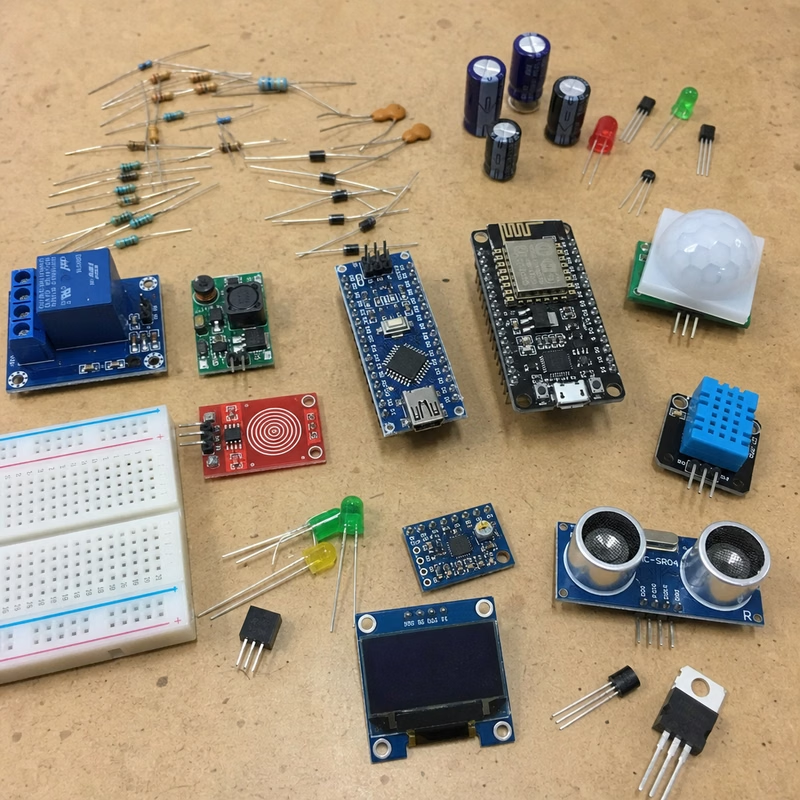
The main categories of basic electronic components
Most electronics projects use a mix of passive components, active components, electromechanical parts, power parts, and modules. You do not need to memorize every package size or technical detail at the start. Instead, learn what each component does, where it is commonly used, and which specification matters most when you buy it.
Resistors control current and divide voltage
A resistor is one of the most common electronic components. Its main job is to resist current flow, which helps protect sensitive parts such as LEDs, microcontroller pins, and transistor bases. Resistors are also used in voltage divider circuits, pull-up and pull-down configurations, filters, and timing networks.
When selecting a resistor, check its resistance value, tolerance, and power rating. For small Arduino-style projects, common values such as 220 ohm, 1 kilo-ohm, and 10 kilo-ohm appear often, but the correct value always depends on the circuit. If a resistor overheats, it may be the wrong power rating or the circuit may be drawing more current than expected.
Capacitors store and smooth electrical energy
Capacitors temporarily store electrical charge. In practical circuits, they are often used to smooth power supply noise, stabilize voltage, filter signals, and create timing effects. You will see small ceramic capacitors near microcontroller power pins and larger electrolytic capacitors near voltage regulators or motor drivers.
Important capacitor specifications include capacitance, voltage rating, polarity, and type. Electrolytic capacitors usually have polarity, so connecting them backward can damage the component. Ceramic capacitors are often non-polar and useful for noise filtering. A good habit is to choose a voltage rating comfortably above the voltage used in your circuit.
Diodes guide current in one direction
A diode allows current to flow mainly in one direction. This makes it useful for reverse polarity protection, rectification, flyback protection across relays and motors, and signal control. The LED, or light-emitting diode, is a special diode that produces light when current flows through it.
When buying a diode, check its current rating, reverse voltage rating, and forward voltage. For LEDs, also check color, size, brightness, and recommended current. Always use a current-limiting resistor with a basic LED unless the module already includes one.
Transistors switch and amplify
Transistors act like electronic switches or amplifiers. In beginner projects, they are often used to let a small microcontroller signal control a larger load, such as a motor, relay, buzzer, solenoid, or LED strip. Common types include bipolar junction transistors and MOSFETs.
A transistor is not selected by name alone. You need to consider voltage, current, switching speed, heat, and whether the control signal can drive it properly. For example, not every MOSFET switches fully from a 3.3V microcontroller pin. This is why reading the datasheet, or buying a module designed for microcontroller use, can save frustration.
Integrated circuits combine many functions
Integrated circuits, often called ICs, contain many internal components inside one package. They may perform logic, amplification, voltage regulation, timing, communication, memory, motor control, or processing. A 555 timer, an op-amp, a voltage regulator, and a microcontroller are all examples of ICs with very different roles.
With ICs, pinout matters. Before wiring one into a breadboard or PCB, confirm the package type and pin numbering. Many ICs also require supporting parts, such as capacitors, resistors, crystals, or heat sinks, so do not assume the chip works alone simply because it is the main part.
Sensors and modules make projects easier
Sensors detect real-world conditions such as light, temperature, distance, motion, gas, sound, pressure, humidity, or magnetic fields. A raw sensor may need careful circuit design, while a module usually includes supporting components and ready-to-use pins. This is why beginners often use sensor modules with Arduino, ESP32, Raspberry Pi, or similar development boards.
Modules can include relay boards, motor drivers, Bluetooth modules, Wi-Fi boards, display modules, battery charging boards, and power converters. They are convenient, but you still need to check voltage levels, current requirements, and communication type. A module labeled for Arduino may not automatically be safe for every 3.3V board.
How do you choose the right component for a project?
Choose the right component by matching the circuit requirement first, then checking the component’s value, voltage rating, current rating, package, quality, and compatibility. The safest process is to start from the project goal, identify what each part must do, and then confirm the specifications before buying. This prevents common problems such as burned LEDs, weak motors, unstable sensors, and modules that do not communicate properly.
A simple selection checklist can help:
- Function: What job should the component perform: sensing, switching, storing energy, regulating voltage, or protecting the circuit?
- Voltage: Can it safely handle the supply voltage in your circuit?
- Current: Can it carry the expected load without overheating or failing?
- Signal compatibility: Does it work with 5V, 3.3V, analog signals, digital pins, I2C, SPI, UART, or another interface?
- Package and size: Will it fit a breadboard, perfboard, module header, or PCB footprint?
- Tolerance and accuracy: Does the project need a rough value or a precise reading?
- Availability: Can you source replacements easily from electronic components shops in Karachi or an online electronics components store Pakistan buyers already use?
- Documentation: Is there a datasheet, wiring guide, pinout, or example circuit available?
For a beginner Arduino temperature project, for example, you might need a development board, temperature sensor module, jumper wires, breadboard, resistor, USB cable, and maybe a display. The sensor must match your board’s voltage and interface. The display may need I2C pins. If you plan to power the project from a battery, you also need to think about voltage regulation and charging safety.
Newest in the store


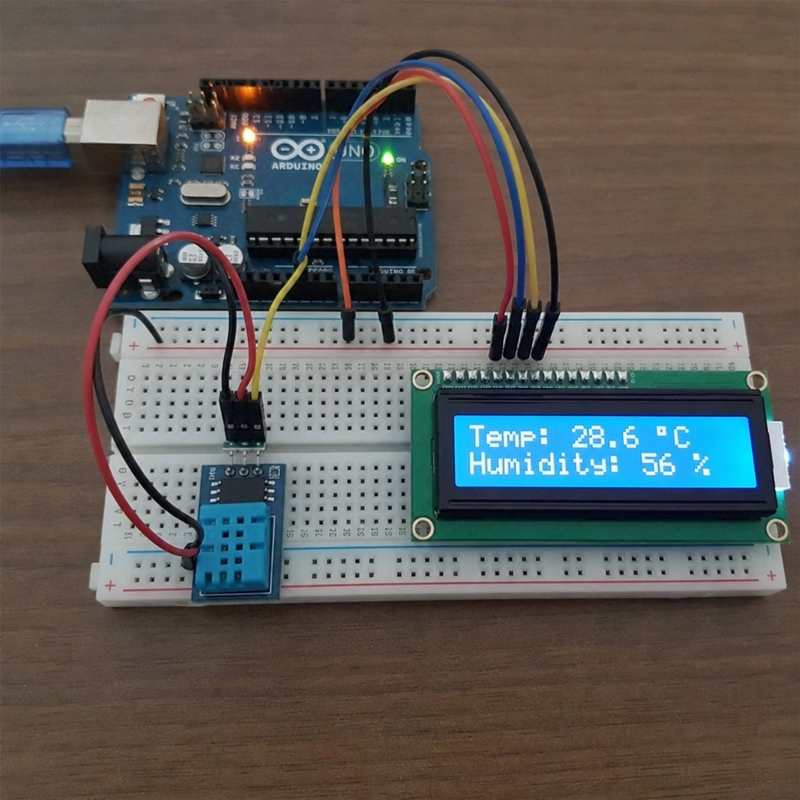
Buying components in Pakistan without wasting time or money
Shopping for electronic components in Pakistan can be simple when you know what to ask for and what to verify. The local market can offer quick access to everyday parts, while online options make it easier to compare items, search by module name, and order parts that may not be available nearby. The best choice depends on urgency, project complexity, and how confident you are about the exact specifications.
If you search for an “electronic components shop near me,” do not judge only by distance. A nearby shop is useful for common resistors, capacitors, connectors, switches, soldering items, and replacement parts. For specialized modules, microcontrollers, development boards, sensors, and battery charging boards, online electronics components shopping in Pakistan may offer wider choice and clearer product descriptions.
Karachi is a major commercial city, so many students, technicians, hobbyists, and small businesses look for electronic components shops in Karachi when they need urgent parts. Offline shopping is especially helpful when you want to physically compare connectors, switches, wires, enclosures, sockets, or tools. However, always carry the part number, value, photo, or circuit requirement, because verbally asking for “the same part” can lead to mismatches.
When buying electronics parts in Pakistan, use these practical checks:
- Confirm the exact value or part number before paying.
- Inspect pins, markings, and packaging for damage, rust, bent leads, or unclear labeling.
- Ask about voltage and current ratings for adapters, relays, motors, drivers, and power modules.
- Check module pin labels because similar-looking modules can have different layouts.
- Buy a few spare low-cost parts such as resistors, LEDs, headers, and common transistors.
- Avoid suspiciously cheap critical parts for batteries, chargers, power supplies, and high-current circuits.
- Prefer documented modules when you are still learning.
Local shops and online stores both have a place
Offline and online sourcing are not enemies; they solve different problems. A local shop is often better when you need an urgent electrical part, want to match a connector by sight, or need quick advice from someone who handles these parts daily. Online buying is often better when you need to compare variants, read specifications, order multiple modules, or find items that are not stocked in your area.
For students and hobbyists, a balanced approach works well. Buy common electronic parts locally when timing matters. Use an online electronics components store Pakistan search when you need Arduino kits, sensor modules, development boards, displays, battery charging modules, motor drivers, and other project-specific items. If you are ordering for a deadline, leave time for delivery delays, stock changes, and the possibility that one part may need replacement.
For professionals, consistency becomes more important than convenience. If you are building the same circuit repeatedly, test samples before ordering in quantity. Keep a record of suppliers, part numbers, substitutions, and results. This helps reduce confusion when sourcing electronic components in Pakistan across different cities, stores, or online platforms.
Component quality and counterfeit concerns
Not every poor result means your circuit design is wrong. Sometimes the component is weak, damaged, mislabeled, counterfeit, or simply not suitable for the load. This is especially important with voltage regulators, MOSFETs, relays, ICs, power adapters, lithium battery chargers, and high-current modules.
Quality checks do not need to be complicated. Compare markings with a datasheet, look for consistent printing, test basic values with a multimeter, and inspect solder joints on modules. For critical builds, avoid relying on unknown parts in safety-related circuits. If a project controls mains voltage, batteries, heating elements, or motors, use properly rated parts and get experienced guidance.
A few small habits make buying safer:
- Read the datasheet or product notes before wiring the part.
- Test one piece first before using multiple units in a project.
- Measure voltage output from power modules before connecting sensitive boards.
- Keep components labeled in small boxes or bags to avoid mixing values.
- Use trusted repeat suppliers when you find consistent quality.
How do components connect to PCB assembly?
Electronic components connect to PCB assembly through footprints, pads, holes, traces, solder joints, and placement decisions. In a prototype, you may use a breadboard or jumper wires, but a more permanent product usually needs a printed circuit board designed around the exact component packages. The component choice affects the PCB layout, soldering method, enclosure size, heat management, and repairability.
Through-hole parts are easier for beginners to solder and replace, making them useful for learning, testing, and low-volume projects. Surface-mount parts are smaller and common in modern products, but they require more careful assembly. Modules sit somewhere in between: they simplify design, but they take more board space and may limit how compact the final product can be.
Before moving from breadboard to PCB, confirm every footprint and connector direction. Check whether a regulator needs heat relief, whether a sensor should be kept away from heat sources, and whether high-current traces need extra width. These practical choices often matter as much as the schematic.
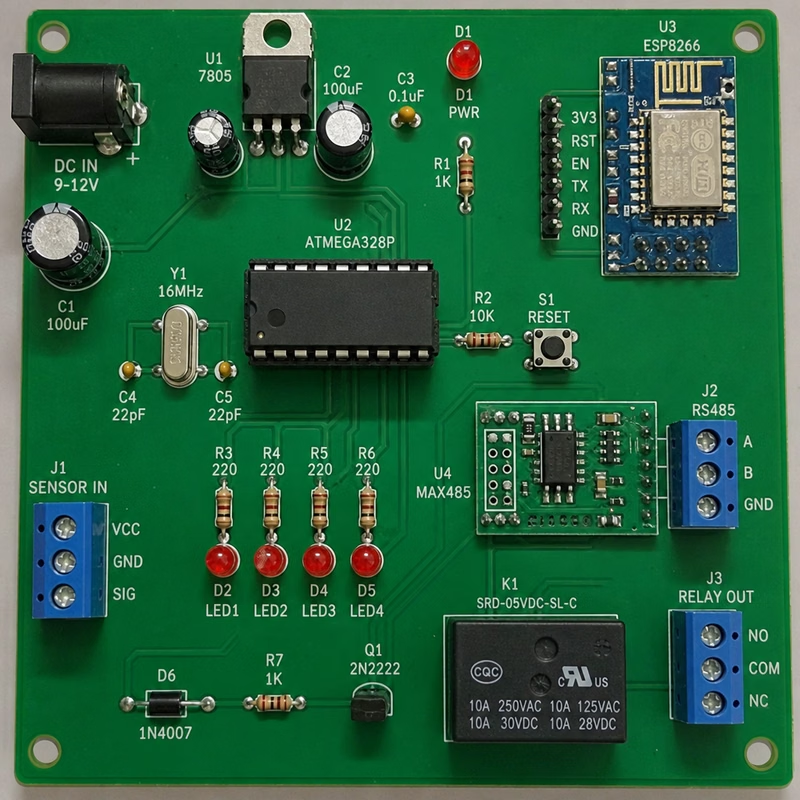
A simple path for beginners
Learning electronics becomes easier when you connect theory with small working projects. Start with safe, low-voltage circuits and build confidence one function at a time. You do not need a large inventory on day one; you need the right starter set and a habit of checking specifications.
A useful beginner kit might include:
- Assorted resistors and LEDs
- Ceramic and electrolytic capacitors
- Push buttons, switches, and jumper wires
- Breadboard and basic soldering tools
- Common diodes and transistors
- A multimeter
- Arduino-compatible board or similar development board
- A few sensor modules, such as light, temperature, and distance
- Relay or motor driver module for controlled loads
- Regulated power supply or safe battery holder
Begin with projects that show one concept clearly. Blink an LED to learn output control. Read a button to learn digital input. Use a potentiometer to learn analog input. Add a sensor to learn measurement. Drive a motor through a transistor or driver module to learn why microcontroller pins cannot power every load directly.
Key takeaway
Electronic components are easier to understand when you focus on their purpose, not just their names. Resistors limit current, capacitors store and smooth energy, diodes guide current, transistors switch or amplify, ICs process functions, and sensors connect circuits to the real world. Once you understand those roles, buying the right electronic components becomes far less confusing.
Whether you shop locally in Karachi, search for an electronic components shop near me, or compare options through online electronics components shopping in Pakistan, the same rule applies: match the part to the project before you buy. Check ratings, compatibility, quality, and documentation. That habit will save time, reduce failed circuits, and help you build projects that work reliably from the first prototype to the final PCB.