


How to Count significant figures Correctly

How to Count significant figures Correctly
Counting significant figures is a practical way to show how precise a number really is. Whether you are working through chemistry homework, checking a lab report, or reviewing measurement accuracy in a math class, significant digits help you avoid pretending your answer is more exact than your data allows. This guide explains the core rules, common traps, and simple practice habits that make numerical precision much easier to manage.
What are significant figures?
Significant figures are the digits in a measured or calculated number that communicate meaningful precision. They include all certain digits plus the final estimated digit in a measurement, which is why they matter in science, engineering, statistics, and everyday problem solving. In simple terms, significant digits tell the reader how carefully a value was measured or reported.
For example, the value 24.6 cm is more precise than 25 cm because it gives information to the tenths place. The value 24.60 cm is even more precise because the zero at the end shows that the measurement was recorded to the hundredths place. That final zero is not decoration; it carries math significance because it communicates measurement detail.
This is where significant figures differ from ordinary place value. Place value tells you what a digit is worth in a number. Significant figures tell you which digits matter for precision numbers and which digits are only placeholders.

The basic rules for counting significant digits
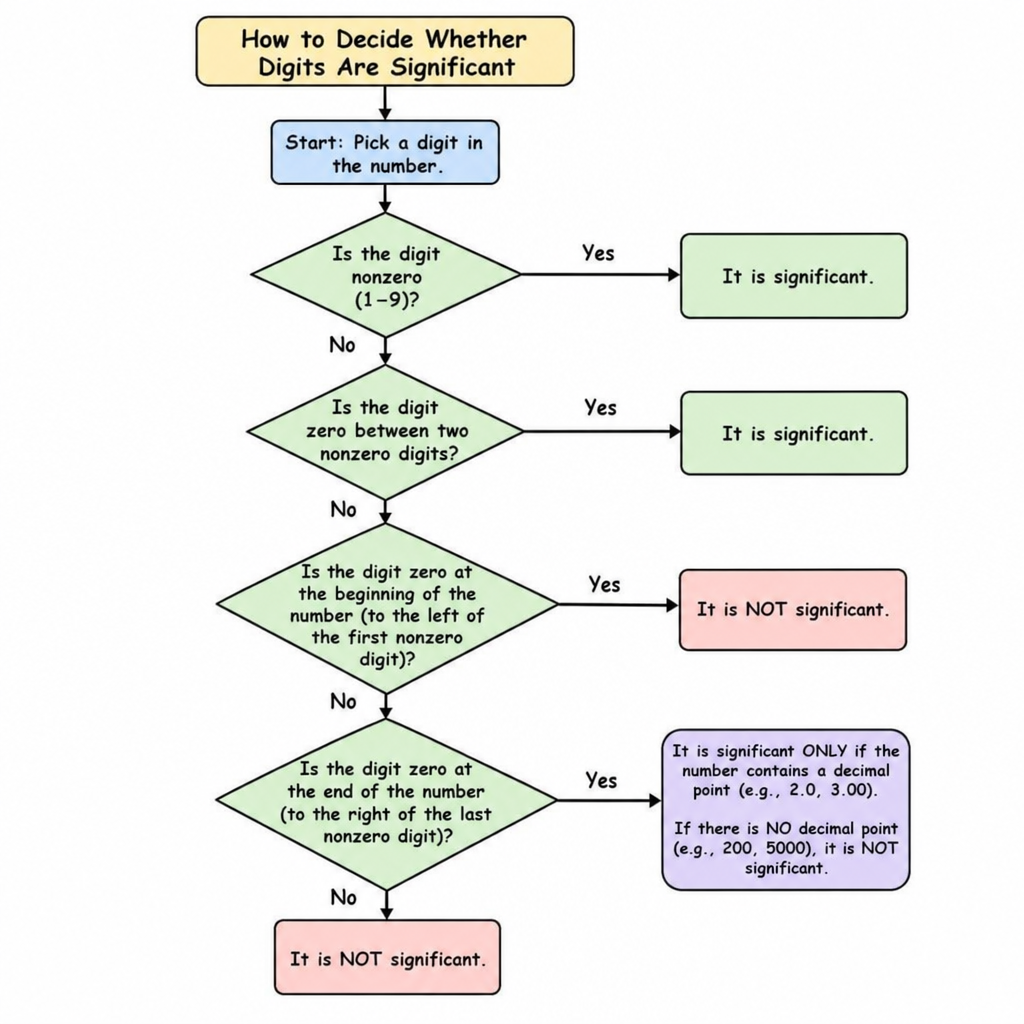
The fastest way to count significant figures correctly is to learn which digits always count, which digits never count, and which zeros depend on context. Most mistakes happen with zeros, especially in numbers like 0.00450, 100, and 1000. Once you understand the role of each zero, the process becomes much more predictable.
Use these rounding rules and counting rules as your foundation:
All nonzero digits are significant. In 347, the digits 3, 4, and 7 are all significant. The number has 3 significant figures.
Zeros between nonzero digits are significant. In 305, the zero is trapped between 3 and 5, so it counts. The number has 3 significant figures.
Leading zeros are not significant. In 0.0062, the zeros before 6 only place the decimal point. The number has 2 significant figures: 6 and 2.
Trailing zeros after a decimal point are significant. In 8.200, all three digits after the decimal show precision. The number has 4 significant figures.
Trailing zeros in whole numbers can be ambiguous. In 100, the zeros may or may not be significant unless the number is written in a way that makes precision clear.
A useful habit is to ask yourself what the number is trying to communicate. Is it a counted value, an estimate, a rounded measurement, or a precise decimal? The answer often determines how you should interpret the digits.
Zeros are the main source of confusion
Zeros do different jobs in different numbers. Sometimes they show precision, and sometimes they simply hold a place so the number has the correct size. This is why a student may count 100.0 correctly but hesitate when asked, “how many significant digits are in 100?”
Here are the most common zero patterns:
- Leading zeros: In 0.00091, the zeros are not significant. They only show that the 9 is in the ten-thousandths place.
- Captive zeros: In 7.04, the zero is significant because it is between significant digits.
- Trailing decimal zeros: In 6.2500, the zeros are significant because they show measurement precision to four decimal places.
- Trailing whole-number zeros: In 500, the zeros are unclear unless the writer uses a decimal point, scientific notation, or another precision marker.
This is also why decimal places and significant figures are related but not identical. Decimal places count digits to the right of the decimal point. Significant figures count meaningful digits wherever they appear in the number.
For instance, 0.0048 has four decimal places but only 2 significant figures. Meanwhile, 4.800 has three decimal places and 4 significant figures. Same basic digits, different precision message.
How many significant digits are in 100?
The number 100 usually has 1 significant digit if it is written without a decimal point or other precision indicator. The 1 is significant, while the two zeros are often treated as placeholders. However, 100. can indicate 3 significant figures, and 100.0 indicates 4 significant figures.
This is why the question “how many significant digits in 100” depends on notation. In many classroom settings, plain 100 is assumed to have 1 significant figure. But if a teacher, worksheet, or lab manual says the number is measured to the ones place, then all three digits may be intended as significant.
To avoid confusion, use scientific notation:
- 1 × 10² has 1 significant figure.
- 1.0 × 10² has 2 significant figures.
- 1.00 × 10² has 3 significant figures.
- 1.000 × 10² has 4 significant figures.
Scientific notation is not just a style choice. It is one of the clearest ways to show numerical precision when zeros appear at the end of a whole number.
How many significant digits in 1000?
The number 1000 usually has 1 significant digit when written plainly. The digit 1 counts, and the three zeros are typically placeholders. But just like 100, the exact answer changes if the number is written with a decimal point or in scientific notation.
For example:
- 1000 usually has 1 significant figure.
- 1000. has 4 significant figures.
- 1000.0 has 5 significant figures.
- 1.00 × 10³ has 3 significant figures.
- 1.000 × 10³ has 4 significant figures.
If you see the question “how many significant digits in 1000” on a significant digits quiz, check whether there is a decimal point. If there is no decimal point and no extra context, the safest classroom answer is often 1. If there is notation showing precision, count the digits that are clearly intended to be significant.
This distinction matters because a reported measurement of 1000 mL may be rough, while 1000.0 mL suggests much finer measurement accuracy. The numbers look similar, but they do not communicate the same level of precision.
A step-by-step method for any number
When you need to label each of the digits as significant or not significant, do not rely on guessing. Move through the number systematically. This works especially well on a significant digits worksheet because it keeps your reasoning visible.
Try this method:
Find the first nonzero digit. Everything before it is a leading zero and is not significant.
Count all nonzero digits. Nonzero digits always count.
Newest in the store
-
Count zeros between nonzero digits. Captive zeros are significant.
Look for a decimal point. If trailing zeros appear after a decimal point, they are significant.
Check whole-number trailing zeros carefully. If the number ends in zeros without a decimal point, look for context or scientific notation.
Use scientific notation when you write an ambiguous answer. This removes doubt and makes your intended precision clear.


Consider 0.05040. The first significant digit is 5. The zero between 5 and 4 is significant because it is captive. The final zero is significant because it comes after the decimal and follows significant digits. So 0.05040 has 4 significant figures: 5, 0, 4, and 0.
Now compare that with 5040. The 5, 0, and 4 are significant, but the final zero may be ambiguous unless a decimal point or scientific notation clarifies it. Written as 5.040 × 10³, it has 4 significant figures.
Significant figures and rounding digits
Counting significant figures is only half the skill. You also need to know how to round an answer to the correct number of significant digits after a calculation. Rounding digits keeps your final answer consistent with the precision of the original values.
The basic rounding rules are familiar:
- If the next digit is 0, 1, 2, 3, or 4, keep the target digit the same.
- If the next digit is 5, 6, 7, 8, or 9, increase the target digit by 1.
- Drop the extra digits after rounding.
- Add zeros only if they are needed to show the correct place value or precision.
For example, round 8.746 to 3 significant figures. The first three significant digits are 8, 7, and 4. The next digit is 6, so the 4 rounds up to 5. The answer is 8.75.
Now round 0.003281 to 2 significant figures. Ignore the leading zeros and start at 3. The first two significant digits are 3 and 2. The next digit is 8, so 2 rounds up to 3. The answer is 0.0033.
Rounding to decimal places is different. If you round 8.746 to 2 decimal places, the answer is also 8.75, but that is because the place and significant-figure targets happen to align. With 0.003281, rounding to 2 decimal places gives 0.00, which is not useful for communicating the same precision. Always check whether the instruction says significant figures or decimal places.
Rules for calculations with significant figures
Different operations use different precision rules. The goal is not to make the answer less accurate on purpose. The goal is to avoid claiming more precision than the original measurements support.
For multiplication and division, your final answer should have the same number of significant figures as the measured value with the fewest significant figures.
Example:
- 4.2 × 3.18 = 13.356
- 4.2 has 2 significant figures.
- 3.18 has 3 significant figures.
- Final answer: 13 with 2 significant figures.
For addition and subtraction, your final answer should match the least precise decimal place, not the fewest significant figures.
Example:
- 12.11 + 18.0 + 1.013 = 31.123
- 18.0 is precise to the tenths place.
- Final answer: 31.1
This difference is important. Multiplication and division focus on the number of significant figures. Addition and subtraction focus on decimal places because the uncertainty lines up by place value.
Common mistakes that lead to wrong answers
Most errors with significant figures come from moving too quickly. Students often memorize one rule but forget to check the type of number or operation. A careful pause can prevent most wrong answers.
Watch for these mistakes:
- Counting leading zeros: In 0.0007, only 7 is significant.
- Ignoring decimal zeros: In 2.500, the zeros count because they show precision.
- Treating every whole-number zero the same: 100, 100., and 100.0 do not show the same precision.
- Mixing up decimal places with significant figures: They overlap sometimes, but they are not the same rule.
- Rounding too early: Keep extra digits during multi-step calculations and round the final answer.
- Forgetting units and context: Measured values, counted values, and defined constants may follow different expectations.
Exact counted quantities, such as 12 students or 4 wheels, are usually treated as exact numbers rather than measured values. Defined conversions, such as 100 centimeters in 1 meter, are also exact in many contexts. They do not limit the significant figures in a calculation the same way measured values do.
Quick significant digits practice
Use the following significant digits practice set to test your understanding. Try solving before looking at the answers.
Count the significant figures
- 0.00406
- 90.0
- 700
- 7.00 × 10⁴
- 3.0500
- 1000.
Answers:
- 0.00406 has 3 significant figures: 4, 0, and 6.
- 90.0 has 3 significant figures because the decimal shows the zero is measured.
- 700 usually has 1 significant figure unless context says otherwise.
- 7.00 × 10⁴ has 3 significant figures.
- 3.0500 has 5 significant figures.
- 1000. has 4 significant figures.
Round to the requested precision
- Round 46.872 to 3 significant figures.
- Round 0.009876 to 2 significant figures.
- Round 1549 to 2 significant figures.
- Round 12.995 to 4 significant figures.
Answers:
- 46.9
- 0.0099
- 1500, or better, 1.5 × 10³ to show 2 significant figures clearly.
- 13.00, because 4 significant figures must be preserved.
These examples make a strong mini significant digits quiz because they include leading zeros, trailing zeros, rounding digits, and ambiguous whole numbers.
A practical checklist for homework and lab work
Before turning in a calculation, run through a short checklist. It takes only a moment and helps you catch precision errors before they cost points.
- Identify whether the number is measured, counted, or defined.
- Count nonzero digits first.
- Ignore leading zeros.
- Count captive zeros.
- Count trailing zeros only when the decimal point or notation makes them significant.
- For multiplication and division, round by significant figures.
- For addition and subtraction, round by decimal places.
- Use scientific notation for whole numbers ending in zeros.
- Keep guard digits during intermediate steps and round only at the end.
- Make sure the final answer does not imply more measurement accuracy than the original data.
This checklist is especially helpful when a problem asks you to explain your work. Instead of only writing an answer, you can show why each digit counts or does not count.
Final takeaway
Significant figures are not just a classroom rule; they are a practical language for numerical precision. They tell readers which digits are meaningful, how precise a measurement is, and how much confidence a final answer should claim.
If you remember nothing else, remember this: nonzero digits count, leading zeros do not, zeros between significant digits count, decimal trailing zeros count, and whole-number trailing zeros need context. Use scientific notation when numbers like 100 and 1000 are unclear, follow the correct rounding rules for the operation, and practice until the pattern feels natural.