


Understanding the Basics of supply chain

Understanding the Basics of supply chain
A strong supply chain connects people, materials, machines, information, and decisions so products can move from an idea to a finished item in a customer’s hands. Whether you are managing food packaging, mechanical parts, specialty plastics, puzzle production, or industrial minerals, the same fundamentals apply: plan clearly, control quality, reduce waste, and keep every process visible.
This article explains the Basics of supply chain in a practical way, with examples from real manufacturing environments. You will learn how supply chain thinking supports better production efficiency, smoother operations, and more reliable outcomes across different industrial processes.
What does a supply chain actually include?
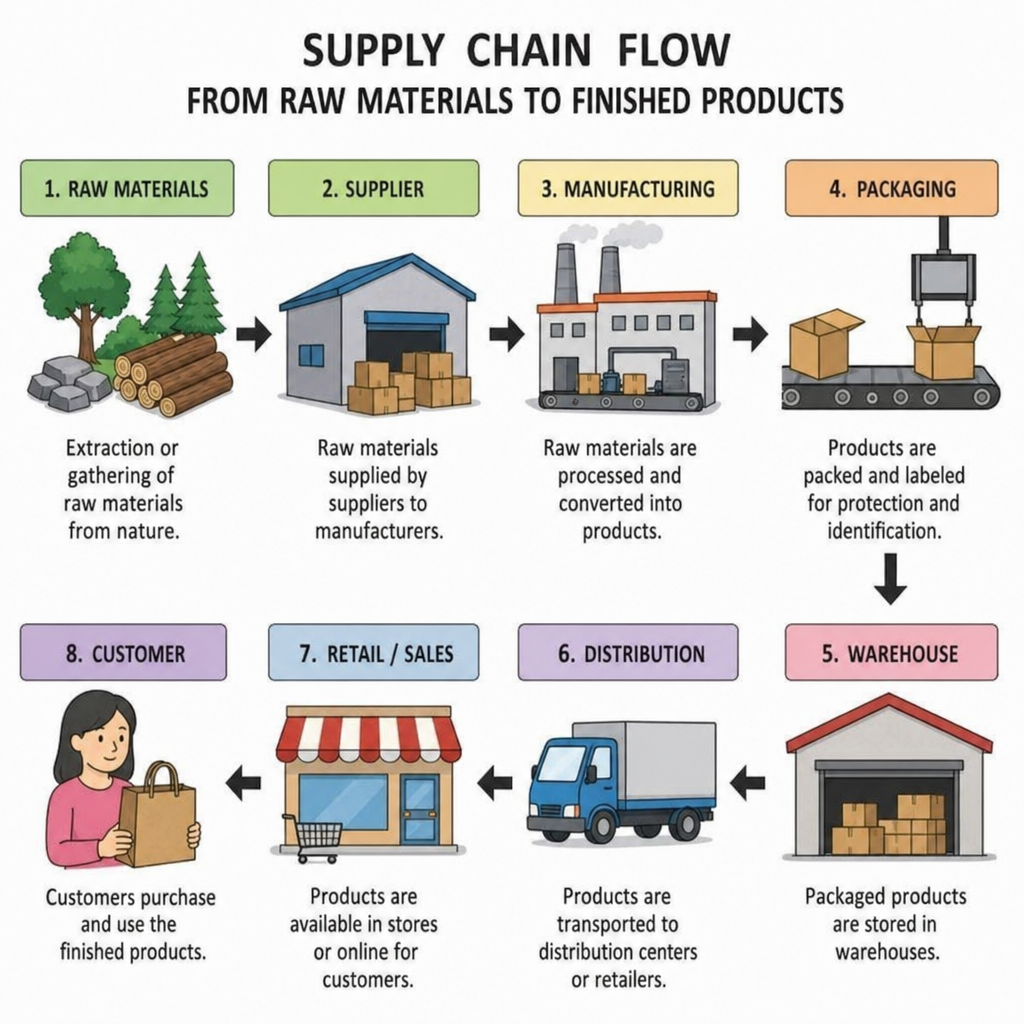
A supply chain includes every step required to source materials, transform them into a product, store them, move them, and deliver them to the next user or final customer. It is not only purchasing or logistics. It also includes demand planning, supplier selection, inventory control, manufacturing process design, quality control, packaging, documentation, transportation, and after-sales support.
In manufacturing, the supply chain begins long before the assembly line starts moving. Teams must confirm material specifications, production methods, lead times, equipment capacity, labor availability, inspection standards, and delivery commitments. If one part of that system is unclear, delays and defects can quickly spread across the whole operation.
A useful way to understand the supply chain is to view it as a flow:
- Materials flow from suppliers into production and then toward customers.
- Information flows through forecasts, work orders, specifications, drawings, labels, and approvals.
- Money flows through purchasing, production costs, inventory investment, and customer payment.
- Risk flows through supplier disruption, poor quality, machine downtime, demand changes, and shipping delays.
When these flows are managed well, companies can respond faster, waste less, and make better decisions.

The supply chain starts with planning
Planning is where supply chain performance is either protected or weakened. Before production begins, a company needs to understand demand, available capacity, supplier reliability, material lead times, and the realistic speed of each manufacturing process. Good planning does not remove uncertainty, but it gives teams a practical way to respond when conditions change.
For example, a business producing packaging material may need to coordinate artwork approvals, printing schedules, film layers, filling compatibility, and dispatch timing. In the asepto packaging manufacturing process artwork prepress stage, even a small file, color, or layout issue can delay downstream printing and converting. That is why pre-production reviews are part of supply chain control, not just a design task.
Planning should also connect sales expectations with operations. If demand rises but material orders, staffing, and machine time are not adjusted, the result may be overtime, rushed inspections, missed shipments, or inconsistent quality. A clear supply chain plan helps prevent those problems before they reach the customer.
Core stages in a manufacturing supply chain
Most manufacturing supply chains follow a similar structure, even when the products are very different. A silica cat litter manufacturing process will not look like mechanical parts assembly or plastic masterbatch production, but the management logic is familiar: define the input, control the transformation, inspect the output, and move it efficiently.
1. Sourcing and supplier coordination
Sourcing involves choosing suppliers that can provide materials at the right specification, quantity, time, and cost. It is not enough to find the lowest price. A supplier must also be able to deliver consistent quality, provide documentation, respond to changes, and support long-term production needs.
In the masterbatch manufacturing process, for instance, pigment, carrier resin, additives, and formulation consistency are critical. Poor incoming material control can affect color strength, dispersion, processing behavior, and final product performance. Supplier qualification and incoming inspection are therefore essential supply chain activities.
2. Production preparation
Before the first batch or order begins, teams must prepare machines, tools, work instructions, inspection plans, and materials. This stage often includes trial runs, tooling checks, job cards, safety reviews, and operator briefings.
For engineered products, the manufacturing process steps for mechanical parts assembly may include part cleaning, dimensional verification, sub-assembly, fastening, lubrication, functional testing, labeling, and packing. Each step should be documented so the process can be repeated consistently by different operators or shifts.
3. Manufacturing and transformation
This is where raw materials become finished or semi-finished goods. Different manufacturing techniques may be used, such as molding, extrusion, cutting, mixing, drying, machining, coating, sealing, or assembly. The selected technique depends on material behavior, product design, tolerance requirements, production volume, and cost targets.
In an agricultural shade net machine manufacturing process, production may involve metal fabrication, component machining, frame assembly, electrical installation, testing, and final inspection. The supply chain must ensure that bought-out parts, fabricated components, motors, control systems, and packing materials arrive in the correct sequence.
4. Inspection, packaging, and delivery
Final inspection confirms that the product meets agreed requirements before shipment. Packaging protects the product during storage and transit, while labeling and documentation help the receiver identify and use it correctly.
Delivery is not simply the last step. It is the point where all previous supply chain decisions become visible to the customer. If production was rushed, records were incomplete, or packing was poor, the issue may appear as damage, rejection, delay, or complaint.
How do quality control and process optimization work together?
Quality control checks whether products and processes meet defined standards, while process optimization improves the way work is performed so those standards are met more reliably and efficiently. In a strong supply chain, these two disciplines support each other. Inspection finds problems, and optimization reduces the chance that the same problems happen again.
Quality control can happen at several points:
- Incoming inspection: Verifies raw materials, bought-out parts, packaging, or labels before use.
- In-process inspection: Checks dimensions, weight, color, bonding, alignment, temperature, speed, or machine settings during production.
- Final inspection: Confirms that the finished product meets customer and internal requirements.
- Documentation review: Ensures records, batch numbers, test reports, and approvals are complete.
Process optimization looks deeper than the defect itself. If a layered puzzle is coming apart, the team should not only reject defective pieces. It should review the best gluing process for layered puzzles manufacturing, including adhesive type, application method, pressure, curing time, humidity, material surface condition, and operator technique.
The goal is to create a process that is stable, understandable, and easy to repeat. When quality control and optimization are connected, companies move from “catching defects” to “preventing defects.”
Production methods shape supply chain decisions
Production methods influence everything from inventory levels to staffing and delivery promises. A custom job shop, for example, may need flexible scheduling and skilled operators. A high-volume assembly line may depend more on standard work, balanced cycle times, spare parts, and automated inspection.
Common production methods include:
Newest in the store


- Make-to-order: Products are manufactured after a customer order is confirmed. This can reduce finished goods inventory but may require longer lead times.
- Make-to-stock: Products are made in advance based on forecast demand. This can improve response speed but increases inventory risk.
- Batch production: Items are produced in groups, which works well when changeovers are manageable and demand comes in repeat quantities.
- Continuous production: Materials move through a steady process, often used where stopping and starting is inefficient.
- Assembly line production: Work is divided into repeatable stations to improve speed, consistency, and production efficiency.
Choosing the right method is a supply chain decision as much as a factory decision. It affects purchasing patterns, warehouse space, machine utilization, maintenance plans, and delivery reliability.
Lean manufacturing reduces waste across the chain
Lean manufacturing focuses on creating value for the customer while reducing activities that do not add value. In supply chain work, waste can appear as excess inventory, waiting time, unnecessary movement, overproduction, rework, poor communication, or unused employee knowledge.
A lean approach encourages teams to ask practical questions: Are materials arriving too early or too late? Are operators waiting for approvals? Are products moving back and forth across the factory? Are defects being discovered only after a full batch is complete? Are work instructions clear enough for consistent results?
Lean does not mean cutting resources blindly. It means making work flow better. A company may improve results by reorganizing a workstation, reducing changeover time, improving supplier communication, simplifying documentation, or placing inspection closer to the source of variation.
Practical lean actions include:
- Map the process. Follow the product from material receipt to dispatch and record delays, handoffs, and rework loops.
- Standardize repeat tasks. Use clear work instructions, visual guides, and defined acceptance criteria.
- Balance the line. Avoid one station producing faster than the next can handle.
- Reduce unnecessary inventory. Keep enough material for stability without hiding problems behind excess stock.
- Review defects regularly. Use defect data to improve processes, not only to sort good product from bad.
When applied thoughtfully, lean manufacturing supports both cost control and customer satisfaction.

Examples from different industrial processes
The best way to understand supply chain basics is to see how the same principles appear in different sectors. Products change, but the need for material control, fabrication steps, production discipline, and final verification remains constant.
Silica cat litter production
A silica cat litter manufacturing process may involve material preparation, moisture control, sizing, screening, packaging, and batch identification. Teams may use a silica cat litter manufacturing process video for operator training, customer education, or internal process review. However, video guidance should support documented procedures rather than replace them.
The supply chain challenge is to maintain consistent input material, packaging availability, dust control, filling accuracy, and dispatch timing. If packaging stock is delayed or particle size is inconsistent, customer experience can suffer even when the main production equipment is functioning.
Mechanical parts assembly
Mechanical assembly depends on accuracy, repeatability, and component availability. Fabrication steps such as cutting, drilling, turning, grinding, welding, surface treatment, and inspection must be coordinated before final assembly begins.
The manufacturing process steps for mechanical parts assembly should clearly identify the order of work, torque requirements, fit checks, lubrication points, test criteria, and packing rules. Without that clarity, two operators may build the same product in slightly different ways, increasing the risk of variation.
Packaging and printed materials
Packaging supply chains must manage both technical and visual requirements. In aseptic or asepto packaging contexts, artwork prepress, material compatibility, printing accuracy, sealing performance, and hygiene expectations may all influence production readiness.
Artwork approval is especially important because mistakes can travel quickly through printing and conversion. A supply chain that treats design files, proofs, barcodes, and color standards as controlled inputs can avoid costly rework.
Puzzle and specialty product manufacturing
Layered puzzles require accurate cutting, clean surfaces, controlled adhesive application, and proper pressing or curing. The best gluing process for layered puzzles manufacturing depends on material type, adhesive behavior, production volume, and the expected handling of the finished product.
From a supply chain viewpoint, the adhesive is not just a consumable. It is a performance-critical input that affects durability, appearance, drying time, packing readiness, and customer satisfaction.
What should teams track to improve production efficiency?
Teams should track the few measures that reveal whether work is flowing smoothly, quality is stable, and resources are being used well. Too many metrics can create noise, but too few can hide problems until they become expensive. The best measures are simple, visible, and connected to action.
Useful indicators include:
- On-time material availability: Shows whether production can begin as planned.
- First-pass quality: Measures how often work is completed correctly without rework.
- Machine downtime: Highlights maintenance, setup, or reliability issues.
- Changeover time: Shows how quickly teams can move from one product or batch to another.
- Scrap and rework levels: Reveals waste caused by defects or unstable processes.
- Order lead time: Tracks how long it takes to move from order confirmation to delivery.
- Schedule adherence: Compares planned production with actual completion.
These indicators are most useful when discussed close to the work. Operators, supervisors, quality teams, planners, and maintenance staff often see different parts of the same issue. Bringing those views together helps the business identify root causes instead of treating symptoms.
Building a stronger supply chain mindset
A supply chain mindset means seeing connections. A delayed supplier shipment can affect machine utilization. A vague drawing can affect inspection time. Poor packaging can damage a good product. A rushed purchase can create problems that appear much later in production.
To strengthen everyday supply chain performance, teams can use a simple checklist:
- Are material specifications clear and approved before buying?
- Are suppliers evaluated for reliability, not only price?
- Are production methods matched to order volume and product complexity?
- Are work instructions easy to understand and follow?
- Are quality control points built into the process early enough?
- Are critical fabrication steps documented and verified?
- Are inventory levels visible and realistic?
- Are improvement ideas collected from people doing the work?
- Are customer complaints reviewed for process causes?
- Are changes communicated across purchasing, planning, production, quality, and dispatch?
This mindset turns supply chain management into a daily operating habit. It helps teams prevent avoidable disruption and build confidence in the way products are made and delivered.
The practical takeaway
Understanding the supply chain is not about memorizing terminology. It is about recognizing how decisions in sourcing, planning, manufacturing, quality control, packaging, and delivery affect one another. When those links are managed with care, businesses can improve reliability, reduce waste, and serve customers with greater consistency.
From the masterbatch manufacturing process to agricultural shade net machinery, from silica cat litter to mechanical assemblies and layered puzzles, the fundamentals remain the same. Define the process, control the inputs, standardize the work, inspect intelligently, and keep improving. That is how a supply chain becomes more than a sequence of steps—it becomes a practical system for better performance.