


MCP4728 DAC: 7 Checks for Four Reliable Analog Outputs

MCP4728 DAC: 7 Checks for Four Reliable Analog Outputs
Plan an MCP4728 DAC project with reference selection, output loading, synchronized updates and safe EEPROM use before connecting four analog channels. This is a documentation-based bench-planning guide, not a claim of independent hands-on testing.
1. Define the MCP4728 output job
An MCP4728 converts digital commands into four buffered analog voltages. Microchip specifies a quad 12-bit DAC with nonvolatile configuration storage and an I2C interface. That makes it useful for adjustable low-power setpoints, not a substitute for a power supply. Before buying a board, list the required voltage range, acceptable error, load impedance and startup behavior for each output. Keep safety-critical control independent of an unvalidated prototype. Manufacturer documentation.
2. Separate the chip from the carrier
The device supply range is 2.7 V to 5.5 V, but a carrier may add regulators, address arrangements and pull-up resistors. Inspect its schematic rather than assuming every pin accepts the controller voltage. Identify ground, supply, SDA, SCL and output connections with power disconnected. Check where the bus resistors pull high. A regulator on the board does not automatically provide logic-level translation.
3. Choose the voltage reference deliberately
MCP4728 reference selection changes the relationship between a code and its output voltage. The internal reference option and the supply-referenced option require different calculations; applicable gain settings matter too. Use the datasheet transfer equation for the chosen configuration, then check supply headroom. A nominal digital code cannot force an output beyond the available analog swing. Record the reference and gain alongside each channel code. Manufacturer documentation.
4. Begin with unloaded measurements
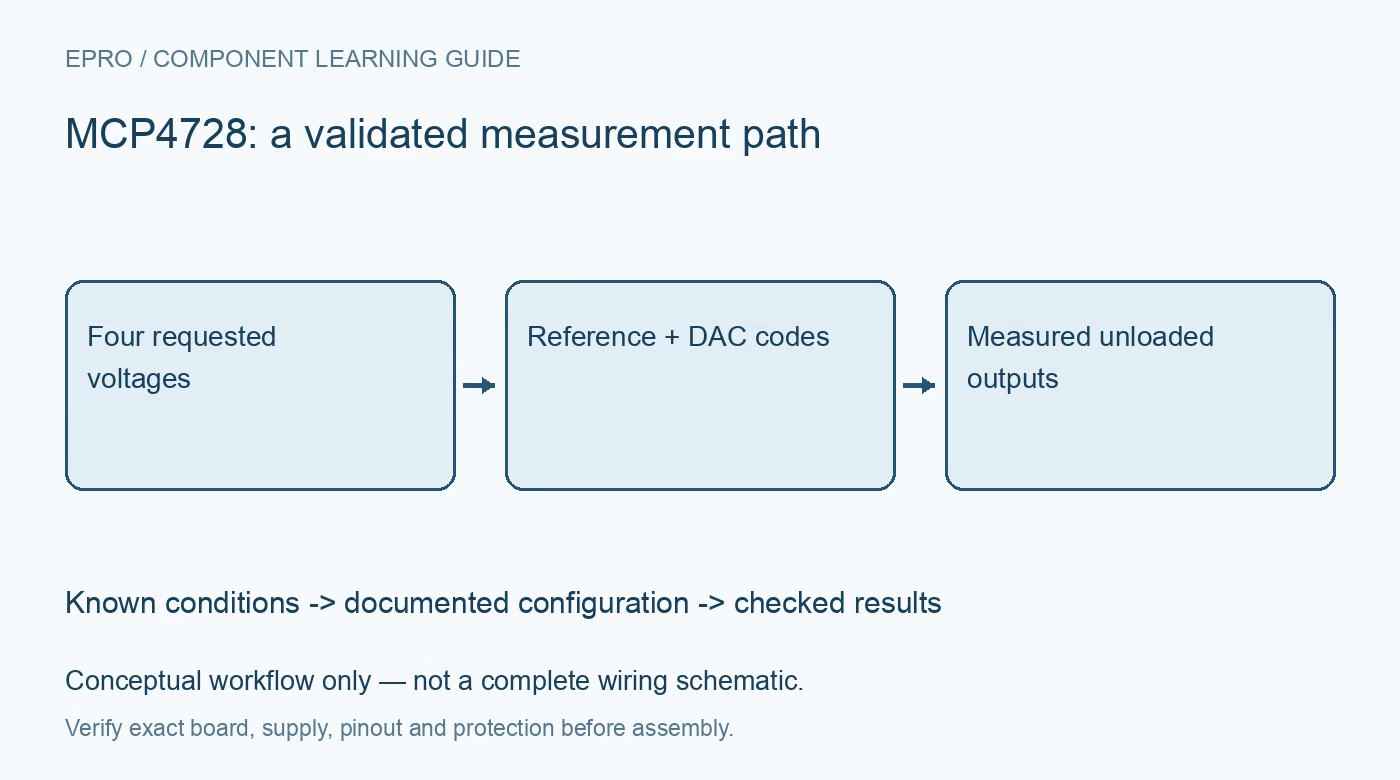
Use a current-limited, low-voltage bench setup and leave the application disconnected. Request several modest output levels, then measure each channel with a suitable meter relative to DAC ground. Compare commanded and measured values, including the zero-code region and upper operating region. Small code steps are not proof of equally small absolute error. Account for reference tolerance, meter accuracy, output offset and settling before drawing conclusions.Newest in the store


5. Plan channel updates and loading
A four-channel command is not automatically a simultaneous analog event. Choose the documented update mechanism and any LDAC behavior to match the application. Check timing before using related channels together. Output buffers have finite drive capability, so verify the allowed resistive and capacitive loading. A downstream amplifier may be necessary. Never connect motors, heaters or another voltage source directly to a DAC output.
6. Keep EEPROM writes intentional
Use volatile register updates for routine adjustments. Reserve EEPROM operations for deliberate saved defaults, respecting the documented write sequence, completion indication and endurance limits. Continuous saving inside a fast control loop is unnecessary wear. After saving, power-cycle only in a safe disconnected setup and measure the restored outputs. Verify what happens before firmware initializes the device, particularly when an analog setpoint could enable another circuit. Manufacturer documentation.
7. Validate the complete MCP4728 record
Store channel number, reference, gain, requested code, measured voltage and load conditions in a small test log. Reject communication failures instead of presenting the previous command as a fresh measurement. For background on a single-channel device, compare the existing MCP4725 first-output test linked below; it is not a pin-compatible setup recipe. A reliable MCP4728 design combines controlled startup, measured loading and a repeatable configuration record.
Related reading: MCP4725 DAC: A Safe First Output-Voltage Test. For current listings, check the Epro catalog; a matching item was not returned by the exact-part catalog search on 22 October 2026. No price, stock or included-accessory claim is made here.