


ADS1256 ADC: 7 Checks Before Trusting 24-Bit Readings

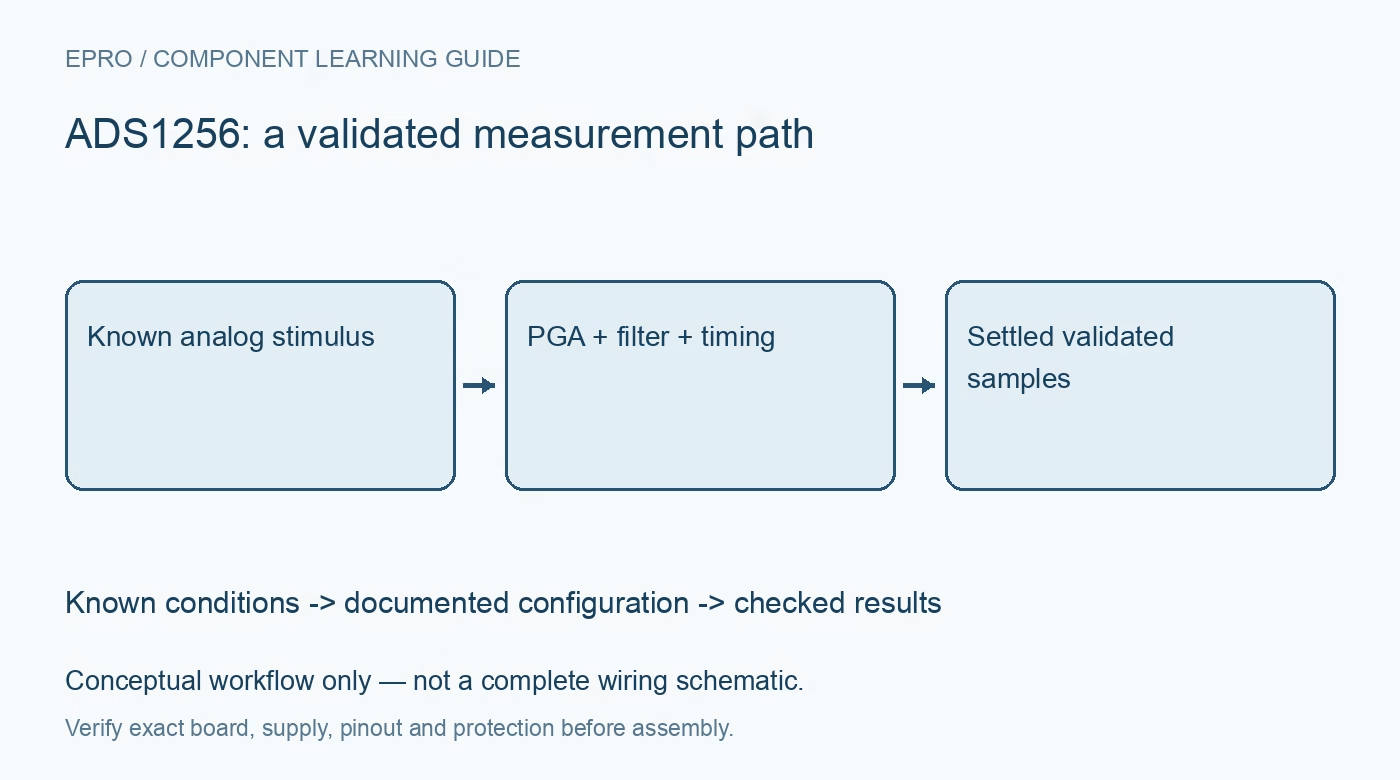
ADS1256 ADC: 7 Checks Before Trusting 24-Bit Readings
Evaluate ADS1256 ADC modules using reference quality, input limits, channel settling and noise tests rather than assuming 24-bit codes mean 24-bit accuracy. This is a documentation-based bench-planning guide, not a claim of independent hands-on testing.
1. Define what an ADS1256 reading means
The ADS1256 is a multiplexed delta-sigma ADC with a programmable gain amplifier and an SPI-compatible interface. Texas Instruments describes 24-bit output and selectable data rates, but code width is not guaranteed system accuracy. Decide the smallest meaningful signal change, required bandwidth and permitted measurement delay first. A stable slow sensor and a rapidly changing waveform need different acquisition settings even when they use the same converter. Manufacturer documentation.
2. Verify analog and digital supplies
The published device requirements distinguish the nominal 5 V analog supply from the 1.8 V to 3.6 V digital supply. A module may distribute these through onboard regulators or connectors in unexpected ways. Identify both rails, reference terminals and signal grounds from its schematic. Confirm host input and output levels separately. Never assume a board labeled for one supply voltage makes every attached signal safe.
3. Treat the reference as a measurement input
An external reference defines the conversion scale. Noise or drift on that reference appears in the result, so record its nominal value, source and measured stability. Inspect decoupling and the return path rather than correcting every discrepancy with software. Keep sensor wiring away from switching currents. The ADS1256 can amplify small differential signals, but amplification does not eliminate common-mode limits or protect pins from excessive voltage. Manufacturer documentation.
4. Check input limits before gain
Review allowable analog input voltages for the exact supply, buffer state and gain setting. A small differential voltage can still be unsafe if both inputs sit outside their permitted range. Begin with a documented low-voltage source and protective interface suitable for the sensor. Do not attach mains, unknown industrial outputs or floating high-energy sources to a hobby module. A differential input is not galvanic isolation.Newest in the store


5. Budget time when changing channels
The headline maximum output rate is not the usable per-channel rate for an arbitrary scan. Multiplexer changes, digital-filter settling, synchronization commands and data-ready timing all affect when a result represents the new input. Follow the datasheet sequence and discard transitional results where required. Timestamp each accepted sample with its channel and configuration. Scanning eight inputs does not make eight simultaneous converters.
6. Measure noise under realistic conditions
Start with a stable input and collect a series rather than judging one attractive number. Compare spread at different data rates and gain settings while keeping wiring and source conditions unchanged. Then repeat with the actual sensor and its source impedance. Use the documented self or system calibration procedure as appropriate. Calibration can correct supported offset and gain errors; it cannot repair clipping, wrong channel selection or a noisy reference. Manufacturer documentation.
7. Keep an auditable ADS1256 data record
Save raw code, signed conversion method, reference value, gain, data rate, channel and validity status together. Test timeouts and disconnected-sensor behavior explicitly. Compare a known stimulus against an independent instrument within a stated uncertainty budget. The existing ADS1115 selection article gives lower-speed context, not interchangeable wiring. Choose ADS1256 hardware only after confirming that its settling and noise performance match the actual acquisition task.
Related reading: ADS1115 ADC: 7 Checks Before Buying. For current listings, check the Epro catalog; a matching item was not returned by the exact-part catalog search on 22 October 2026. No price, stock or included-accessory claim is made here.