


BQ27441 Fuel Gauge: 7 Checks Before Trusting Battery Percent

BQ27441 Fuel Gauge: 7 Checks Before Trusting Battery Percent
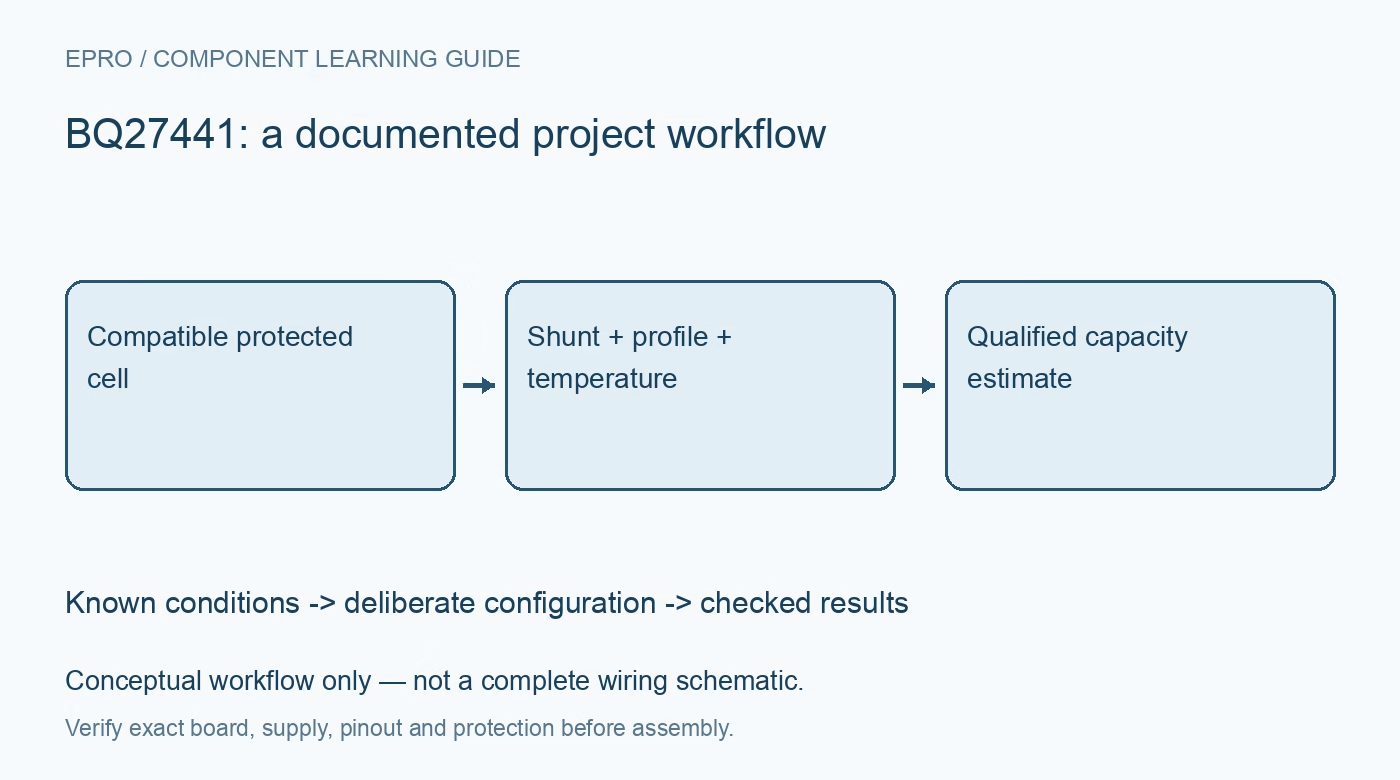
Plan BQ27441-G1 gauging with the correct cell profile, current-sense path, design parameters, temperature source and explicit estimation limits. This is a documentation-based planning guide, not a report of independent hands-on testing.
1. Match the BQ27441 to the battery
BQ27441-G1 is a system-side fuel gauge for a single-series lithium-ion cell configuration. Confirm the full ordering variant, supported cell profile and carrier before connecting a battery. Obtain the cell specifications and retain suitable independent protection. A fuel gauge is not a charger or a complete battery-management safety system. The ability to display percentage does not establish compatibility with an arbitrary cell chemistry, pack voltage or charging arrangement. Manufacturer documentation.
2. Review the current-sense path
The documented measurement arrangement uses an external low-value sense resistor. Inspect its value, tolerance, routing and orientation in the actual assembly. Identify which load and charging currents pass through the sense path and which paths may bypass it. A plausible battery voltage can coexist with an incorrect current measurement. Keep source and load wiring within the cell and board ratings, and do not create fault currents or deep-discharge abuse merely to demonstrate a gauge endpoint. Manufacturer documentation.
3. Configure design parameters deliberately
Use the manufacturer configuration procedure and appropriate battery data when setting required design information. Preserve units, values, variant and the reason for each setting with a revision record. Do not substitute an advertised capacity of an unidentified cell or copy a complete configuration from another battery because its enclosure looks similar. A configuration accepted by the device is not proof that it represents the connected battery. Confirm initialization and relevant status before treating derived capacity values as meaningful. Manufacturer documentation.
4. Establish the temperature source
Review whether the design uses the documented internal or host-reported temperature arrangement and how that quantity relates to the battery. Device die temperature is not automatically cell temperature under every installation condition. Preserve the source and update policy in the configuration record. Temperature affects battery behavior and the estimation model, so arbitrary constant values or stale host data should not be hidden behind a stable percentage display. Investigate a missing or unsuitable temperature input rather than cosmetically adjusting results. Manufacturer documentation.
Newest in the store


5. Decode voltage, current and capacity separately
Apply the documented units, sign conventions and command definitions to each reported quantity. Voltage, average current, remaining capacity, state of charge and health-related information are not interchangeable fields. Keep raw responses and flags alongside engineering values during evaluation. A byte-order or sign error can produce changing but believable results. Treat communication failure and invalid state explicitly instead of silently repeating the previous percentage as though the gauge had provided a fresh observation. Manufacturer documentation.
6. Respect model state and initialization events
The Impedance Track estimation process depends on appropriate configuration and operating history. Do not assume repeated reset or reinitialization is a calibration method for an unexpected percentage. Record battery changes, reset events, relevant flags and initialization steps so a discontinuity can be interpreted. A state-of-charge estimate is not a direct universal measurement of available watt-hours, nor does a smooth percentage establish battery health or remaining service life independently of the model and its application boundary. Manufacturer documentation.
7. Evaluate through safe ordinary operation
Retain cell identity, sense resistor, current path, design parameters, temperature source, flags and timestamps with observations. Compare behavior using suitable reference methods during supervised operation within battery specifications. The related MAX17048 guide describes a different gauging architecture, not an interchangeable configuration or sensing circuit. This BQ27441 workflow proposes traceable evaluation and claims no independent battery-cycle tests, universal capacity accuracy or complete protection merely because the host can read a plausible remaining-capacity register. Manufacturer documentation.
Related reading: MAX17048 Fuel Gauge: 7 Checks for Credible Battery Percent.
Catalog note: The exact-part search did not return a matching Epro listing during preparation. Check the current catalog; this guide makes no price, availability or included-accessory claim.