


SGP40 VOC Sensor: 7 Steps from Raw Ticks to a Meaningful Index

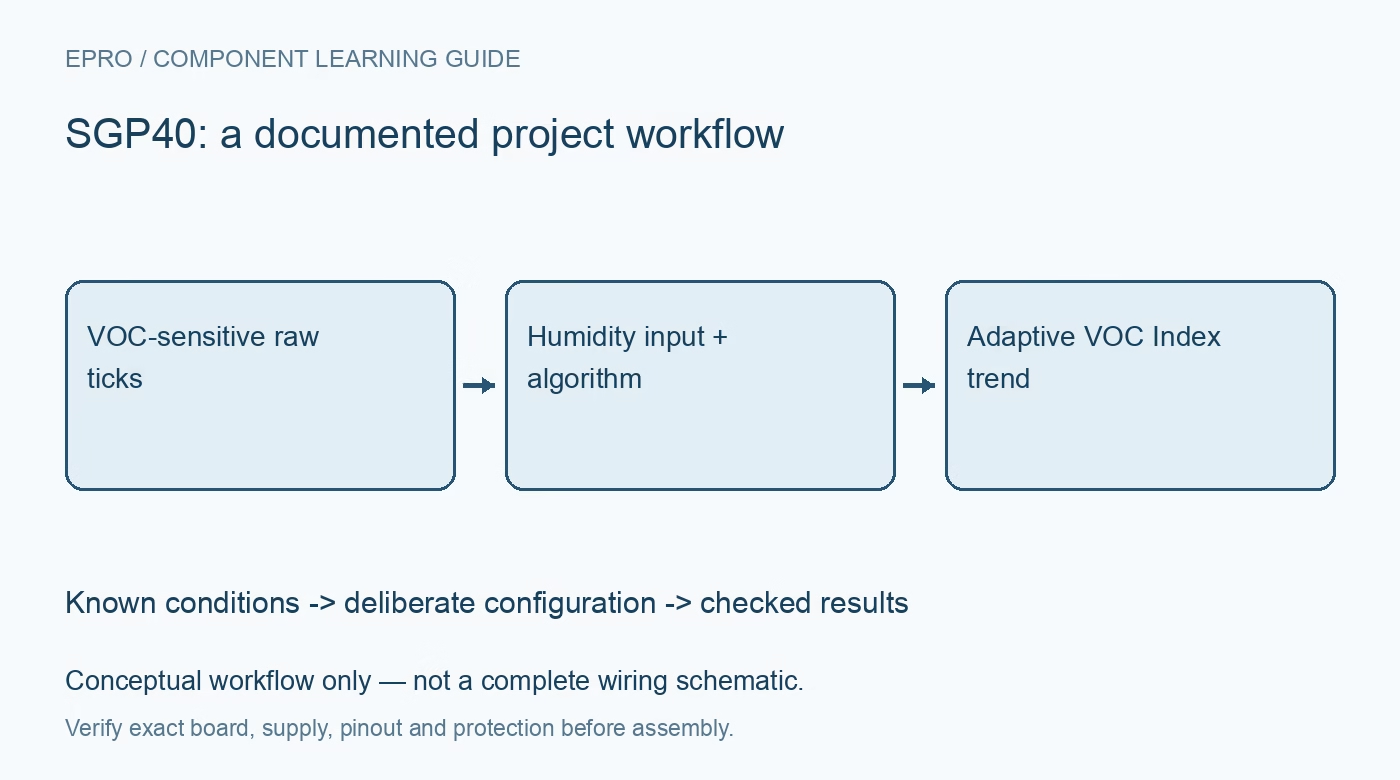
SGP40 VOC Sensor: 7 Steps from Raw Ticks to a Meaningful Index
Use SGP40 raw VOC ticks with CRC checks, humidity inputs and the documented Gas Index Algorithm without confusing an index with gas concentration. This is a documentation-based project guide, not an independent hands-on test report.
1. Name the SGP40 output correctly
Sensirion describes SGP40 as a digital VOC-sensitive gas sensor whose raw signal can feed its Gas Index Algorithm. The raw word is not a direct concentration reading for a specific chemical. Establish whether the project will store raw ticks, the derived VOC Index or both. Label the plotted quantity clearly. A changing index reflects the behavior of a sensing and processing system, not a laboratory identification of everything in the air. Manufacturer documentation.
2. Check power, bus and placement
Inspect the carrier supply requirements and the voltage on its I2C pull-ups. Keep the sensor in representative air, with the final enclosure airflow considered from the beginning. Confirm identity and any available self-test using the documented sequence. Do not infer a healthy gas measurement from an address scan alone. Place temperature and humidity references where they describe the same air rather than a warm processor corner or an unrelated room location. Manufacturer documentation.
3. Supply deliberate humidity compensation inputs
The raw-measurement command includes temperature and relative-humidity input words with CRC protection. Convert real environmental measurements using the specified encoding, checking units and numerical bounds. If using documented default values instead, record that choice and do not claim live humidity compensation. Track whether the environmental reference is stale. Accidentally feeding Fahrenheit or an unscaled percentage can undermine the result while leaving the I2C transaction apparently successful. Manufacturer documentation.
4. Reject corrupt or incomplete responses
Wait for the documented measurement duration and read the full raw-result response. Verify its CRC before passing data to further processing. Use explicit timeout, transport-error and checksum-error states. A failed transaction must not become a valid zero or an invented replacement tick. During development, save command inputs and returned bytes so a decoding problem can be distinguished from an environmental change or an algorithm startup condition. Manufacturer documentation.
Newest in the store


5. Respect the algorithm sampling contract
Run the Gas Index Algorithm at its documented cadence and configuration. Keep its state persistent in memory between updates instead of constructing a new instance for every sample. Understand startup and adaptive behavior before interpreting the chart. If the application pauses, follow the library guidance for recovery and state management. Feeding many repeated copies of one old sample does not compensate for a missed acquisition interval or preserve a valid time history. Manufacturer documentation.
6. Avoid concentration and safety shortcuts
A VOC Index is an adaptive air-quality indicator, not a universal ppm value and not measured carbon dioxide. Do not calculate a supposed gas concentration by scaling ticks to a convenient range. Compare ordinary room activities and ventilation changes with their timestamps documented. Avoid deliberate exposure to hazardous gases or aerosols. This component project must not replace a certified smoke, carbon monoxide or combustible-gas alarm, regardless of how responsive its graph appears. Manufacturer documentation.
7. Keep context with every SGP40 trend
Store raw ticks, CRC status, compensation inputs, algorithm version, sampling gaps and index output. Mark startup and invalid periods rather than hiding them through smoothing. Repeat observations under comparable conditions and explain limitations to anyone reading the dashboard. The existing SGP30 article is useful background, but its commands, outputs and state handling are not automatically interchangeable. A trustworthy SGP40 trend preserves the path from raw observation to the displayed index. Manufacturer documentation.
Related reading: SGP30 Air Quality Sensor: 7 eCO2 and Baseline Checks.
Catalog note: The exact-part search did not return a matching Epro listing during preparation. Check the current catalog; this guide makes no availability, price or accessory claim.