


The History of Motors: Who Invented Motor?

Who Invented Motor? History Explained
The electric motor was not invented in one step. It grew from many tests that turned electrical force into motion.
Michael Faraday is often called the electric motor creator. In the early 1820s, his setup showed that electricity could make steady motion.
But the history of motors also includes the people who made motors stronger, safer, and useful in factories, cars, tools, and robots.
If you ask who invented motor, the answer depends on which stage you mean.
Who invented the electric motor?
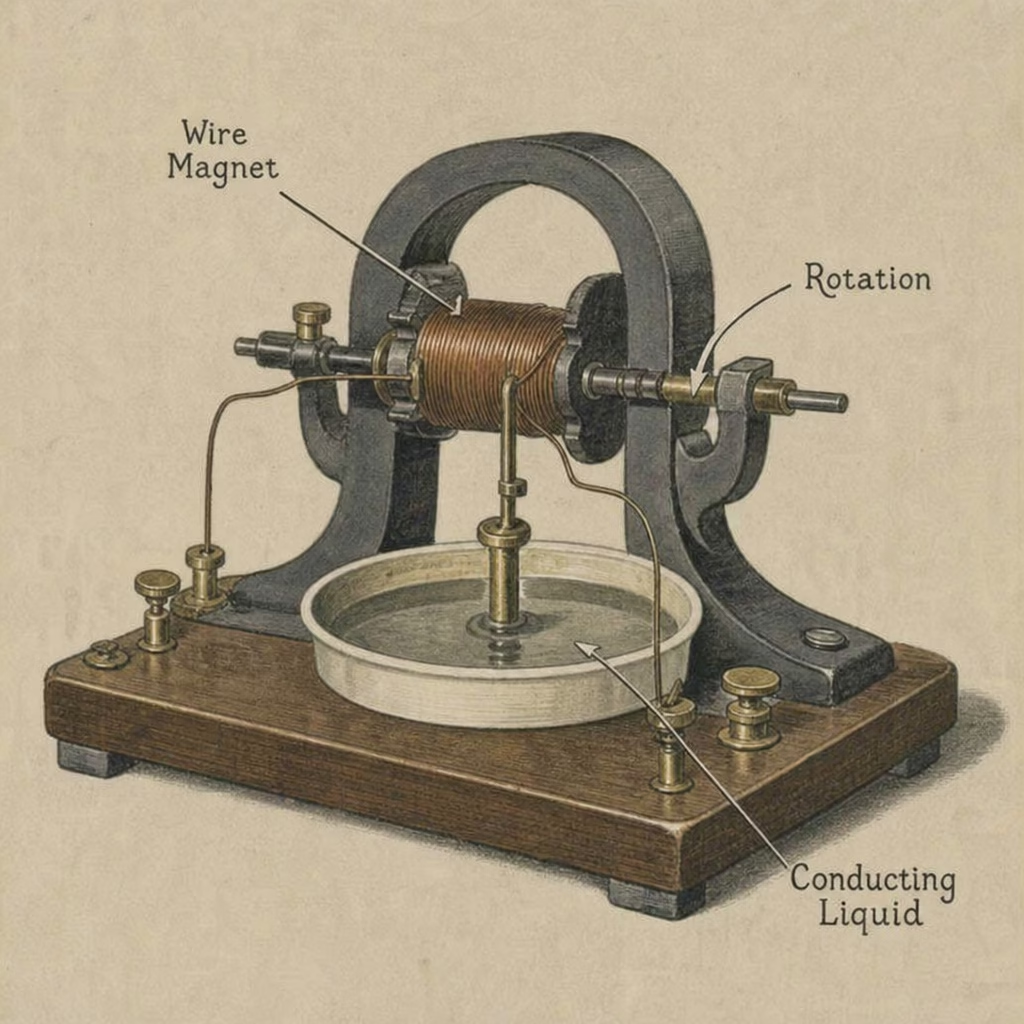
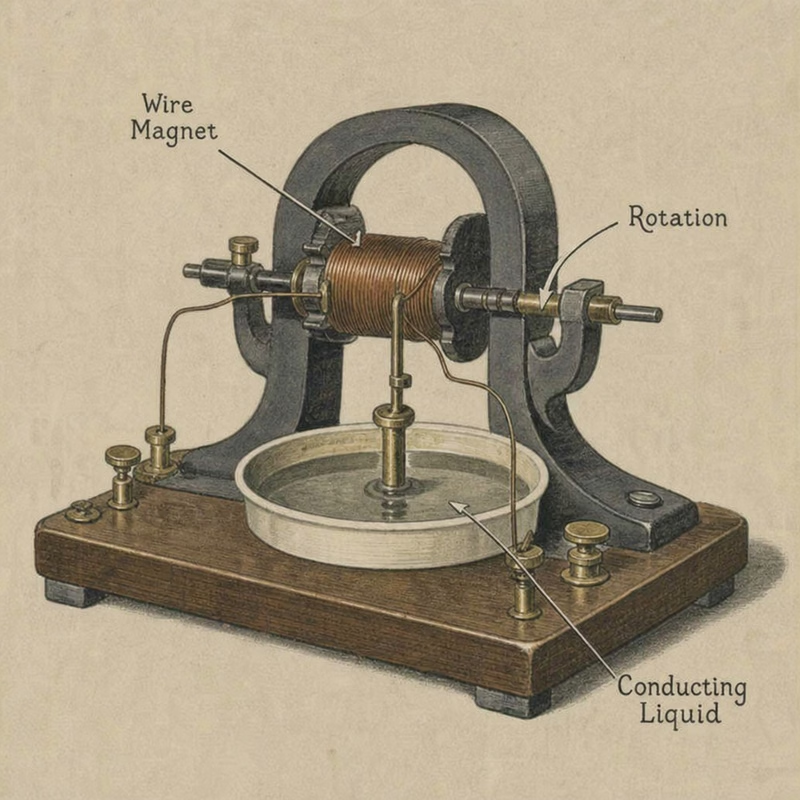
Michael Faraday is the main name when people ask who invented electric motor technology. In 1821, he showed that current and magnetism could make rotation.
His setup used a wire, a magnet, and a liquid that carried current.
It was not a useful machine yet, but it proved the core idea behind the electric motor.
That difference matters. If the question is who invented the electric motor as a scientific breakthrough, Faraday is the key figure.
If the question is who invented motor systems that could do useful work, the answer widens to William Sturgeon, Thomas Davenport, Moritz von Jacobi, Nikola Tesla, Frank Julian Sprague, and others.
Invention here was not one moment. It was a bridge built over many years.
The first breakthrough was motion, not power
Faraday’s work mattered because it turned electricity from a lab curiosity into a possible source of motion.
Before motors could run shops or move people, someone had to show that electric energy could become motion at all.
Faraday did that. Later inventors used that result as a starting point.
The early setup was not made for daily use. It had little force, needed lab conditions, and was more of a demo than a product.
Still, it gave later inventors a clear target: make the motion stronger, easier to control, and more reliable.
This is why the question who invented motor technology is hard to answer in one line.
A motor can mean a principle, a prototype, a working machine, a vehicle engine, or a control device.
The answer changes with the part of the story you ask about.
A practical motor development timeline
The motor development timeline helps separate discovery from use.
Each step solved a different problem: making motion, adding force, improving current flow, cutting waste, or making motors useful in real machines.
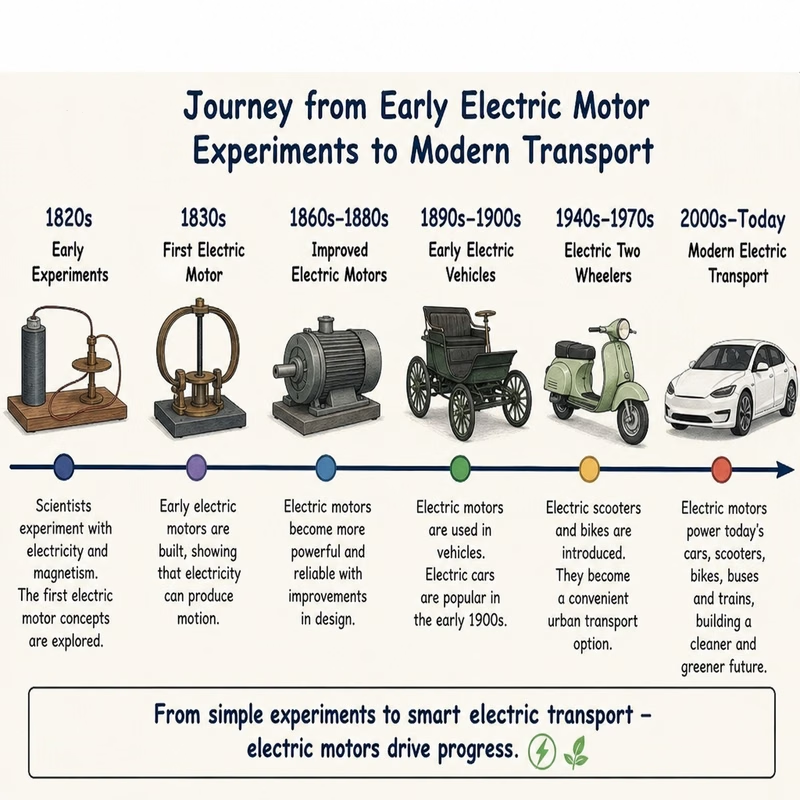
- 1821: Michael Faraday shows how current and magnetism make motion. This is the starting point for the electric motor idea. It showed that electricity and magnetism could create steady movement.
- 1832: William Sturgeon builds an early DC motor. For readers asking who invented the dc motor, Sturgeon is a major name because his work pushed the idea toward direct-current design.
- 1834: Moritz von Jacobi improves power output. Jacobi showed that motors could be built for more than small tests. They could do more mechanical work.
- 1837: Thomas Davenport patents a practical DC motor. If the question is who invented dc motor technology in a practical, patentable form, Davenport is often part of the answer.
- 1880s: Frank Julian Sprague improves practical electric motors. Sprague helped make electric motors more reliable in real systems, where steady power mattered.
- 1888: Nikola Tesla patents the AC induction motor. Tesla’s alternating-current design became a major step toward efficient power systems and industrial use.
- 1891: Three-phase motor development expands practical use. Three-phase systems made motors more powerful and efficient for industry, which helped move the field from invention to infrastructure.
This timeline shows why the phrase the inventor can be misleading.
Faraday revealed the principle, but later engineers turned it into a machine people could use.
Direct current, alternating current, and practical use
Early motor builders faced problems that still sound familiar today: weak output, waste, sparking, voltage loss, and poor control.
A motor that spins in a lab is interesting.
A motor that can run real equipment is a different result.
That gap explains why so many names appear in the history of motors.
DC motors mattered because direct current systems were among the first practical electrical systems.
Sturgeon, Davenport, Jacobi, and later Sprague each helped make DC motors stronger and more useful.
When someone asks who invented the dc motor, the fairest answer is that Sturgeon made an early version, Davenport patented a practical design, and later inventors improved it for broader use.
AC motor development opened another chapter.
Tesla’s induction motor mattered because it worked with alternating current, which became central to large-scale electrical distribution.
The AC induction motor helped move electric power from isolated demos to systems that could serve factories, cities, and later homes.
How electric motors shaped cars and scooters
Electric motors changed transport by proving that vehicles did not have to depend only on muscle, steam, or fuel.
They could also use controlled power from electricity.
Still, the questions who invented motor car first and who invented the motor car first belong to a different branch of invention than Faraday’s motor.
A motor car involved steering, brakes, power supply, road use, and making, not just the motor itself.
This is where readers often mix categories.
A motor is a device that creates motion.
A motor car is a road vehicle built around a drive system.Newest in the store


A motor scooter is a small two-wheeled vehicle with its own history, usually tied to later work in personal transport.
So if you are asking who invented motor scooter technology, the answer is not Faraday, even though electric motor science helped make later electric scooters possible.
The phrase who invented motor scooter points to vehicle history, not to the first electric motor.
Early scooter development came from the wider rise of compact engines, personal transport, and later electric drive systems.
Why the difference matters
Confusing motors with vehicles can make the timeline seem odd.
Faraday’s 1821 work came long before practical motor cars and scooters became common.
That does not make the dates wrong.
It only means the core motor principle came before many of its best-known uses.
Think of it this way.
The electric motor was a base technology.
Cars and scooters were systems built from many parts.
Motors, batteries, controls, frames, wheels, transmissions, and making methods all had to improve before electric movement could become everyday transport.
Where the servo motor fits
A servo motor comes later in the story.
It is built for precise control and usually works with feedback so the system can manage position, speed, or torque.
When people ask who invented servo motor technology, the answer is not as simple as naming one early pioneer.
Servo systems grew from motors, control theory, feedback, electronics, and automation.
The key idea behind a servo is control.
A basic motor may spin when powered, but a servo motor is used when a system needs to move to a set position or respond in a fixed way.
That is why servos are common in robotics, making, model vehicles, camera systems, and many automated devices.
In the larger history of motors, servo motors show how the field moved from a basic question about making motion to a new one about precise control.
That shift is one reason motors became central to modern tech instead of staying simple spinning machines.
The pioneers solved different parts of the same puzzle
The most useful way to understand motor history is to connect each inventor with the problem they helped solve.
Faraday showed the principle.
Sturgeon and Davenport pushed DC motors toward workable machines.
Jacobi sought more power.
Tesla advanced AC motor design.
Sprague helped make electric motors practical in demanding systems.
Together, these pioneers changed what motion could mean.
Instead of relying only on natural forces, animals, steam, or fuel, engineers could design motion into machines through electricity.
That shift changed industry first, then transport, home tools, communication systems, automation, and digital devices.
For students, researchers, and curious readers, this also explains why search phrases like who invented electric motor and who invented the electric motor lead to layered answers.
The first breakthrough and the first practical machine are not always the same thing.
Invention often starts with discovery, then grows through refinement.
Key takeaways from the history of motors
- Faraday is the key figure for the first electric motor principle. His rotation test showed that electricity could create steady motion.
- DC motor history has several contributors. Sturgeon, Davenport, Jacobi, and Sprague each made direct-current motors more practical and powerful.
- Tesla changed the AC motor story. His induction motor helped alternating current become practical in industry and power systems.
- Motor cars and scooters are separate inventions. They depend on motor technology, but their history also includes vehicle design, controls, power sources, and making.
- Servo motors are a later stage of refinement. They focus on precision, feedback, and control rather than only rotation.
The electric motor story is powerful because it shows how one scientific insight can become a platform for many later inventions.
Faraday may be the best answer to who invented the electric motor, but the modern motor was built by many hands.
From early DC tests to AC induction systems, servo control, motor cars, and scooters, each generation added another layer to the same idea: electricity can be turned into useful motion.
So if you ask who invented motor, the answer is not one person. It is a chain of inventors and ideas.