


HX711: 7 Load Cell and Amplifier Buying Checks

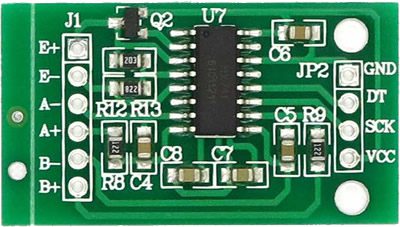
An HX711 module connects a suitable strain-gauge load cell to a microcontroller. The module is not the load cell, and neither part becomes a calibrated weighing instrument simply by printing a number. Mechanical installation and calibration are as important as the electronics.
This guide compares Epro component listings for an educational weighing project. It does not claim certified accuracy, approval for trade weighing or suitability for medical, lifting or other safety-critical measurement.

HX711 and load-cell prices in Pakistan
| Listed item | Price (PKR) | Project role |
|---|---|---|
| Arduino Load Cell Amplifier HX711, HX-711 (Digital Scale) | 160 | HX711 amplifier / ADC module; no load platform |
| 5Kg Range Weighing Sensor Load Cell Sensor for Electronic YZC-133 in Pakistan | 325 | Nominal 5 kg load-cell listing |
| Straight Bar Load Cell 20Kg in Pakistan | 325 | Nominal 20 kg straight-bar load-cell listing |
Price snapshot: Epro listings checked on 18 October 2026. Confirm the current price, availability, delivery charges and package quantity on the linked page before ordering. These are dated listing prices, not a quotation or an independent performance test.
The HX711 module reads a small differential bridge signal. The 5 kg load cell and 20 kg bar cell provide the mechanical sensing element. A controller, mounting arrangement, wiring and suitable reference masses are additional requirements.
1. Match the bridge configuration
A common four-wire full-bridge cell has two excitation connections and two signal connections. A three-wire half-bridge sensor is a different arrangement and may need additional compatible sensors or completion circuitry. Do not connect one to a full-bridge tutorial by guessing which terminal to omit.
The three-wire load-sensor listing is therefore not a direct drop-in substitute for every four-wire example. Check an authoritative wiring diagram for the exact sensor before selecting the rest of the system. A bare foil strain gauge is another distinct component, not a ready-made weighing platform.
2. Choose capacity with mechanical margin
Nominal capacity is not the same as measurement accuracy. A larger capacity does not automatically improve a small-load measurement, and a smaller cell must not be overloaded while testing. Include the platform, container and expected dynamic forces when considering the load.
A hobby project should not suspend valuable or hazardous loads from a small sensor as an improvised lifting device. Use a mechanically appropriate support and keep the first demonstration on a stable bench with modest loads.
3. Read output and excitation specifications
Many load cells express sensitivity in millivolts per volt of excitation. That signal needs an appropriate differential measurement path. It is not a voltage intended to drive an actuator or directly provide a convenient kilogram reading on an analog input.
Newest in the store


Confirm the load cell’s permitted excitation and the module’s actual supply arrangement. The current HX711 listing specifies 5 V operation. Do not assume that a 3.3 V controller can safely accept the module’s data output when the board is powered from 5 V.
4. Verify mounting before blaming noise
A straight-bar load cell must flex in its intended direction and according to its mounting design. Clamping both ends indiscriminately, allowing the platform to rub on the base or loading the wrong surface can produce unusable results even when the wiring is correct.
Plan spacers, rigid supports and a clear load path. Cable strain should not change the applied force. Calibration cannot reliably repair a mechanical arrangement that bypasses or constrains the sensing element.
5. Distinguish ADC resolution from accuracy
The HX711 is described as a 24-bit converter. That is a conversion-format specification, not a promise of 24-bit effective weighing accuracy. Noise, bridge quality, temperature, mounting and software settings limit the usable result.
Likewise, a module listing’s refresh-rate figure should be checked against the board’s RATE configuration. Do not assume every board is configured identically or that a faster setting automatically improves a stable weight measurement.
6. Budget for calibration and repeatability checks
You need a known reference mass and a repeatable mechanical setup. Tare removes an offset; it does not set the scale factor. Calibration should be checked with more than one load and repeated placement, while remaining within the cell’s limits.
The bogde HX711 library documents separate tare and scale operations. Copying another project’s calibration constant is not a valid substitute for measuring your own assembly.
7. Start with raw, zeroed counts
Use the HX711 Arduino wiring and calibration guide to observe the signal before labelling it in grams or kilograms. If the value drifts or changes when the platform is touched sideways, investigate wiring and mechanics first. Adding more decimal places or heavier averaging does not certify the finished scale.