


HTU21D Humidity Sensor: 7 Board and Interface Checks

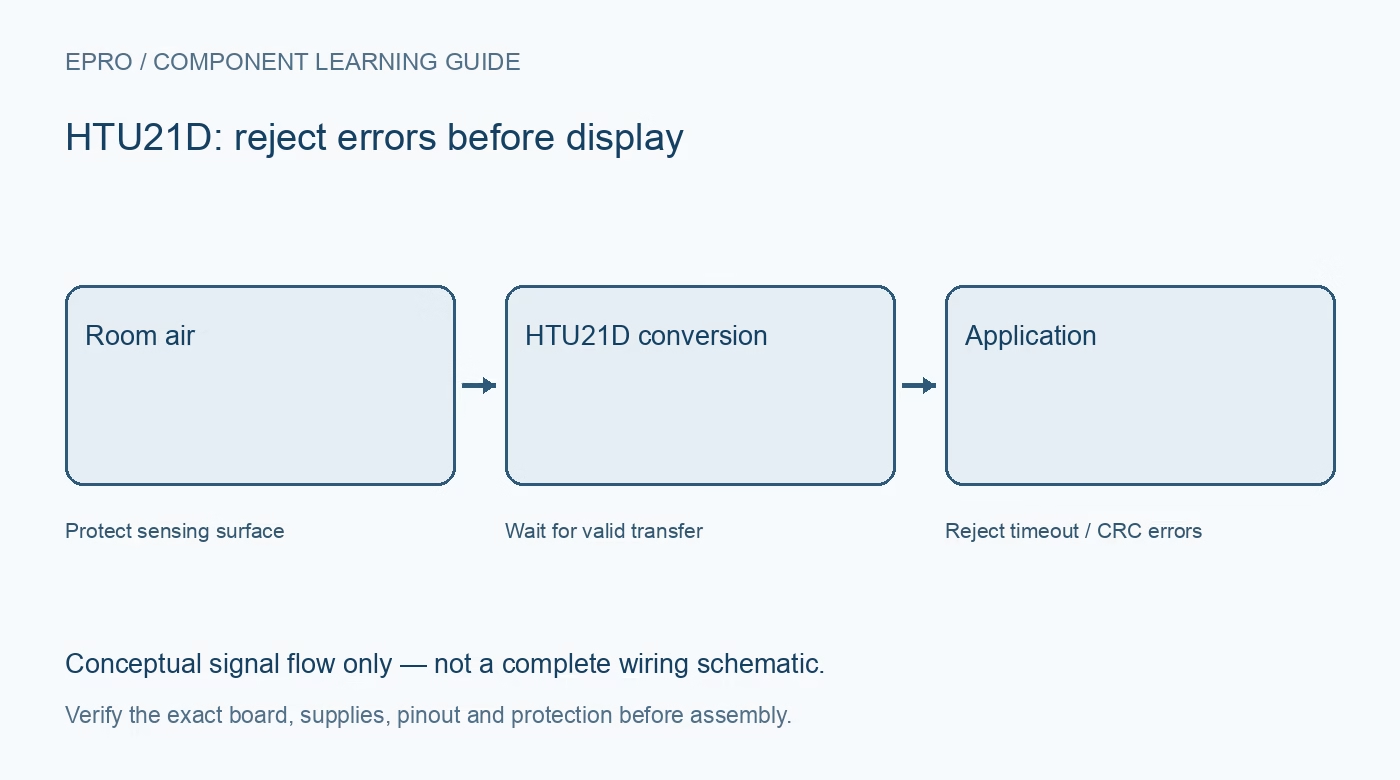
The HTU21D provides digital temperature and humidity information, but buying the right breakout requires more than recognizing its name. The SparkFun reference board is a 3.3 V design; another vendor’s carrier must be checked independently rather than assumed equivalent.
Identify the carrier, not just the sensor label
Request a schematic or a clear board-specific connection guide. A header marked VCC does not prove it accepts 5 V. Distinguish the reference board from similar layouts and avoid assigning pin order from a photograph of a different module revision.
Keep the bus pull-ups compatible
I2C uses pull-ups on its open-drain lines. Check which rail supplies them and whether the host enables additional pull-ups. Do not treat a series resistor as a universal voltage translator. For an initial low-voltage test, choose compatible 3.3 V operation or a correctly designed bidirectional level-shifting arrangement.
Plan the single-address limitation
The reference guide notes that only one HTU21D can be independently addressed on a single unsegmented bus. If the project needs several locations, plan a suitable multiplexer or separate buses. Buying multiple identical boards does not give each one a unique software-selectable address.
Read accuracy conditions rather than only the number
The guide quotes typical performance, not a guarantee for every enclosure and exposure. Relative humidity depends on temperature, and a nearby warm processor changes local conditions. A sensor located inside a sealed warm box may be functioning correctly while measuring the wrong environment for your application.
Keep moisture and contamination under control
A humidity sensor is not automatically waterproof. The reference guide advises against harsh environments with direct water contact. Keep the sensing surface away from splash, condensation, solder flux and solvent residues. Provide air exchange without presenting an open path for rain onto the electronics.
Choose a driver with explicit failure semantics
The referenced SparkFun library uses special values for timeout and CRC errors. A program that treats every numeric return as a real reading can store those errors as extreme temperatures. Inspect the actual library version and document its return convention before selecting an example as your application foundation.
Newest in the store


Define an acceptance test and maintenance record
For a first test, require repeatable communication, sensible room readings, documented units and a visible failure state after an intentional software-address mismatch. Record board revision and library version. Agreement with a household meter is useful context but does not establish traceable calibration or suitability for regulated monitoring.
Frequently asked questions
Can an HTU21D be left outdoors without protection?
Do not assume so. A breakout and sensing opening need a suitable environment and enclosure; the reference guide warns against direct water exposure.
Can I add another module by changing its library address?
Not if the hardware address is fixed. Use a supported bus-segmentation strategy instead.
Availability and illustration note
No matching Epro product was returned by the catalog search on 19 October 2026. This learning guide does not assert stock, a selling price or compatibility of an unidentified substitute. The illustration is an original conceptual signal-flow diagram, not a product photograph or complete wiring schematic.
Related Epro reading
For a first bench setup, review breadboard connections and continuity checks and I2C voltage-level translation. These guides do not replace the exact module schematic.
Technical references and limitations
Source: SparkFun HTU21D hookup guide and library reference. Electrical limits apply to the named part, not automatically to every carrier board. This is a documentation-based learning workflow, not a claim of independent hardware testing, traceable calibration or safety certification.