


TLC5940 Arduino: 7 BLANK, Latch and Channel Checks

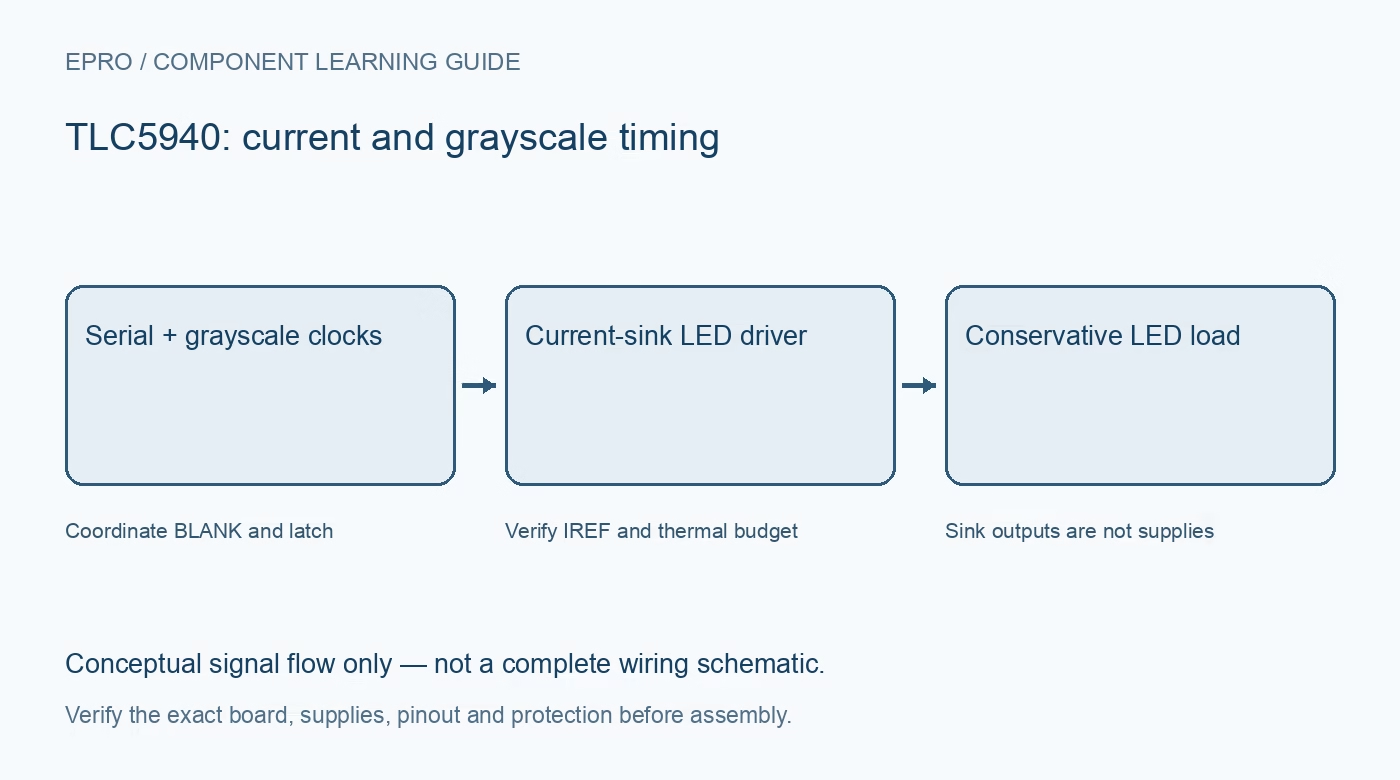
A TLC5940 Arduino test should first establish a safe off state, then exercise one LED at a conservative setting. Check the library’s timing and pin ownership before combining it with unrelated peripherals, because serial data is only one part of grayscale operation.
Verify sink wiring and the current resistor
Check the exact package, supply, ground, LED polarity and IREF resistor before applying power. Use a current-limited low-voltage supply and a modest LED load. Do not infer a safe channel current from a breakout colour, a software brightness argument or an unverified resistor label.
Hold outputs blanked during setup
BLANK high disables the outputs. Provide a predictable startup state while the host configures pins and sends known data. Software initialization happens after power is applied, so review any required hardware biasing rather than assuming a reset microcontroller immediately controls every driver signal.
Check library timers and pin assignments
A maintained TLC5940 library may generate GSCLK through a hardware timer and schedule blanking and latching using interrupts. Read its board-specific requirements. Another library that reconfigures the same timer can disturb grayscale operation even though data writes still appear to succeed.
Send the complete grayscale frame
Sixteen twelve-bit channel values form a 192-bit grayscale payload for one device. Verify bit order, channel order and chain length through the library rather than sending sixteen ordinary bytes. A one-channel walking pattern is easier to diagnose than a complex fading animation.
Coordinate XLAT and BLANK timing
New grayscale data should be latched at the documented cycle boundary, with the required clock and blanking relationship. Switching from dot-correction input to grayscale has additional sequencing requirements. Let a verified driver handle them instead of treating XLAT as an arbitrary enable pulse.
Measure one channel before scaling up
Start at low duty cycle with a correctly limited peak current, then verify the physical output index and LED behaviour. Keep unused channels at known off values. Do not command all channels to full brightness merely to prove a transfer worked; power and thermal design must be checked first.
Newest in the store


Verify off and recovery behaviour
Test normal off commands and a controlled restart without introducing wiring faults under power. A completed serial write is not acknowledgment from an individual LED. If diagnostics are used, distinguish open-load and thermal conditions from a software mapping error and record the observed status separately.
Frequently asked questions
Why can another Arduino library stop the LEDs working?
It may take over the timer or interrupt resources used for GSCLK and blanking.
Can sixteen eight-bit values replace the grayscale packet?
No. The device expects the documented twelve-bit-per-channel format and correct transfer sequence.
Availability and illustration note
No matching Epro product was returned by the catalog search on 21 October 2026 UTC. This learning guide does not assert stock, a selling price or compatibility of an unidentified substitute. The illustration is an original conceptual signal-flow diagram, not a product photograph or complete wiring schematic.
Related Epro reading
For a first bench setup, review breadboard connections and continuity checks and I2C voltage-level translation. These guides do not replace the exact module schematic.
Technical references and limitations
Source: Texas Instruments TLC5940 datasheet. Electrical limits apply to the named part, not automatically to every carrier board. This is a documentation-based learning workflow, not a claim of independent hardware testing, traceable calibration or safety certification.