


MCP3002 ADC: 7 Checks for a Two-Channel SPI Input

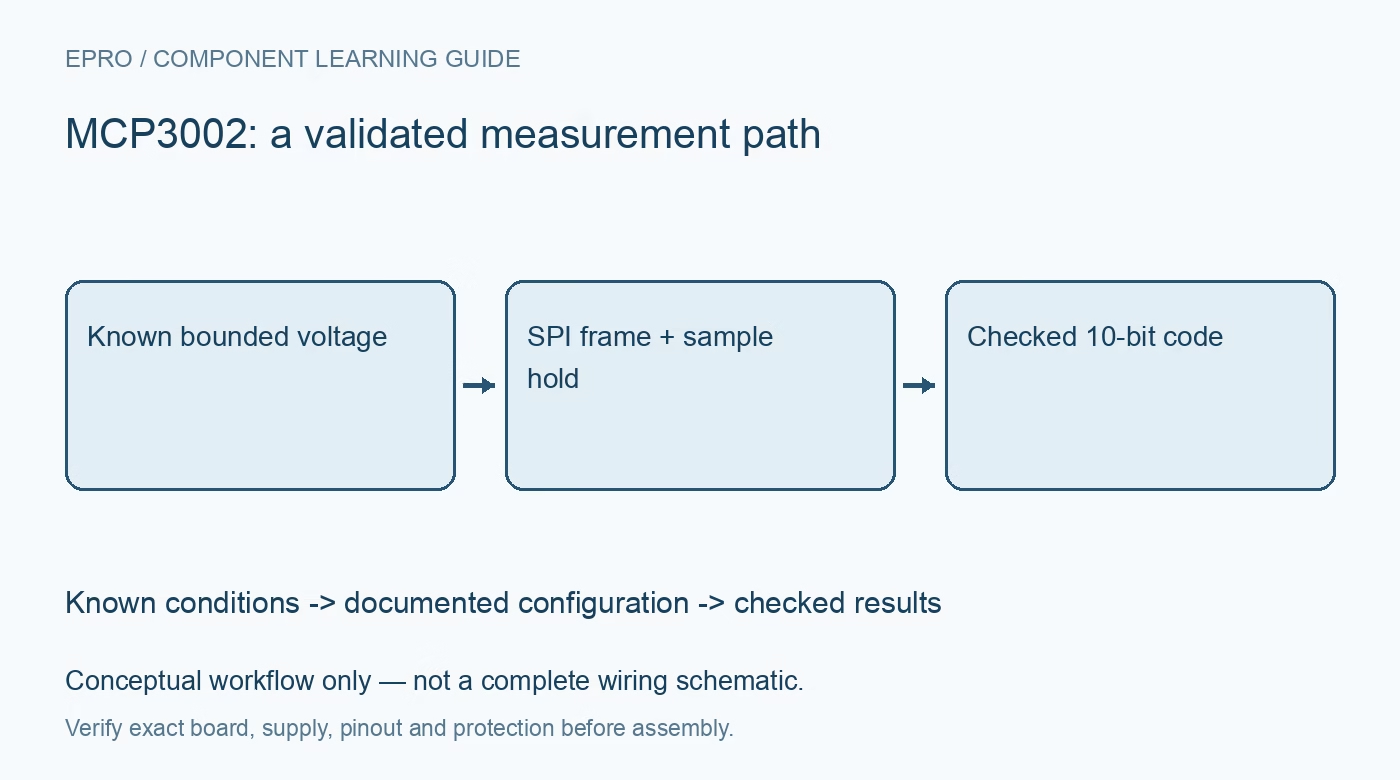
MCP3002 ADC: 7 Checks for a Two-Channel SPI Input
Bring up an MCP3002 ADC with a known input, correct SPI framing, supply-referenced scaling and a source impedance check before sampling two channels. This is a documentation-based bench-planning guide, not a claim of independent hands-on testing.
1. Choose the MCP3002 for the right task
The MCP3002 is a dual-channel, 10-bit successive-approximation converter with sample-and-hold circuitry and a serial interface. It is useful when two modest-resolution analog measurements are enough. Microchip publishes speed and electrical limits under particular operating conditions, so do not treat the maximum headline rate as universal. Write down signal range, required update interval and acceptable measurement uncertainty before selecting the chip or carrier. Manufacturer documentation.
2. Inspect the supply and reference connection
The MCP3002 combines its supply and reference function at the VDD/VREF connection. Changes in that voltage affect the scale of a voltage reading. Check the exact package pinout, decoupling and controller logic compatibility before applying power. A higher reference does not improve a small signal automatically; it increases volts per code. Measure the operating reference rather than substituting a board label into every calculation.
3. Start with a safe known input
Use a current-limited low-voltage setup and a signal constrained within the converter input limits. A potentiometer across a suitable reference can provide a repeatable first stimulus, provided the wiring and source impedance are appropriate. Begin near the middle of the range, then approach each end gradually. Never connect an unknown sensor output until its maximum voltage, ground relationship and possible startup transients are understood. Manufacturer documentation.
4. Build the serial frame explicitly
The serial command selects single-ended or differential operation, channel information and output format. Chip-select transitions and clock timing are part of the transaction, not incidental details. Use the documented frame for the exact device rather than copying an MCP3008 byte sequence blindly. Inspect received bits against a known input and confirm where the null bit and ten data bits occur. A shifting error can look deceptively like a scaling problem.Newest in the store


5. Respect the sample-and-hold source requirement
The internal sampling capacitor must charge sufficiently while the input is acquired. A high-resistance source, long cable or added filter can prevent settling at the selected clock rate. Consult the datasheet guidance for source impedance and timing, then slow the acquisition or add a suitable buffer when necessary. Compare a direct known source with the final sensor path. Averaging cannot restore information that was never sampled correctly.
6. Do not confuse differential with bipolar
Differential selection changes the relationship of the two inputs; it does not grant unrestricted negative input voltage or isolation. Check both absolute input limits and the documented conversion behavior. For an initial single-ended test, keep the input and reference ground relationship clear and verify monotonic changes across the usable range. Retain the raw ten-bit result so the conversion can be checked independently of display formatting. Manufacturer documentation.
7. Validate MCP3002 scaling and channel identity
For an ideal supply-referenced single-ended conversion, one code step is approximately VREF divided by 1024; endpoint and error behavior still follow the datasheet. Record reference voltage, channel, raw code and sample time. Alternate two distinct known levels to catch channel-selection mistakes. The existing MCP3008 potentiometer guide is useful background, but its eight-channel command format is different. Finish by testing communication failures without silently reusing stale data.
Related reading: MCP3008 Raspberry Pi: A 3.3V Potentiometer Input Test. For current listings, check the Epro catalog; a matching item was not returned by the exact-part catalog search on 22 October 2026. No price, stock or included-accessory claim is made here.