


LIS3DH Accelerometer: 7 Checks for Correct Motion Data

LIS3DH Accelerometer: 7 Checks for Correct Motion Data
Validate LIS3DH motion data using range and mode settings, correct output scaling, mounting orientation and FIFO timing before interpreting acceleration. This is a documentation-based bench-planning guide, not a claim of independent hands-on testing.
1. Define the LIS3DH measurement goal
The LIS3DH is a three-axis linear accelerometer with I2C and SPI interfaces, selectable full-scale ranges and an embedded FIFO. ST describes motion and orientation-related functions, but the sensor is not a complete navigation system. Define whether the project needs slow tilt, impact observation or periodic motion detection. These jobs require different range, bandwidth and timing choices. Acceleration includes gravity, so a stationary reading is not expected to be zero on every axis. Manufacturer documentation.
2. Confirm the board and electrical interface
The bare sensor supply range is 1.71 V to 3.6 V, with separate interface-supply requirements detailed in its documentation. Check the carrier regulator, pull-ups, address or interface selection and chip-select wiring. A breakout with a convenient connector is not automatically compatible with every controller voltage. Verify the device identification response before configuration, then read back important settings. Avoid changing multiple unexplained library defaults before the first known-position check.
3. Match range, mode and sensitivity
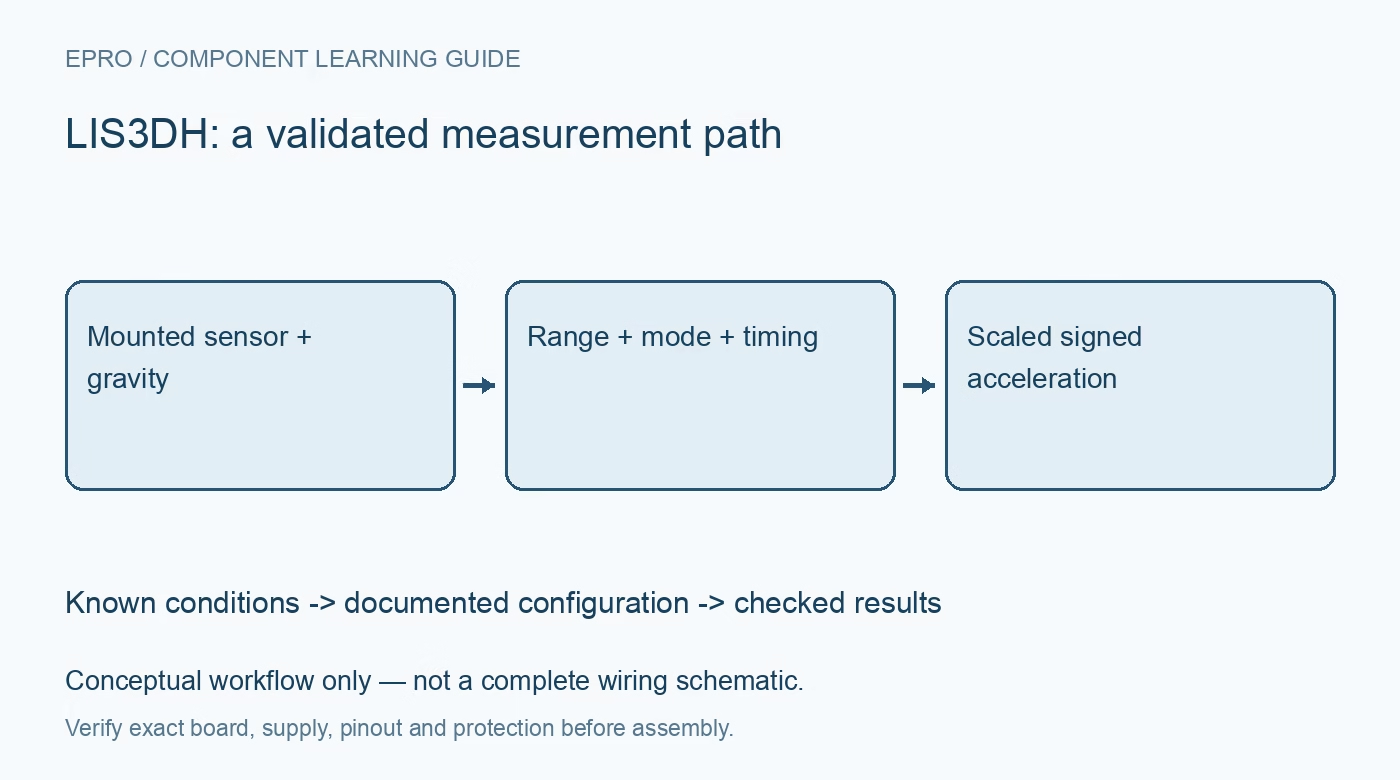
The LIS3DH supports selectable ranges of plus or minus 2, 4, 8 and 16 g. Its operating modes affect resolution and output interpretation; a sixteen-bit register pair does not imply sixteen effective measurement bits in every mode. Use the documented sensitivity for the selected mode and range. Confirm byte order, sign extension and any required bit alignment before converting raw values to physical acceleration units. Manufacturer documentation.
4. Establish the mounting coordinate system
Mark the physical board axes and record how the sensor sits in the final assembly. In a still setup, turn the board through several known orientations and check which axis changes sign and magnitude with gravity. Do not rename axes merely to make one plotted trace look right. Flexible mounting, cable movement and enclosure vibration can distort dynamic observations. Compare the assembly at rest before attempting meaningful motion classifications.Newest in the store


5. Read coherent samples with timing
Use the documented multi-byte access and data-coherency mechanisms so low and high bytes belong to the intended sample. Select an output data rate suitable for the signal and host processing budget. Polling faster than that rate does not create new measurements. Record timestamps and handle overrun indications. If the software occasionally stalls, measure the resulting gaps rather than assuming that every displayed point represents an equal time interval.
6. Use FIFO and self-test purposefully
The embedded FIFO can reduce host intervention, but firmware must understand its mode, sample ordering and overflow behavior. Test a deliberate pause in host reads and confirm recovery. Follow the manufacturer self-test procedure with the required operating conditions and acceptance limits. A successful self-test checks specified internal behavior; it is not a full application calibration or proof of accurate impact measurement after an arbitrary mounting change. Manufacturer documentation.
7. Validate LIS3DH conclusions against reality
Log device identity, range, mode, data rate, scale factor, axis mapping and validity status. Compare static orientations and a modest controlled movement before enabling event thresholds. Integrating acceleration into velocity or position requires additional assumptions and drift management; this guide does not promise reliable displacement from raw samples alone. The existing ADXL345 orientation guide provides a useful comparison, but LIS3DH registers, sensitivity and self-test criteria must come from its own documentation.
Related reading: ADXL345 Arduino: I2C Bring-Up and Six-Orientation Checks. For current listings, check the Epro catalog; a matching item was not returned by the exact-part catalog search on 22 October 2026. No price, stock or included-accessory claim is made here.