


BME680 Gas Sensor: 7 Rules for Interpreting Heater and IAQ Data

BME680 Gas Sensor: 7 Rules for Interpreting Heater and IAQ Data
Separate BME680 gas resistance from processed air-quality estimates, with heater-status checks, environmental compensation and clearly labeled outputs. This is a documentation-based project guide, not an independent hands-on test report.
1. Separate the four measurements
BME680 combines gas sensing with pressure, humidity and temperature measurement. Bosch describes a gas-resistance signal alongside environmental channels. These are related observations, not four interchangeable air-quality scores. Define the output your project actually needs before choosing software: raw gas resistance, environmental logging or a processed index. A number shown by an example application may come from an algorithm rather than a register that directly measures that named quantity. Manufacturer documentation.
2. Verify the board and compensation path
Confirm supply requirements, logic levels, bus selection and physical sensor identity. Load the device-specific calibration data and use the documented compensation routines for the enabled channels. Keep the board away from strong local heat sources when evaluating ambient temperature. The gas heater and the surrounding electronics can influence thermal conditions. A correct I2C address does not establish that the wiring, component variant or compensation implementation is correct. Manufacturer documentation.
3. Make the heater profile explicit
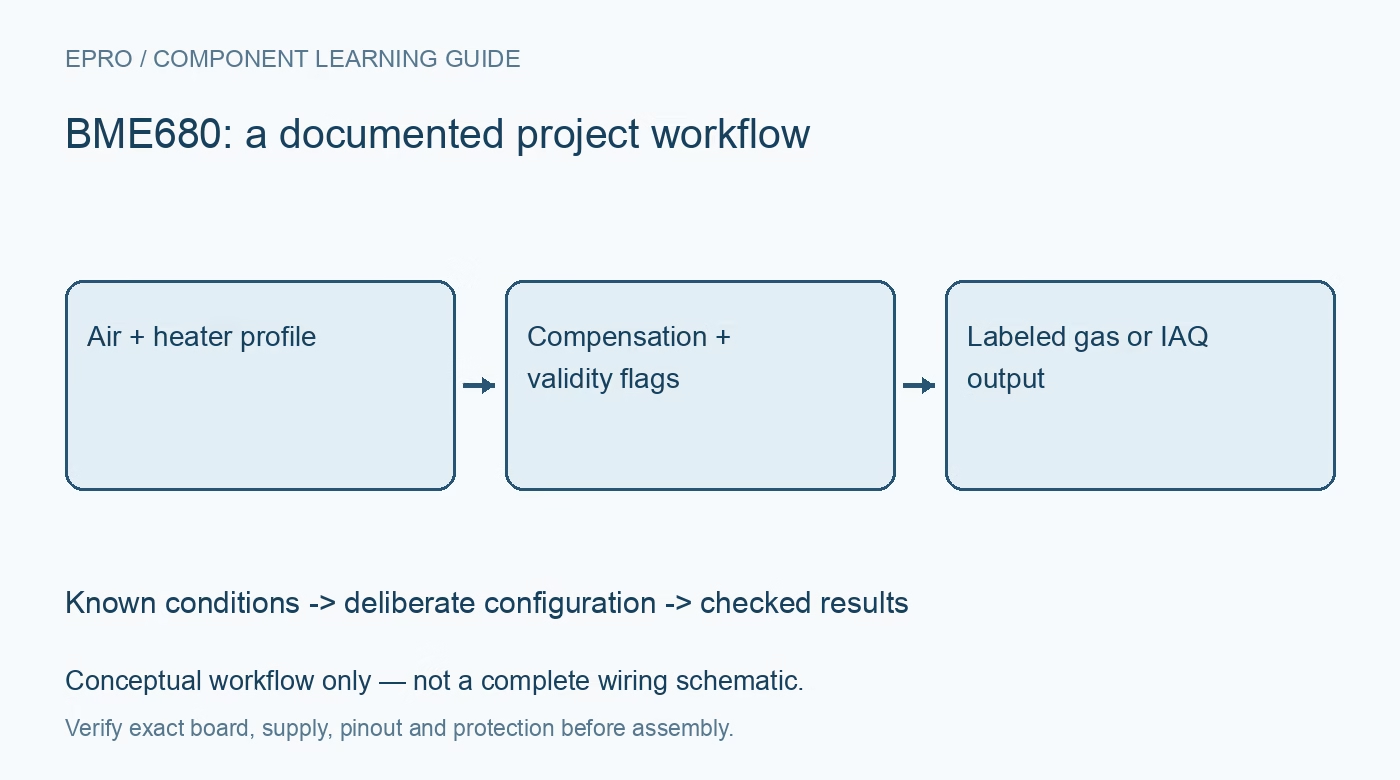
The gas measurement depends on a configured heater target and duration. Select them through a supported driver and documented use case, rather than adjusting settings until the display looks attractive. Record the profile with each session. A changed profile changes the measurement conditions and can make before-and-after resistance traces incomparable. Check conversion timing for the complete enabled measurement sequence, including environmental oversampling and the heater interval. Manufacturer documentation.
4. Require new and valid gas data
Use the new-data indication to distinguish fresh observations from a repeated register value. Check both gas-valid and heater-stable status for the gas result. A heater that has not reached its configured condition is not a normal sample simply because resistance is nonzero. Preserve failed status in the log. Do not substitute a previous good value without marking it as stale, particularly when a dashboard calculates rolling averages. Manufacturer documentation.
Newest in the store


5. Label resistance and IAQ differently
Compensated gas resistance is not a direct parts-per-million measurement of one named gas. Bosch BSEC processing can provide derived air-quality outputs under its documented requirements. If using it, preserve the software version, configuration, required sample scheduling and reported status or accuracy information. Never rename a raw resistance curve as measured carbon dioxide. An algorithm-derived equivalent or index needs a label that explains what is estimated and by which processing path. Manufacturer documentation.
6. Test ordinary environmental changes safely
Start with a stable room baseline and normal ventilation changes. Log humidity and temperature alongside gas observations because environmental conditions influence interpretation. Do not expose the board to flammable vapors, spray cleaners onto it or treat a response to an unknown mixture as selective identification. Allow the chosen processing pipeline its documented startup and adaptation behavior. A brief response demonstration cannot establish calibration, long-term stability or suitability for a hazardous-gas alarm. Manufacturer documentation.
7. Build a reproducible BME680 record
Retain timestamp, compensated channels, heater profile, validity flags and processing state. If restoring algorithm state, follow the library guidance rather than assuming any saved bytes remain suitable forever. Compare sessions only with their conditions available. The related BME280 guide covers environmental channels without this gas-measurement path. BME680 is useful for learning and trend projects, but this article does not validate a life-safety monitor or certify indoor air as safe. Manufacturer documentation.
Related reading: BME280 Sensor: 7 Checks for Humidity and Pressure Projects.
Catalog note: The exact-part search did not return a matching Epro listing during preparation. Check the current catalog; this guide makes no availability, price or accessory claim.