


HDC3022 Humidity Sensor: 7 Checks for Protected Air Sensing

HDC3022 Humidity Sensor: 7 Checks for Protected Air Sensing
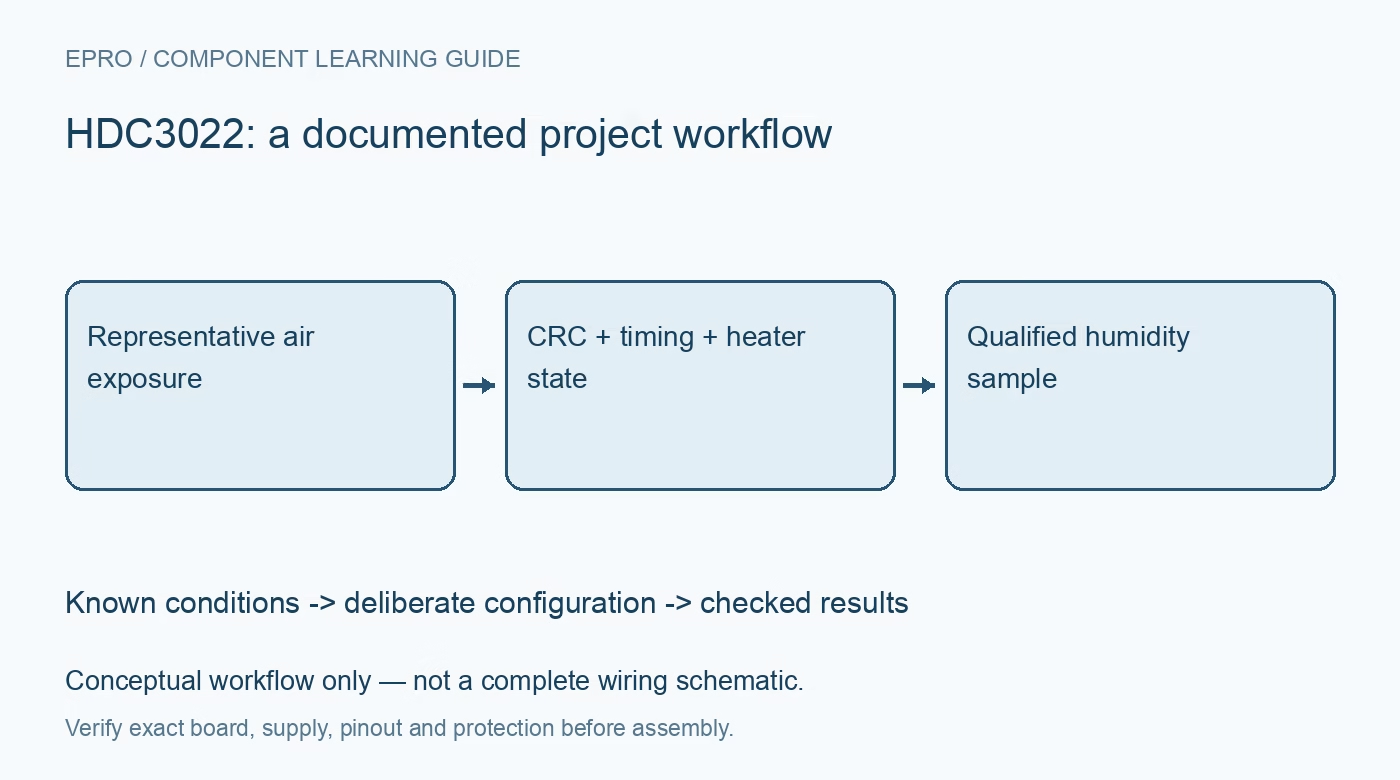
Use HDC3022 humidity data with its permanent protective membrane, per-word CRC, deliberate timing and explicit heater-recovery conditions. This is a documentation-based planning guide, not a report of independent hands-on testing.
1. Identify the HDC3022 cover correctly
The shared HDC3020-family documentation describes different protective arrangements. HDC3022 has a permanent protective membrane; it should not be treated as the removable assembly tape of another variant. Confirm the exact part before cleaning, coating or handling the sensing area. A component-level protection feature does not establish the ingress rating of an entire enclosure. Document the air path, exposure conditions and any additional cover rather than assuming the package makes every installation waterproof. Manufacturer documentation.
2. Build a representative humidity location
Relative humidity depends on local temperature as well as moisture. Position the sensor with deliberate airflow and away from unintended heating where practical. Record enclosure vents, nearby electronics and whether the air reaching the membrane represents the environment of interest. A protected sensor recessed in a warm cavity can report a different condition from freely exposed room air. Mechanical protection and representative sampling must be designed together, not evaluated as unrelated features. Manufacturer documentation.
3. Verify electrical and command compatibility
Check supply, logic levels, address selection and pull-ups against the exact carrier. Use the documented command protocol rather than importing an unrelated humidity sensor routine because both devices use I2C. Record startup and reset handling, then confirm the intended measurement mode. An acknowledged address establishes only a narrow communication check. It does not demonstrate that the host sends the correct command, waits for the required conversion or reads fields in the proper arrangement. Manufacturer documentation.
4. Preserve per-word integrity checks
The interface supplies checksum information with the measurement data. Validate the documented CRC for each protected word before converting humidity or temperature. Keep byte order, payload length and checksum coverage explicit in the driver. A failed check should produce a flagged invalid sample or a controlled retry, not a plausible default humidity number. Preserve raw data during evaluation so communication corruption can be distinguished from an environmental change or a numerical conversion error. Manufacturer documentation.
Newest in the store


5. Select mode and timing for freshness
Choose the documented measurement mode and repetition behavior for the application. Associate each accepted result with its acquisition time and validity state. Avoid presenting repeated reads as independent new observations when the conversion process has not updated the underlying data. Define timeout and restart behavior for interrupted communication. Averaging or smoothing in the host can alter responsiveness, but it does not repair a stale sample, an incorrect command or exposure conditions outside the intended operating boundary. Manufacturer documentation.
6. Treat heater operation as a special state
The integrated heater supports the documented moisture-handling functions, but heating changes the local sensing condition. Mark heater activity and the subsequent recovery period rather than merging those observations invisibly into an ordinary ambient humidity log. Follow the manufacturer operating guidance and do not improvise continuous heating as a calibration method. Offset correction also needs a defensible basis. A number that looks more comfortable after adjustment is not evidence that a contamination or placement problem has been solved. Manufacturer documentation.
7. Keep protection and accuracy claims bounded
Retain device identity, air-path arrangement, mode, checksum status, heater history and any justified correction with evaluation data. Reassess after changing the enclosure or exposing the sensing area to cleaning materials. The linked HDC1080 guide discusses paired environmental acquisition on another device, not interchangeable commands or packaging. This HDC3022 workflow is documentation-based and claims no independent chamber testing, complete enclosure certification or universal recovery from every contaminant that a protected sensor might encounter. Manufacturer documentation.
Related reading: HDC1080 Humidity Sensor: 7 Steps to Valid Paired Readings.
Catalog note: The exact-part search did not return a matching Epro listing during preparation. Check the current catalog; this guide makes no price, availability or included-accessory claim.