


DRV8838 Motor Driver: 7 Checks Before Treating Disable as Coast

DRV8838 Motor Driver: 7 Checks Before Treating Disable as Coast
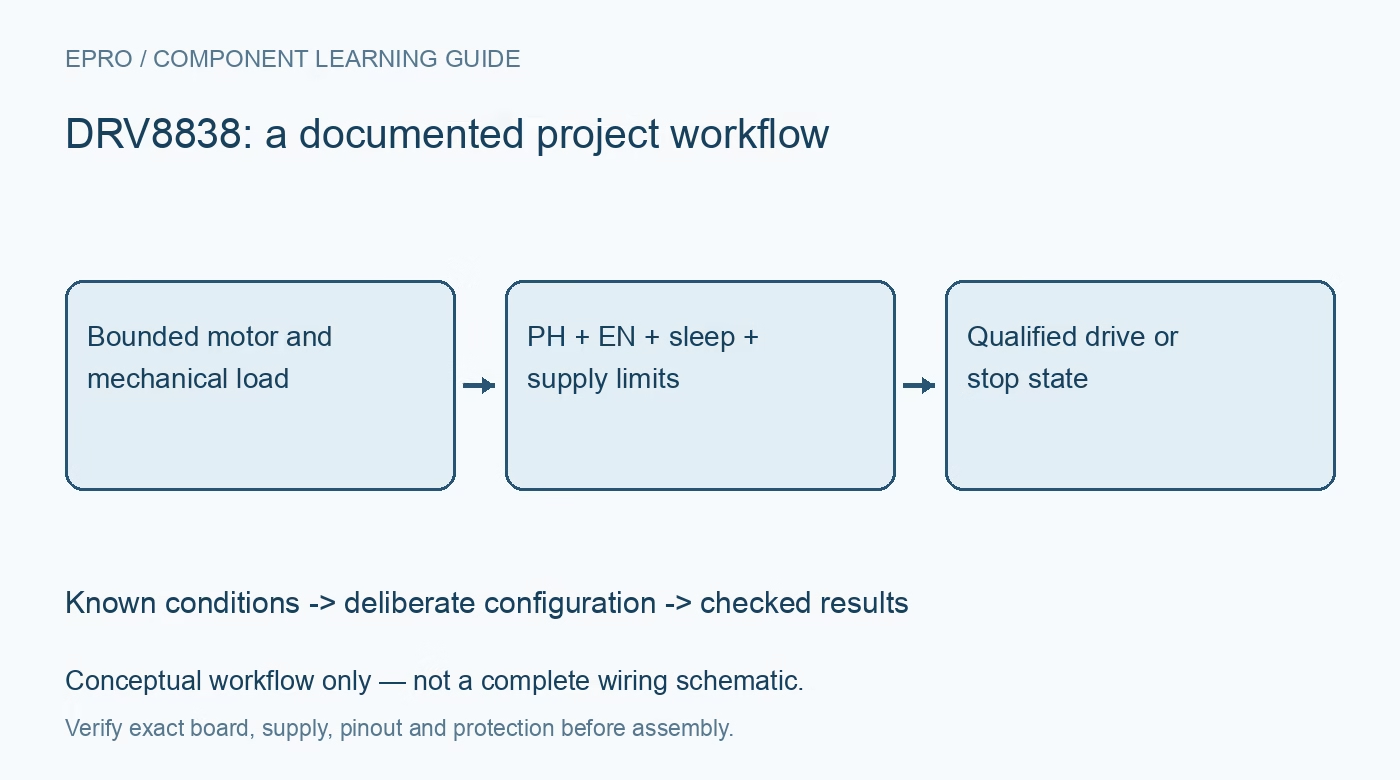
Plan DRV8838 motion with the PH/EN truth table, brake-versus-coast behavior, separate supplies, motor-current budgeting, sleep timing and controlled reversal. This is a documentation-based planning guide, not a report of independent hands-on testing.
1. Identify the DRV8838 control interface
The shared family document includes DRV8837 and DRV8838, but their control interfaces differ. DRV8838 uses PH and EN; do not copy an IN1/IN2 truth table from DRV8837 into the application. Record the actual driver, board and motor connection. This device drives a single H-bridge load; it does not provide a position estimate or a closed-loop motion controller by itself. Define the intended forward, reverse and stopped behavior before producing any PWM. Manufacturer documentation.
2. Distinguish braking from coasting
With DRV8838 awake, the documented EN-low state drives both outputs low, producing the listed brake state. Sleep instead places the outputs in a high-impedance coast condition. These are not interchangeable ways to describe a motor stop. A change in stopping behavior can affect mechanics, current and application timing. Preserve the selected policy and verify it with a safely restrained low-energy mechanism. Do not assume that a software function named disable necessarily leaves the motor terminals floating. Manufacturer documentation.
3. Check motor and logic supplies separately
Review VM and VCC limits independently, along with host logic compatibility and decoupling. The documented logic-supply undervoltage behavior is not a general motor-supply supervision guarantee. Inspect the carrier for tied supplies or extra components before using a generic wiring example. Keep initial evaluation protected and low voltage. A motor can produce disruptive current and voltage conditions even when its nominal supply appears modest, so source wiring and local energy handling remain part of the design. Manufacturer documentation.
4. Budget startup and blocked-rotor current
Use the motor specification and load requirements to assess startup, running and credible blocked conditions. A headline maximum driver current is not a continuous rating for every small board and thermal environment. Account for resistance, dissipation and connection losses. Overcurrent protection is not a programmable precision motor-current controller. Do not deliberately hold a motor stalled as an ordinary tuning procedure. Choose safe current-limited evaluation methods and suitable independent measurement equipment rather than relying on repetitive protective shutdown. Manufacturer documentation.
Newest in the store


5. Choose PWM and reversal policy deliberately
Use the documented PH/EN behavior to select PWM and direction changes. Assess the consequence of changing direction while the mechanism is moving instead of instantly commanding full reverse from an arbitrary speed. Motor inertia and current decay matter beyond the GPIO truth table. Start with bounded duty and a controlled mechanical setup. A driver can switch correctly while the resulting motion remains unsuitable for the gearing, source or application safety requirements. Manufacturer documentation.
6. Include sleep and fault recovery timing
Honor documented wake-up behavior before expecting a valid driven output. Define host pin states during reset and distinguish intentional sleep from absent logic power or a protective shutdown. Review thermal and overcurrent recovery rather than calling every interruption a firmware fault. DRV8838 does not turn a raw PWM command into verified motion feedback. Preserve any external observation or sensing method used to determine whether the mechanism actually moved and whether its stop state was acceptable. Manufacturer documentation.
7. Record electrical and mechanical conditions
Retain driver identity, supplies, motor, load, PWM policy, brake/coast choice, sleep timing and thermal conditions with observations. Keep the mechanism guarded and do not claim a fail-safe stop merely from an H-bridge command. The related DRV8213 guide discusses different features, including device-dependent sensing responsibilities, not matching control pins. This DRV8838 workflow proposes documentation-based motion checks and reports no independent stall-current qualification, stopping-distance measurement or safety certification of a finished actuator system. Manufacturer documentation.
Related reading: DRV8213 Motor Driver: 7 Checks Before Trusting Stall Detection.
Catalog note: The exact-part search did not return a matching Epro listing during preparation. Check the current catalog; this guide makes no price, availability or included-accessory claim.