


OPT4060 RGBW Sensor: 7 Checks for Comparable Color Samples

OPT4060 RGBW Sensor: 7 Checks for Comparable Color Samples
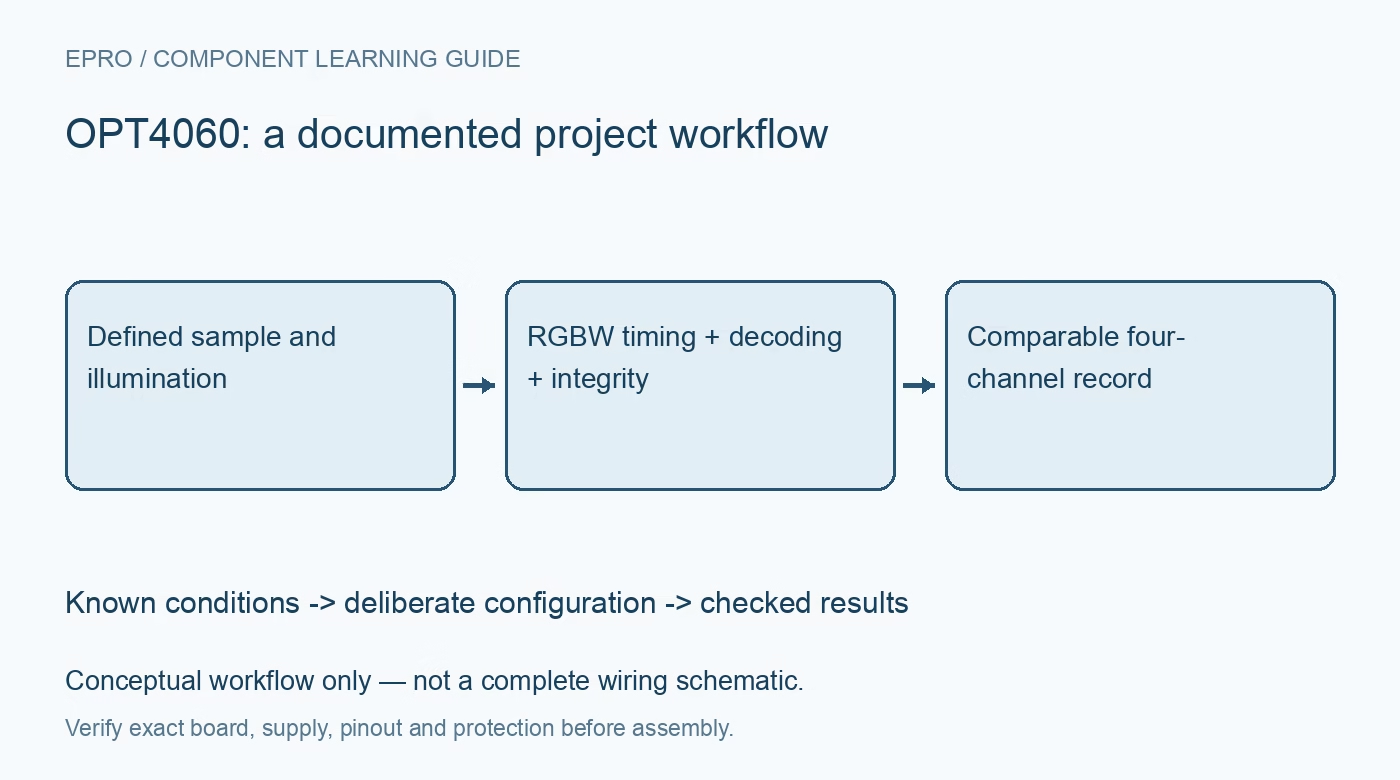
Plan OPT4060 RGBW acquisition with complete mantissa decoding, counters and CRC, channel timing, controlled illumination and a justified color model. This is a documentation-based planning guide, not a report of independent hands-on testing.
1. Define the OPT4060 optical observation
OPT4060 measures four channels with red, green, blue and wide-band responses. Define whether the application observes a light source, transmitted light or a reflected sample before choosing a color calculation. Illumination, distance, angle and the enclosure window affect the observation. A raw RGBW vector is not automatically a calibrated surface-color label. Preserve the physical arrangement so a changed lamp or sample position is not mistaken for a change caused by the sensor electronics. Manufacturer documentation.
2. Keep channel identity and units explicit
Use the documented spectral responses and application guidance when deriving light or color quantities. Do not assume OPT4060 outputs are interchangeable with another sensor’s XYZ channels or that one channel alone represents every desired photometric quantity. Keep raw channel information separate from the application model. A conversion matrix or normalization needs a justified basis and appropriate reference conditions. A plausible-looking color name or correlated color temperature does not independently validate that model for arbitrary sources. Manufacturer documentation.
3. Decode exponent and mantissa completely
Each channel result combines a four-bit exponent with a 20-bit mantissa assembled from the documented result fields. Apply the specified linearization and use adequate numerical width. Do not treat one register as the complete reading or include counter and CRC bits as additional signal resolution. Verify field extraction with numerical test cases before testing optics. Automatic range changes can alter the raw representation, so compare properly reconstructed values rather than judging a physical change from an isolated mantissa. Manufacturer documentation.
4. Select conversion time for the real signal
Choose operating mode, per-channel conversion time and range policy from expected illumination and required update behavior. Fast measurements and long averaging windows serve different needs. Account for channel sequencing when observing moving samples or modulated light; four registers are not proof of a simultaneous snapshot. Record the selected timing and trigger arrangement. Flicker, motion and a changing source can produce an apparently unusual channel ratio even when the register arithmetic and bus transfer are correct. Manufacturer documentation.
Newest in the store


5. Use sample counters and CRC deliberately
The documented result includes a channel counter and CRC information. Implement the specified integrity calculation and handle counter wrap rather than treating the small counter as an unlimited timestamp. Detect stale or inconsistent readout according to the acquisition policy. Reading before a completed update can return the previous measurement. CRC protects covered digital information; it does not establish correct illumination, absence of saturation or a calibrated color response for the finished optical assembly. Manufacturer documentation.
6. Preserve the optical stack in evaluation
Record window material, aperture, mounting and contamination conditions alongside the source and target. Strong out-of-band rejection does not remove every spectral or geometric dependency. Compare against suitable references over the actual intended light conditions, and track clipping or invalid acquisition states explicitly. Do not silently normalize a saturated vector into an apparently valid color result. A board evaluated in open air may require fresh characterization after installation behind a colored cover or a changed mechanical opening. Manufacturer documentation.
7. Keep model claims within observed evidence
Retain raw RGBW data, reconstructed values, configuration, counters, integrity status and acquisition time with any derived result. The linked OPT4048 article covers a different channel-response architecture, not interchangeable coefficients. This OPT4060 workflow proposes traceable color-acquisition checks. It reports no independent colorimetric calibration, universal material recognition or validated lux and color-temperature accuracy for every source. The useful outcome is a comparable measurement record with a justified model, not extra precision implied by a large digital range. Manufacturer documentation.
Related reading: OPT4048 Color Sensor: 7 Checks Before Trusting CCT.
Catalog note: The exact-part search did not return a matching Epro listing during preparation. Check the current catalog; this guide makes no price, availability or included-accessory claim.