


OPT4048 Color Sensor: 7 Checks Before Trusting CCT

OPT4048 Color Sensor: 7 Checks Before Trusting CCT
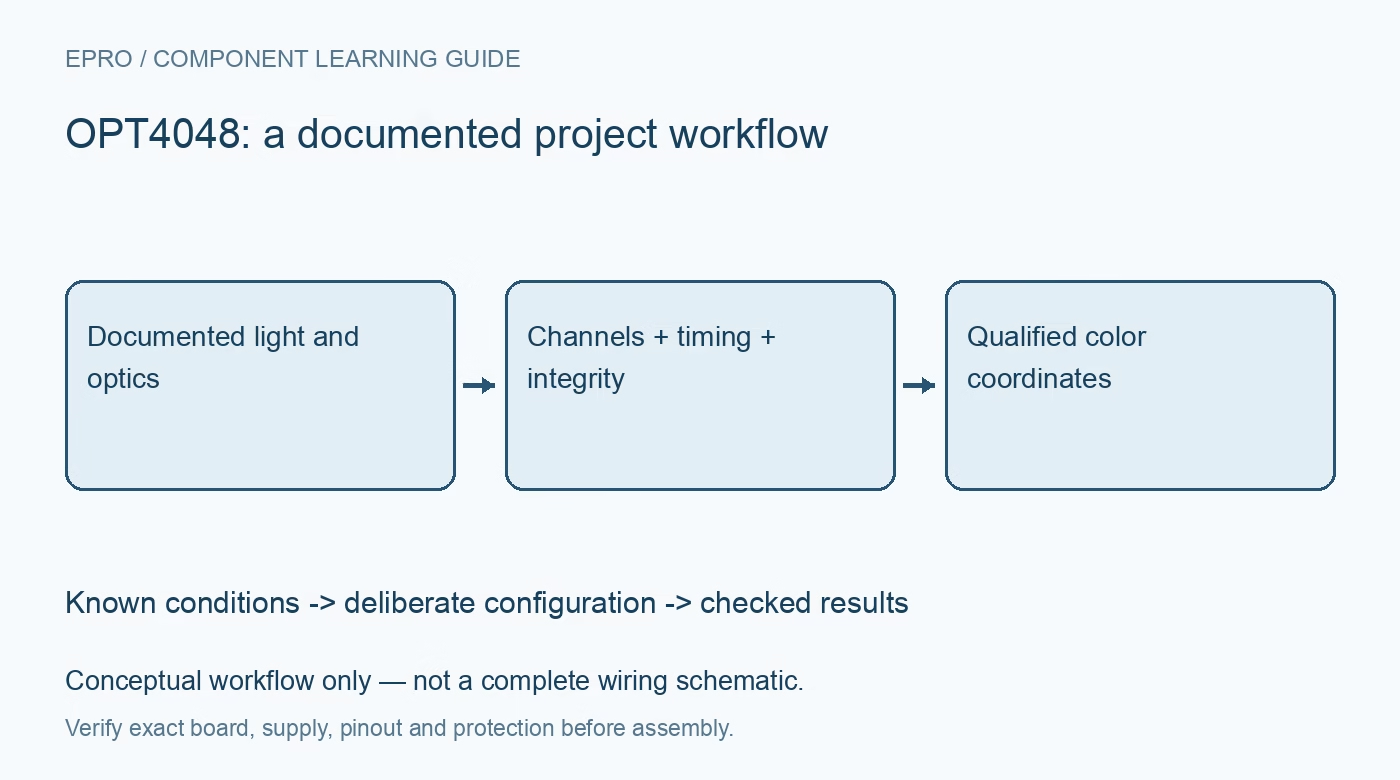
Plan OPT4048 color measurements with coherent XYZ-related channels, timing, counter and CRC checks, optical-window context and bounded CCT interpretation. This is a documentation-based planning guide, not a report of independent hands-on testing.
1. Define the OPT4048 color measurement
OPT4048 measures four optical channels, including responses designed to closely match the CIE tristimulus functions and a wider-band channel. It is not a camera and does not identify every material color independently of illumination. Decide whether the project observes an ambient light source, a controlled sample or another optical arrangement. Record the source, geometry and sensor orientation. The meaning of color coordinates depends on what light actually reaches the package. Manufacturer documentation.
2. Check supply, interface and optical access
Verify supply, I2C logic, address selection and carrier connections against the exact documentation. Check whether an interrupt or trigger feature is actually exposed before depending on it. Inspect covers, apertures and nearby indicator LEDs as part of the measurement design. A transparent-looking window can still affect spectral response. A successful bus transaction verifies only communication, not that the sensor views the intended light or that the host is reconstructing the right channel result. Manufacturer documentation.
3. Select conversion timing for the light source
Choose the documented timing and mode according to required response, expected illumination and source behavior. Flickering or changing light can interact with channel acquisition and timing, so a rapidly updated display is not necessarily a coherent color observation. Preserve conversion settings with the data. Longer observation can change noise and averaging behavior, but it does not automatically remove optical-window error or establish colorimetric accuracy for the completed installation. Manufacturer documentation.
4. Assemble coherent channel results with integrity
Follow the documented exponent, mantissa and multiregister result arrangement instead of applying a generic integer-to-lux conversion. Use the available counter and CRC information according to the specified readout behavior and calculation. Reject or flag inconsistent data rather than combining channel fragments from unrelated updates. Retain raw register values during evaluation. A believable color temperature can emerge from incorrectly assembled data, so plausibility is not a replacement for checking frame integrity and sample association. Manufacturer documentation.
Newest in the store


5. Apply the manufacturer color relationships
Use the documented channel-to-quantity relationships and scaling for the intended coordinates or illuminance result. Keep units and normalization explicit, including handling for weak signals or an unsuitable denominator. Do not label the wide-band channel as an interchangeable camera RGB component or invent a universal white-balance transform. Validate any additional host processing against the actual measurement objective. A coordinate calculation and a calibrated instrument claim are different things and should be documented separately. Manufacturer documentation.
6. Bound the meaning of correlated color temperature
CCT describes a relationship to a reference locus and is not meaningful for every possible light color. Review the manufacturer guidance before assigning a kelvin value to a saturated or otherwise unsuitable source. Preserve chromaticity and validity information alongside any CCT estimate rather than displaying temperature alone. A single color-temperature number cannot describe the complete spectrum, and equal CCT does not imply identical spectral content or identical color rendering under different lamps. Manufacturer documentation.
7. Retain optical conditions with acceptance results
Record device identity, window, geometry, illumination, timing, integrity outcomes and processing revision with observations. Compare the finished installation against suitable reference equipment before claiming accuracy. The linked AS7341 article concerns another optical architecture, not identical channels or equations. This OPT4048 workflow proposes traceable acquisition and bounded color interpretation without claiming independent spectrometer comparisons, universal CCT validity or a certified color measurement merely because the host displays several decimal places. Manufacturer documentation.
Related reading: AS7341 Spectral Sensor: 7 Checks for Repeatable Color Data.
Catalog note: The exact-part search did not return a matching Epro listing during preparation. Check the current catalog; this guide makes no price, availability or included-accessory claim.