


BQ25798 Charger: 7 Checks for Cell Count and Source Policy

BQ25798 Charger: 7 Checks for Cell Count and Source Policy
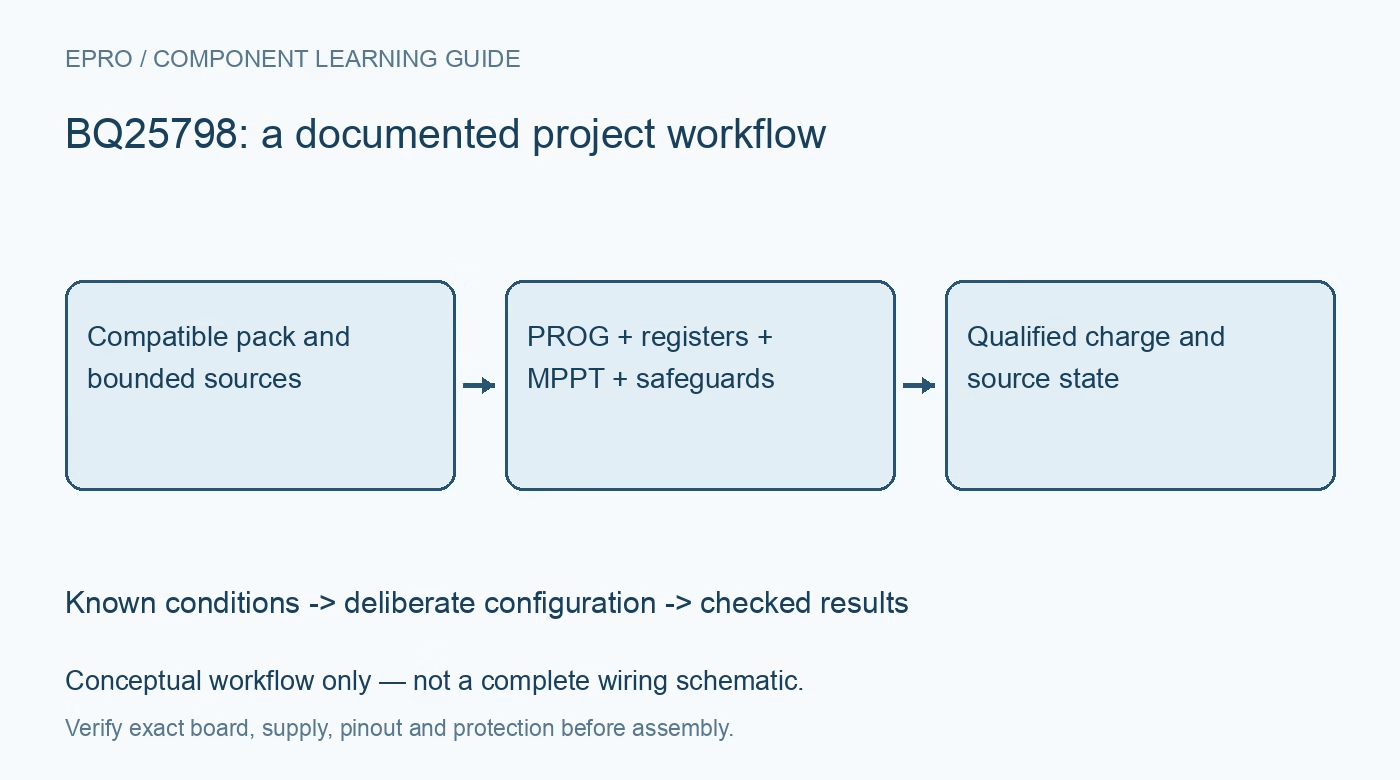
Plan BQ25798 charging with verified pack configuration, source and load budgets, explicit MPPT behavior, watchdog recovery and deliberate backup-mode control. This is a documentation-based planning guide, not a report of independent hands-on testing.
1. Define the BQ25798 pack and safety boundary
BQ25798 supports documented one- to four-cell lithium-ion or lithium-polymer charging arrangements. Confirm series cell count, regulation voltage, allowed current, temperature limits and independent pack protection before configuring it. A multi-cell charger is not automatically a cell-balancing system or a complete battery-management safety design. Use compatible identified packs and supervised protected evaluation. Do not charge unknown, damaged or incorrectly assembled batteries, and do not infer pack suitability from a generic voltage label on a carrier. Manufacturer documentation.
2. Review PROG defaults before relying on software
The PROG resistance participates in the documented power-on defaults for cell count and switching frequency. Verify the actual fitted component and resulting state before enabling an intended charging policy. Then deliberately configure and read back relevant registers. A host variable naming a pack does not prove that the hardware selected the same arrangement during startup. Preserve board identity and reset defaults so a replacement resistor or carrier cannot silently apply an unsuitable policy before firmware takes control. Manufacturer documentation.
3. Budget charging and system load together
Define input-source limits, wiring, system demand and battery current within the complete thermal envelope. Buck-boost conversion allows different input and battery relationships but does not remove power or dissipation constraints. A programmed charge current can be reduced by source, system or temperature regulation. Read the documented state instead of increasing limits to force an expected display. A high headline charge rating is not an unconditional continuous capability of every small board, connector or attached battery. Manufacturer documentation.
4. Understand the actual MPPT algorithm
The supported solar policy periodically samples source open-circuit voltage and establishes an input-regulation target from the configured fraction and timing. It is not unrestricted knowledge of the maximum-power point of every photovoltaic arrangement. Review enable state, sampling pauses and the selected policy for the panel and system load. A favorable target fraction can change with conditions. Preserve configuration and observations rather than describing the feature as guaranteed optimal harvesting or an unlimited solution for arbitrary unstable sources. Manufacturer documentation.
Newest in the store


5. Verify source selection and backup hardware
Review whether the optional external input-selection FET arrangements are actually fitted and how the controller detects and drives them. Dual-source capability is not created solely by two firmware labels or connectors. Evaluate charging, battery supplement, OTG and backup roles as distinct operating states with documented transition conditions. Do not assume a power rail that remains present proves every connected load is protected through a switchover. Keep initial tests bounded and independently instrumented without uncontrolled source conflicts. Manufacturer documentation.
6. Preserve watchdog, temperature and fault policy
Review which configuration fields reset after watchdog expiration or other recovery events, and verify critical settings again when required. Keep temperature sensing, safety timers and pack safeguards intact; do not bypass a fault simply to obtain active charging status. Record the distinction between historical fault information and current operating state using the documented read behavior. The host should know when a record is unavailable or configuration is uncertain rather than reporting a stale normal state after communication recovery. Manufacturer documentation.
7. Evaluate the finished energy system separately
Retain pack specification, PROG network, register state, source limits, MPPT policy, load profile and thermal conditions with results. Component-level features do not establish complete pack protection, USB negotiation or installation compliance. The linked BQ25619 guide covers a different one-cell architecture, not equivalent cell-count settings. This BQ25798 workflow proposes documentation-based power-policy checks and reports no independent charging-cycle qualification, validated solar-energy yield or certification of a finished battery-powered product. Manufacturer documentation.
Related reading: BQ25619 Charger: 7 Checks for Controlled Charge and Boost States.
Catalog note: The exact-part search did not return a matching Epro listing during preparation. Check the current catalog; this guide makes no price, availability or included-accessory claim.