


ADS7142 Sensor Monitor: 7 Checks for a Meaningful Wake Event

ADS7142 Sensor Monitor: 7 Checks for a Meaningful Wake Event
Plan ADS7142 autonomous monitoring with bounded inputs, window thresholds, hysteresis, event counting, buffer interpretation and deliberate host recovery. This is a documentation-based planning guide, not a report of independent hands-on testing.
1. Define the ADS7142 event before sampling
ADS7142 combines analog acquisition with a programmable window comparator and autonomous monitoring features. Decide what condition should wake the host and what evidence should remain available afterward. A threshold crossing, persistent out-of-window condition and short transient are different events. Identify the sensor range and expected behavior before choosing register values. Autonomous operation can reduce host activity, but a low device-power figure does not by itself establish the energy budget or reliability of the entire application. Manufacturer documentation.
2. Select the actual input arrangement
Review the documented dual-channel, ground-sense and pseudo-differential arrangements and choose the one matching the circuit. A configurable multiplexer does not imply that every input can accept arbitrary voltages or that both channels are sampled simultaneously. Check absolute input limits, supplies and source behavior separately. Keep introductory evaluation within a protected low-voltage setup. Preserve the channel selection and electrical reference with each configuration so later software does not interpret one topology using another topology’s assumptions. Manufacturer documentation.
3. Establish the conversion scale and mode
Use the documented data representation for the selected operating mode, including any accumulation or higher-precision arrangement. Do not treat a 16-bit accumulated result as evidence that every individual conversion has identical resolution or accuracy. Record timing and scaling with threshold calculations. A raw count has meaning only relative to its acquisition configuration. Check the numerical handling at representative boundaries before assigning an engineering-unit threshold to a sensor event. Manufacturer documentation.
4. Configure window and hysteresis deliberately
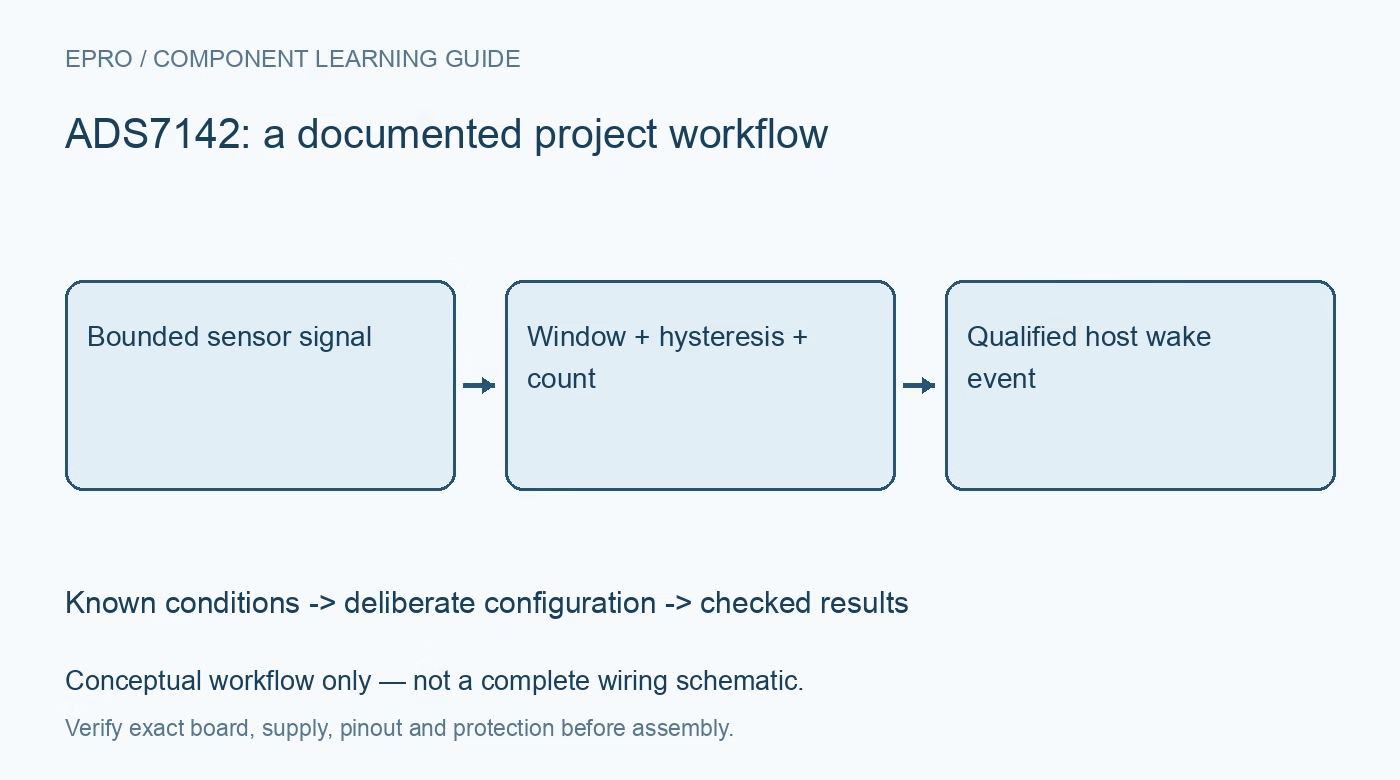
Translate the intended high and low conditions into the documented comparator settings. Include sensor tolerance, normal variation and noise when choosing hysteresis. A window that is too narrow can wake the host repeatedly, while a broad window can miss a relevant condition. Preserve the intended reentry and exit behavior. Do not tune a threshold merely until a demonstration stops triggering; relate it to the application condition and retain the reason for the chosen boundary. Manufacturer documentation.
Newest in the store


5. Use event counting as a time-related policy
The event counter supports qualifying observations rather than treating every crossing as equally significant. Review how the selected sampling behavior and count settings determine the effective response. A count of several observations does not correspond to a universal duration if the conversion cadence changes. Define what resets or advances qualification using the documented behavior. Record that policy alongside thresholds so later changes in timing cannot silently alter the meaning of an accepted wake event. Manufacturer documentation.
6. Interpret buffered data and host handoff
Configure the documented data-buffer behavior and understand which channels, samples and status information it retains. Preserve sample ordering and mode information when the host reads the buffer after waking. Do not assume a buffer is an unlimited event history or that every returned word is a new standalone conversion. Define interrupt handling, status review and rearming deliberately. A host that clears an indication without inspecting its cause can lose the evidence needed to diagnose an unexpected wake. Manufacturer documentation.
7. Evaluate the complete sleep-and-wake cycle
Retain sensor identity, input topology, acquisition mode, thresholds, hysteresis, counter policy, buffer settings and host timing with observations. Assess missed events and unnecessary wakeups through safe controlled procedures and appropriate reference methods. The linked ADS1219 guide describes another acquisition architecture, not matching monitor registers. This ADS7142 workflow proposes traceable event qualification and claims no independent power measurements, universal transient rejection or safety-alarm certification merely because the host can remain asleep between interrupts. Manufacturer documentation.
Related reading: ADS1219 ADC: 7 Checks for a Coherent 24-Bit Sensor Record.
Catalog note: The exact-part search did not return a matching Epro listing during preparation. Check the current catalog; this guide makes no price, availability or included-accessory claim.