


LSM6DSOX IMU: 7 Steps to a Correctly Timed Motion Log

LSM6DSOX IMU: 7 Steps to a Correctly Timed Motion Log
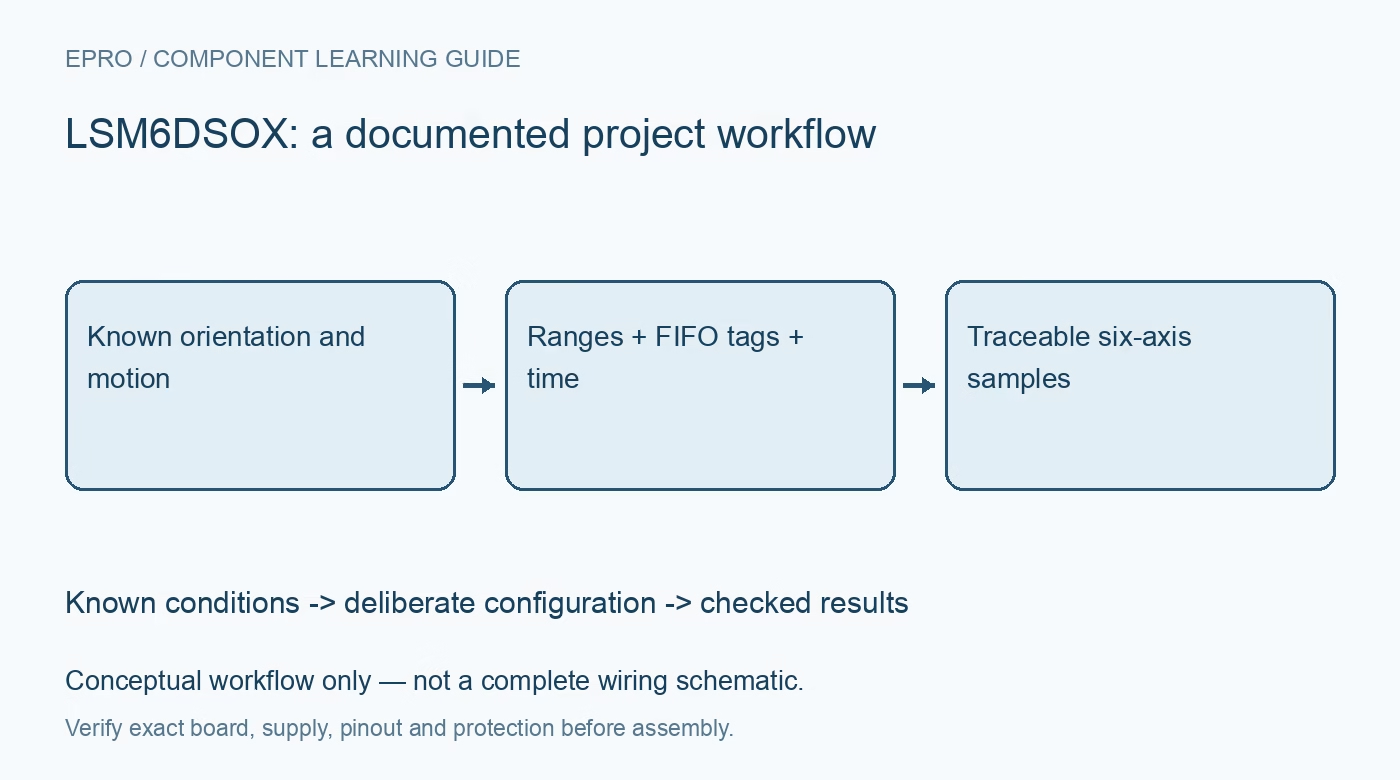
Build an LSM6DSOX motion log with matched ranges, tagged FIFO parsing and timestamp handling before enabling embedded motion classification. This is a documentation-based planning guide, not a report of independent hands-on testing.
1. Define the LSM6DSOX data product
LSM6DSOX combines a three-axis accelerometer with a three-axis gyroscope. ST also documents embedded processing features, including a finite state machine and machine learning core. Begin by deciding whether the project needs raw motion logging, an event detector or a classifier. These are different deliverables. A six-axis sample does not directly provide drift-free position, and an embedded processing block does not arrive as a universally trained recognizer for your particular mechanism. Manufacturer documentation.
2. Establish identity, interface and axes
Confirm the exact carrier schematic, supply and interface selection before applying power. Verify device identity using the documented register rather than relying on a bus scan. Mark the physical axes on the assembly and record its mounting orientation. A diagram for another IMU can reverse an axis or assign a different connector function. Keep the first experiment at low voltage and inspect the logic-level requirements for every connected signal. Manufacturer documentation.
3. Choose ranges and rates together
Select accelerometer and gyroscope full scales for the expected motion, leaving reasonable overload margin. Apply the correct sensitivity for each selected range. Choose output data rates and filters deliberately, then allow settling as documented. A large full scale reduces resolution for small movements, while a narrow scale can clip the event of interest. Store settings with each session instead of embedding an unexplained conversion constant in a plotting script. Manufacturer documentation.
4. Decode the tagged FIFO stream
The FIFO can contain different data types, including acceleration, angular rate, timestamps and configuration information. Read and interpret the tag associated with each entry; do not assume a permanently alternating accelerometer-gyroscope pattern. Begin with an uncompressed configuration before adding compression complexity. Monitor overrun and watermark status. A burst of bytes that fits a buffer is not automatically a complete or correctly ordered history of all enabled channels. Manufacturer documentation.
Newest in the store


5. Reconstruct acquisition time honestly
Distinguish output data rate from FIFO batch rate and host retrieval rate. A sample retrieved after a scheduling delay was not necessarily measured at that instant. Use the documented timestamp format and handle wraparound and any configuration-change records. Mark gaps after overflow instead of joining separated motion segments into a continuous trace. Preserve timing information before attempting integration, frequency analysis or synchronization with a second sensing device. Manufacturer documentation.
6. Validate raw signals before classifiers
At rest, inspect gravity orientation and gyroscope bias. Make a few modest controlled movements and verify axis signs without claiming a precision calibration from hand motion. Only then consider a finite-state program or machine-learning configuration. Record the feature configuration, training basis and expected classes. Test motions outside the intended class set. A classifier output needs application-level evaluation and must not become a safety interlock merely because it runs inside the sensor. Manufacturer documentation.
7. Export a reproducible LSM6DSOX session
Save identity, firmware version, ranges, filtering, output rates, batch rates, timestamps and loss indicators with the raw samples. Compare repeated stationary intervals before judging a motion pattern. The related MPU6050 article provides general IMU background, not a compatible FIFO decoder. A useful LSM6DSOX log preserves the origin and timing of every accepted observation so later processing can distinguish real motion from clipping, bias, missing samples or parser mistakes. Manufacturer documentation.
Related reading: MPU6050 Code: ESP32 Wiring and 7 Reading Checks.
Catalog note: The exact-part search did not return a matching Epro listing during preparation. Check the current catalog; this guide makes no price, availability or included-accessory claim.