


REF3330 Voltage Reference: 7 Checks Before Treating 3 V as Precise

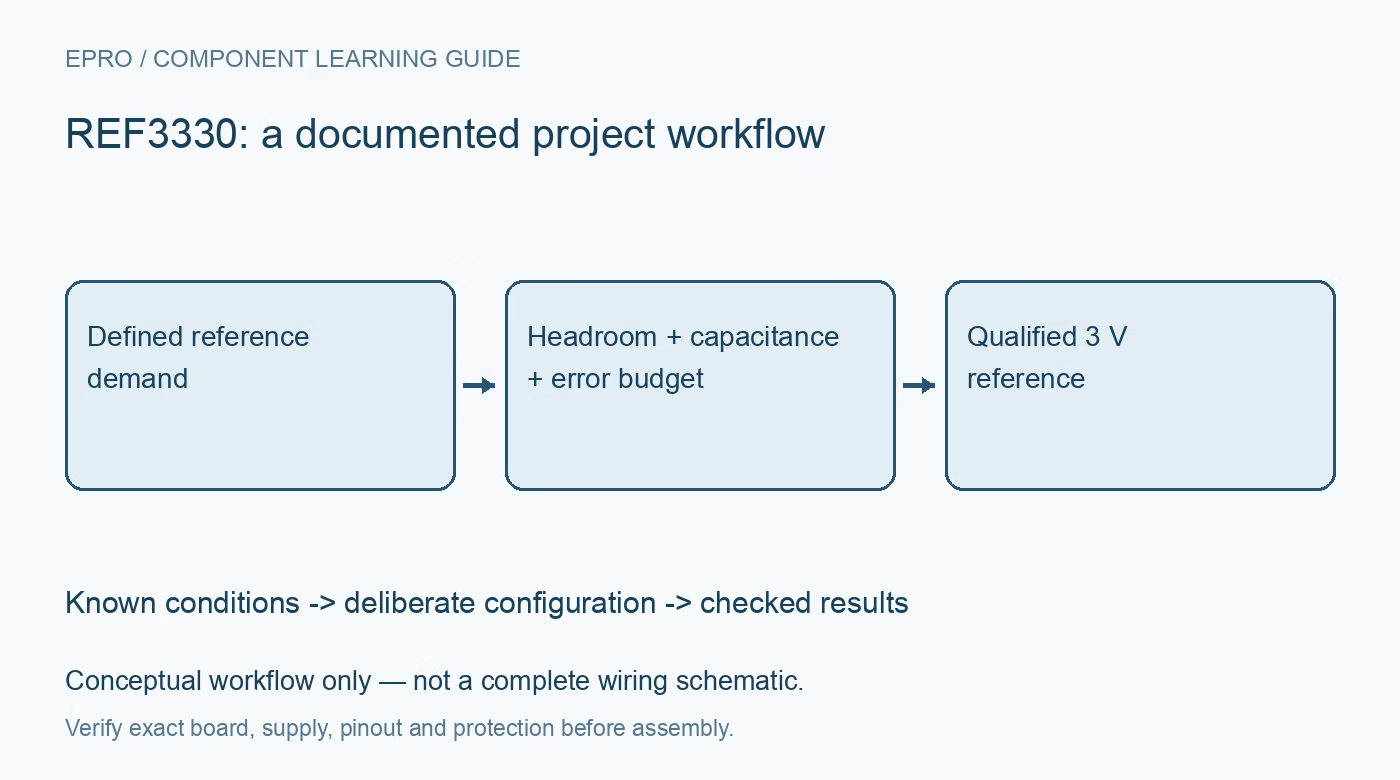
REF3330 Voltage Reference: 7 Checks Before Treating 3 V as Precise
Budget REF3330 reference accuracy, supply headroom, load transients, output capacitance and settling before using nominal 3 V in conversion calculations. This is a documentation-based planning guide, not a report of independent hands-on testing.
1. Confirm the 3 V family member and pinout
REF3330 is the 3 V member of the REF33 reference family. The family document includes several other output voltages and package choices, so verify the complete part and package drawing before using a shared schematic. A nominal voltage label does not identify the installed variant by itself. Record the reference destination, such as an ADC or DAC reference input, together with its loading requirements. Do not treat this precision reference as a general-purpose 3 V power rail. Manufacturer documentation.
2. Separate initial accuracy from operating drift
The family specification includes initial accuracy and temperature drift as distinct contributions. Add the applicable limits to the conversion error budget along with load effects, line effects, noise and other system errors. Use the relevant temperature range and test conditions instead of quoting one headline figure as total accuracy. At 3 V, percentage errors translate into a finite voltage uncertainty that propagates into converter scaling. A display reading exactly 3.000 V is not proof that these errors are absent. Manufacturer documentation.
3. Allow supply headroom at the actual load
A low typical dropout number is not a universal minimum supply margin for every current and temperature. Consult the applicable electrical conditions and curves, including the direction and magnitude of output current. Keep the input supply within recommended limits while allowing sufficient headroom at its lowest point and during transients. Measure at the reference pins, not only at the upstream regulator. A reference that appears correct at no load may lose accuracy when the connected converter becomes active. Manufacturer documentation.
4. Meet the specified capacitance requirements
The REF33 documentation specifies total output capacitance from 0.1 microfarad to 10 microfarads for stability and recommends local input bypassing. Account for the actual installed capacitance, tolerance and voltage dependence rather than the printed nominal value alone. Place components and returns according to the application guidance. Neither omitting the output capacitor nor adding an arbitrarily large reservoir is a justified shortcut. Check any additional filtering or buffering as a complete network with the reference and its intended load. Manufacturer documentation.
Newest in the store


5. Distinguish DC drive from sampling transients
The source and sink capability does not guarantee an arbitrary ADC reference input will settle correctly. Some converters draw dynamic charge pulses, so evaluate the reference input network, sampling rate and local reservoir requirements. A buffer may be appropriate where the converter documentation calls for one, but introduces its own stability and error budget. Observe the reference during actual acquisition. An average current below the headline capability and a quiet meter reading do not establish dynamic reference performance. Manufacturer documentation.
6. Qualify startup without borrowing another variant’s plot
The family documentation includes startup discussion and example curves for particular output options and loads. Use those curves as condition-specific information, not a measured guarantee for every REF3330 assembly. Define a conservative acquisition-enable sequence and verify the actual reference settling under the intended supply ramp and capacitance. Likewise, do not copy a noise figure explicitly identified for another family voltage into the REF3330 budget. Keep device-specific limits, illustrative family curves and measured board results clearly separated. Manufacturer documentation.
7. Save the reference conditions with the conversion result
Compare the settled output with suitable measurement equipment and an uncertainty appropriate to the requirement. Record input voltage, output load, capacitance, temperature, startup delay and whether the attached converter was acquiring. Carry reference uncertainty through subsequent voltage or resistance calculations instead of treating nominal 3 V as exact. This guide offers a documentation-based qualification plan, not independent reference measurements. Recheck dynamic behavior whenever sample rate, converter type, buffering or power sequencing changes, even if the nominal voltage remains unchanged. Manufacturer documentation.
Related reading: DAC60501 DAC: 7 Checks for a Predictable Voltage Output.
Catalog note: The exact-part search did not return a matching Epro listing during preparation. Check the current catalog; this guide makes no price, availability or included-accessory claim.