


SCD30 CO2 Sensor: 7 Checks for Fresh, CRC-Checked Data

SCD30 CO2 Sensor: 7 Checks for Fresh, CRC-Checked Data
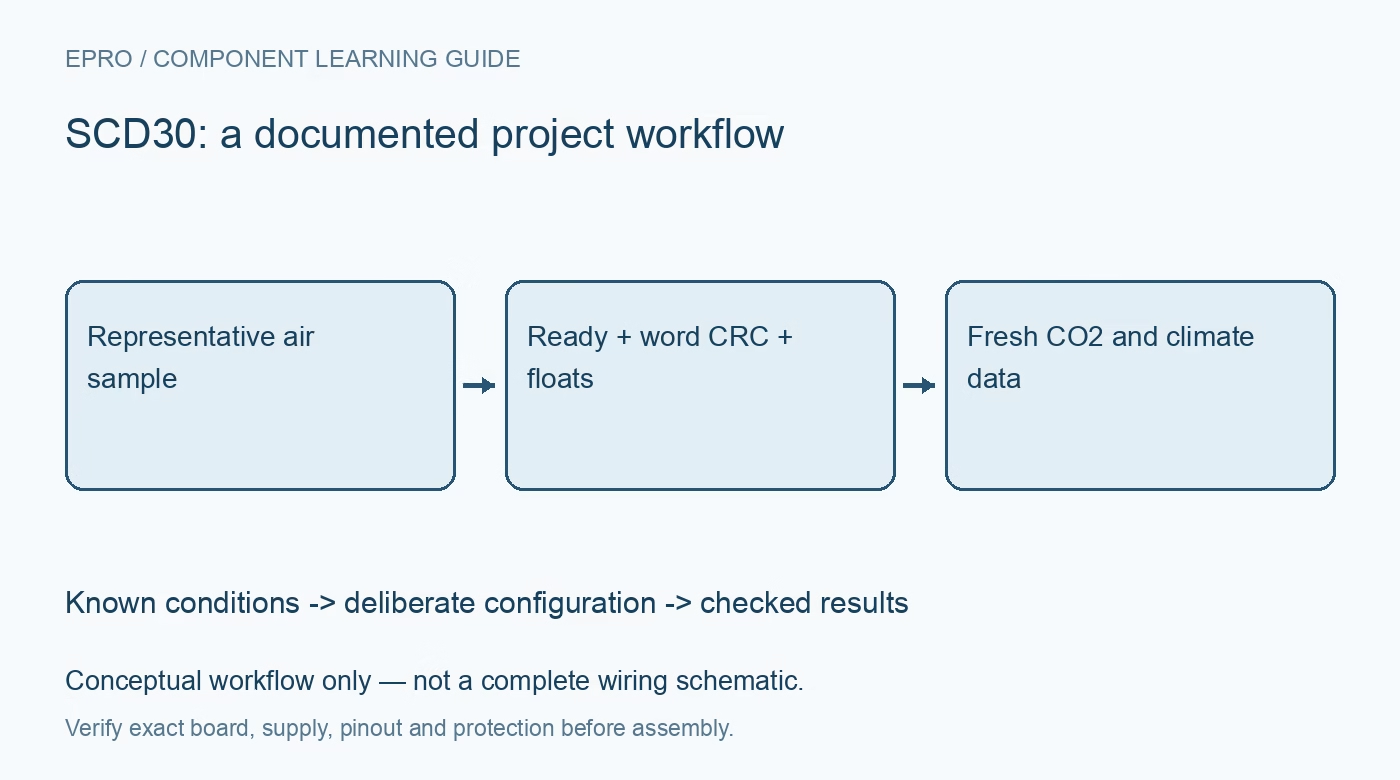
Plan SCD30 CO2 acquisition with compatible clock stretching, command framing, per-word CRC, float decoding and documented calibration conditions. This is a documentation-based planning guide, not a report of independent hands-on testing.
1. Define the SCD30 air measurement context
SCD30 uses an optical carbon-dioxide measurement principle and also reports humidity and temperature information. Begin with a representative sampling location rather than placing it beside a person’s breath and calling the result a room average. Document enclosure airflow, heat sources and installation position. The sensor is not a complete ventilation controller or a certified life-safety alarm. A useful acquisition plan defines what air is being observed and how that observation will be used. Manufacturer documentation.
2. Check clock stretching and command framing
Use an I2C controller and driver compatible with the SCD30 interface requirements, including clock stretching. Follow the specified command transactions rather than assuming a generic register-read helper will produce the correct framing. The interface description also documents restrictions that differ from some common repeated-start patterns. Inspect the actual library behavior and timeout handling. A controller that scans the address successfully can still fail during a real command or measurement-data transaction. Manufacturer documentation.
3. Configure measurement operation deliberately
Record the intended measurement interval and any supported compensation settings before starting periodic acquisition. Follow the documented parameter encoding and command sequence, including integrity bytes where required. Do not repeatedly restart measurement merely to refresh a display. Distinguish configuration changes from ordinary sample reads so the application’s behavior remains interpretable. Where pressure or altitude compensation is used, document the source and meaning of the parameter rather than supplying a guessed value to a sample sketch. Manufacturer documentation.
4. Check readiness rather than trusting a delay
Use the data-ready mechanism to decide whether a new observation is available. A fixed sleep interval can be convenient, but it is not evidence that a particular read returns fresh data after every startup or communication interruption. Define how the application handles not-ready, timeout and failed transactions. Preserve the sample time and validity state with the result. Repeating the last good value without a stale indication can make a disconnected sensor appear to be functioning. Manufacturer documentation.
Newest in the store


5. Validate each word before float reconstruction
The interface protects transmitted 16-bit words with CRC information, while measurement values are represented as floating-point data. Validate and remove the integrity bytes according to the documented arrangement, then reconstruct the big-endian IEEE 754 values correctly. Do not interpret the first payload word as a complete integer CO2 reading. Keep byte order explicit and reject malformed or non-finite results. A reasonable-looking number is not an adequate substitute for checking framing, integrity and field interpretation. Manufacturer documentation.
6. Treat calibration as an environmental procedure
Automatic self-calibration depends on appropriate exposure conditions, not simply on enabling a feature. Forced recalibration requires a defensible reference and the documented procedure; outdoor concentration should not be assumed to equal an arbitrary universal constant. Temperature offset is intended to account for a known installation influence, not to cosmetically repair unexplained errors. Record the calibration policy, reference conditions and enclosure revision. Never calibrate against a short uncontrolled breath exposure or an unknown room concentration. Manufacturer documentation.
7. Preserve quality flags with the climate record
Keep readiness, CRC outcomes, acquisition times, compensation settings and calibration history with CO2, humidity and temperature results. Evaluate the finished installation against appropriate reference methods before making accuracy or air-quality control claims. The related SCD40 guide concerns a different sensor family and is not an interchangeable command implementation. This SCD30 workflow is documentation-based: it proposes traceable acquisition checks without claiming independent chamber measurements, universal ventilation thresholds or certification of a complete environmental monitoring product. Manufacturer documentation.
Related reading: SCD40 Arduino: 7 Ready, CRC and Configuration Checks.
Catalog note: The exact-part search did not return a matching Epro listing during preparation. Check the current catalog; this guide makes no price, availability or included-accessory claim.