


Servo Motor Price in Pakistan: 7 Selection Checks

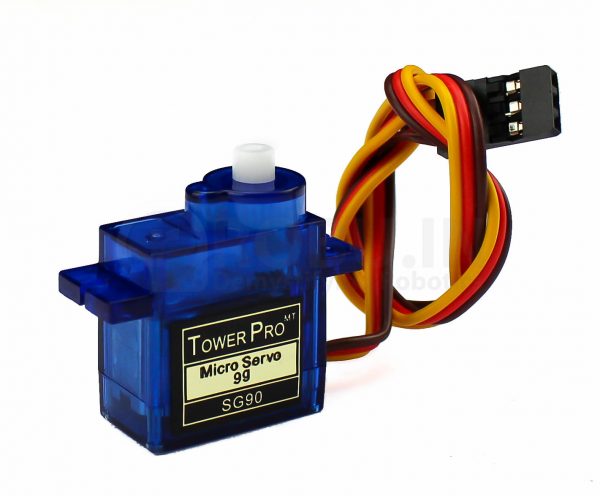
Servo motor price in Pakistan varies with size, gear construction, rotation type and the exact package. A small SG90 for a lightweight demonstration is not equivalent to a larger MG996R, and a continuous-rotation model does not behave like an ordinary positional servo.
This guide compares Epro catalog listings and the checks that matter before adding one to a robot, pan-tilt mechanism or classroom project. The comparisons are based on listed products, not independent load or durability tests.

Servo motor price in Pakistan: current listing snapshot
| Listed item | Listed price (PKR) | Role |
|---|---|---|
| Tower Pro SG90 9G Micro Servo Motor with Accessories Blue | 320 | SG90 micro positional servo listing |
| MG90S Metal Gear Micro Servo Motor in Pakistan | 440 | MG90S metal-gear micro servo listing |
| Servo Motor MG996R -180 degree in Pakistan | 880 | MG996R 180-degree listing |
| MG996R 360 Degree All Metal Gear Servo Motor In Pakistan | 1,190 | MG996R 360-degree listing |
| PCA9685 16 Channel Servo Motor Driver in Pakistan | 1,200 | PCA9685 controller board, not a motor |
Price check: Epro listings checked on 18 October 2026. Prices are a dated snapshot, not a quotation. Confirm the current price, availability, delivery charges and package contents on the linked product page before ordering.
Do not compare a driver board’s price with a complete servo. For a working assembly, budget for the motor, regulated power supply, controller, horn and mounting arrangement. Verify whether the seller includes horns and screws, and inspect the exact variant rather than assuming all similarly named listings are identical.
1. Decide between position and continuous rotation
A positional servo receives a command representing a target position within its supported travel. A continuous-rotation servo generally interprets the control signal as direction and speed around a neutral point. It will not hold a requested angular position simply because a sketch uses a function named write().
The two MG996R listings above explicitly distinguish 180-degree and 360-degree variants. Select the right operating principle first. A wheel-drive demonstration and a camera tilt joint have different needs even when their motors share a similar case.
2. Work out the load and lever arm
Torque requirements depend on both force and distance from the shaft. Moving the load farther out on the horn increases the required torque. Allow for acceleration, friction and a safety margin rather than designing around a headline stall-torque number. A servo stalled against a hard stop can draw high current and overheat.
The SG90 listing gives torque figures associated with particular supply voltages. Those are catalog claims, not a promise that every sample will continuously lift the stated load. Do not treat a kilogram-centimetre torque figure as a direct kilogram lifting capacity independent of the horn length.
Newest in the store


3. Match physical dimensions and mounting
A micro servo may fit a small bracket while a larger servo does not. Check body size, mounting tabs, output shaft and horn compatibility. A pan-tilt bracket is a mechanical accessory, not evidence that your selected motors and payload will fit or balance correctly.
Keep cables clear of moving parts. Test the mechanism with the load removed before fastening a horn in its final orientation. Mechanical interference is often easier to prevent on the bench than to diagnose after a closed enclosure has been assembled.
4. Provide a suitable power supply
Servo current changes substantially with motion and load. Do not assume the controller’s small regulator or USB connection can supply the entire project. Choose a regulated supply within the exact servo’s voltage range and with enough current capacity for the intended motion, including realistic simultaneous demand.
A separate servo supply normally needs a common ground with the controller for the control signal, but its positive output should not be casually tied into another power source. Confirm the board’s power architecture before combining rails. More voltage is not a safe shortcut to more torque.
5. Treat metal gears as one feature, not a guarantee
Metal gears may suit some mechanical demands, but gear material alone does not prove accuracy, quiet operation, authenticity or long life. Backlash, electronics, bearings and assembly quality also matter. If precision is critical, select from documented specifications and test the actual mechanism under its expected load.
6. Plan control channels and accessories
A basic Uno demonstration can drive a servo signal directly with the Servo library. A multi-servo build may use a controller such as the PCA9685 16-channel board, but that board does not eliminate the need to size and distribute motor power correctly. A servo tester can assist bench checks; it is not a power supply or torque measuring instrument.
7. Start with a small, verifiable build
For a lightweight introductory mechanism, follow the SG90 Arduino wiring and code guide and begin without a mechanical load. For other motion types, compare the stepper motor buying guide. Arduino’s servo motor guide explains the control and external-supply arrangement used in a typical beginner setup.