


100 Watt Soldering Iron: 7 Uses and Safety Checks

Last checked: 18 October 2026. Any prices below are dated Epro listing examples, not guaranteed current quotations. Confirm the exact model, stock and package before ordering.
A 100 watt soldering iron can be useful where a joint draws substantial heat, but it is not automatically better for every repair. Available heating power, temperature control, tip geometry and the workpiece all affect the result. Choosing by wattage alone can lead to damaged pads, overheated insulation or an unsuitable tool.

This guide covers tool selection and safe workshop practice. It does not provide instructions for working on live mains equipment or soldering directly to unprotected lithium cells. De-energize equipment and follow the device manufacturer’s service procedures.
1. Understand what a 100 watt soldering iron rating means
The wattage is a heating-power rating, not a direct statement of operating tip temperature or temperature accuracy. A controlled station and an uncontrolled iron with the same nominal power can behave differently. Check how the particular tool senses and controls temperature, and avoid assuming that a numbered dial is calibrated.
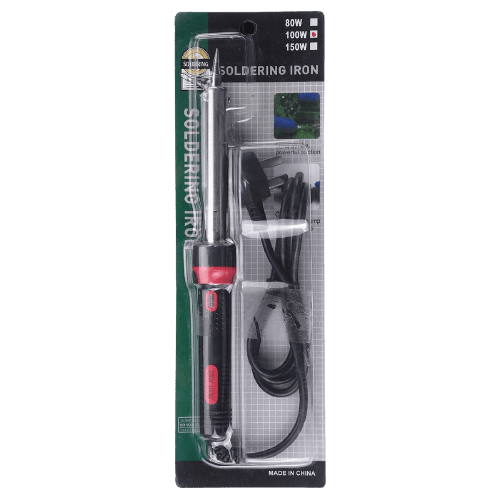
Epro’s Suoer 100W soldering iron listing — PKR 1,290 is one checked example. Confirm the actual model, supply requirements, included stand and tip compatibility. This guide is not an independent performance test or endorsement of that product.
2. Match heat delivery to the workpiece
Large terminals, heavier wire joints and some connectors can remove heat quickly from a tip. A suitable higher-power tool may recover better than an underpowered one. However, nearby plastic, insulation and components still have temperature limits. The correct approach is controlled heat transfer, not leaving a hot tip on the work indefinitely.
A high-power iron is not an all-purpose method for soldering large metal structures. Materials, joint design and the required soldering process determine the appropriate equipment. If the tool documentation does not support the task, choose a better-suited method rather than improvising.
3. Select useful tip contact area
A fine needle-like tip can transfer heat poorly to a large joint. A properly sized chisel or other suitable geometry may provide better contact. It must also fit the joint without touching neighboring parts. Check the tool maker’s tip system and do not modify incompatible tips to make them fit.
4. Be cautious with delicate circuit boards
Small surface-mount pads and multilayer phone boards require controlled technique and suitable equipment. A basic high-power iron may be inappropriate even when it heats quickly. Excessive temperature or long dwell time can lift pads and damage components. Practice on scrap boards and use the mobile repair tool checklist for that work.
Newest in the store


Do not assume a 100 watt soldering iron is safer for delicate work simply because it can finish a joint faster. That depends on temperature regulation, contact area, operator skill and the workpiece.
5. Plan electrical and burn protection
Inspect the plug, lead, handle and stand before use. Follow the stated supply voltage and grounding requirements. Never use a damaged cord, expose live connections or open a mains-powered tool without appropriate qualifications. Keep the lead positioned so it cannot pull the iron off the bench.
Use a stable heat-resistant stand and keep combustible items clear. Treat the tip and surrounding metal as hot even after switching off. Let the tool cool before changing accessories unless the manufacturer explicitly provides a safe hot-change procedure.
6. Control fumes and residues
A larger tool does not remove the need for fume extraction. Avoid overheating flux and keep your head out of the plume. HSE identifies rosin-based solder flux fume as a cause of occupational asthma. Follow the solder and flux safety data, use appropriate extraction and wash hands after handling solder.
Wear eye protection where splashes or clipped leads are possible. Keep food and drinks away from the work area. Lead-free solder is not a reason to ignore flux fumes, hot surfaces or residue handling.
7. Compare the complete setup cost
Include tips, a suitable holder, cleaning materials, solder, flux and extraction rather than comparing only the iron’s price. Check whether replacement heaters and tips are available. For a broader view of basic irons, portable tools and stations, see the soldering iron buying guide.
Frequently asked questions
Does 100W mean the tip is twice as hot as a 50W iron?
No. Wattage and temperature are different quantities; control design and thermal loading affect tip temperature.
Can it replace a hot-air station?
No. The tools deliver heat differently, and some repairs need equipment and training that a soldering iron alone cannot provide.