


Buck Converter Price in Pakistan: 7 Buying Checks

Last checked: 18 October 2026. Product prices and availability, where shown, are a snapshot of Epro listings checked on this date. Confirm the live listing before ordering.
The buck converter price in Pakistan varies with input range, output current, cooling, adjustment controls and protective features. A small adjustable module and a larger constant-current supply are not equivalent just because both reduce DC voltage.

This guide is for low-voltage DC electronics. A buck converter module is not a mains AC adapter and should never be connected directly to a wall outlet. Use a suitable isolated DC supply where required, and choose ratings from the exact module documentation.
Buck converter price in Pakistan: listing examples
The following checked Epro listings illustrate different module classes. Product names may contain advertised maximum ratings; those names do not establish a safe continuous operating point in your enclosure.
- Mini MP1584 step-down module — PKR 145
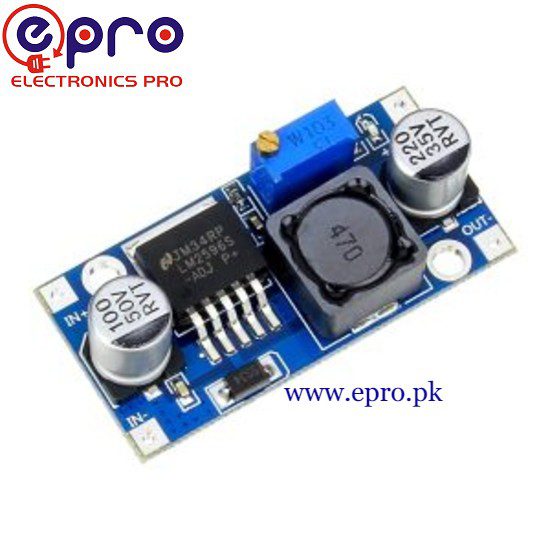
- LM2596 adjustable step-down module — PKR 180
- XL4015 step-down module — PKR 280
- LM2596 module with display — PKR 470
- Buck-boost module with LCD — PKR 1,450
The final example is included as an alternative topology, not as a basic buck-only module. Check buck-boost converter selection guide if your supply can move above and below the output voltage you need.
1. Establish the full input-voltage range
A “12V” battery does not stay at exactly 12V. Its charging voltage and discharge range depend on chemistry and configuration. Check the module’s supported input range against the actual source, including expected variation. Do not use a board close to a headline maximum without adequate design margin.
2. Confirm that step-down conversion fits
A buck converter reduces DC voltage. It cannot maintain a higher output when the input falls below what the circuit needs. A 5V source cannot produce a regulated 12V output through a buck-only module. In practical designs, allow the voltage headroom required by the particular converter.
3. Estimate output power, not current alone
A 5V, 1A load needs 5W at the output. Input power will be higher because the converter is not perfectly efficient. If efficiency were 85% in a worked example, 5W output would require about 5.9W input. That efficiency is an illustration, not a measured specification for the listed products.
Newest in the store


4. Separate chip ratings from board capability
A regulator IC’s headline current is not a guarantee for every low-cost module built around it. Inductor heating, diode ratings, copper area, connectors and airflow all affect continuous operation. Texas Instruments describes the LM2596 as a step-down regulator, but a complete board still needs appropriate thermal design.
5. Choose adjustment and protection features
A display can make setup convenient, but it does not replace a trusted meter or prove calibration. Check whether the module provides voltage adjustment only or also current limiting. Short-circuit, reverse-polarity and over-temperature protection must be confirmed from documentation, not assumed from appearance.
6. Budget for installation details
Consider insulated mounting, terminals, a fuse appropriate to the circuit, a suitable enclosure and cooling. Exposed boards can short against metal surfaces. A loose adjustment screw or poor terminal can cause a fault even when the converter IC itself is correctly specified.
7. Test before connecting valuable electronics
Set the output without the final device attached, verify polarity and voltage with a meter, then test using an appropriate safe load. Check output under load and monitor temperature. See LM2596 adjustment guide for an adjustment workflow. Never treat a voltage-only module as a lithium battery charger unless it has the required charging control and protections.
Frequently asked questions
Is a more expensive module always better?
No. Select the correct voltage range, tested load capability and features for the job. Extra power capacity is not useful if the minimum input or output range is unsuitable.
Can I power an ESP32 through any 5V output?
Check board input requirements, ripple, transient behavior and available current. An ESP32’s 3.3V pin must not receive 5V.
Are these nationwide prices?
No. They are dated examples from Epro’s own listings. Compare the live package and delivery costs before buying.