


Buck Boost Converter: 7 Checks Before Choosing

Last checked: 18 October 2026. Product prices and availability, where shown, are a snapshot of Epro listings checked on this date. Confirm the live listing before ordering.
A buck boost converter can be the right choice when a DC supply moves both above and below the voltage your load needs. However, the product label alone is not enough: some circuits invert polarity, some maintain the same polarity, and module current ratings can mean different things.

This selection guide concerns low-voltage DC projects, not direct mains wiring. Use the exact converter’s documentation and choose an enclosed, appropriately rated supply where required.
Buck boost converter versus buck and boost
| Converter type | Basic role | Main selection question |
|---|---|---|
| Buck | Steps voltage down | Does input always stay sufficiently above output? |
| Boost | Steps voltage up | Does the input stay within the supported lower range? |
| Buck-boost | Can regulate across a suitable input range above and below output | What topology, polarity and current limits does this particular design use? |
A traditional inverting buck-boost produces opposite output polarity. Many hobby modules sold as buck-boost use a non-inverting arrangement. Read the terminal markings and datasheet; never assume these designs are interchangeable.
1. Map the source’s real voltage range
Battery voltage changes with chemistry, state of charge and charging conditions. Write down the minimum and maximum expected input rather than using the battery’s nominal label. Include startup behavior and reasonable design margin. The converter must remain inside its rated operating range throughout the intended use.
2. Calculate output power
Suppose a load needs 12V at 1A: its output requirement is 12W. With an illustrative efficiency of 85% and a 6V input, the source current would be about 12 ÷ (6 × 0.85), or 2.35A. This is a worked example, not a measured efficiency claim for an Epro product.
The example shows why current on the input side can be greater than output current. Check the battery, switch, connector and wiring as well as the converter. When a source cannot supply the required current, a higher output-voltage setting does not solve the power shortfall.
3. Read what the current rating actually means
A rating may refer to switch current, peak current or a thermally limited operating condition rather than continuous output current. Confirm performance at your actual input and output voltages. A module that works at one ratio may have less available output power at another.
Newest in the store


4. Check the output polarity and reference
Identify whether input negative and output negative are common, isolated or part of an inverting arrangement. Incorrectly joining grounds can damage equipment in some topologies. A basic non-isolated converter does not become an isolated supply simply because it has separate input and output terminals.
5. Look for the protections your load needs
Check undervoltage behavior, overcurrent protection, thermal protection and reverse-polarity requirements in the actual documentation. Battery undervoltage protection is particularly important for rechargeable packs. A voltage regulator is not automatically a charger or a battery-management system.
6. Plan setup and cooling
Adjust the converter without the final device attached, verify with a meter and test under a suitable load. Watch for heating and unstable output. A display is convenient, but it does not establish calibration or reveal every ripple and transient issue. Keep bare boards away from conductive mounting surfaces.
7. Compare a real listing against the requirement
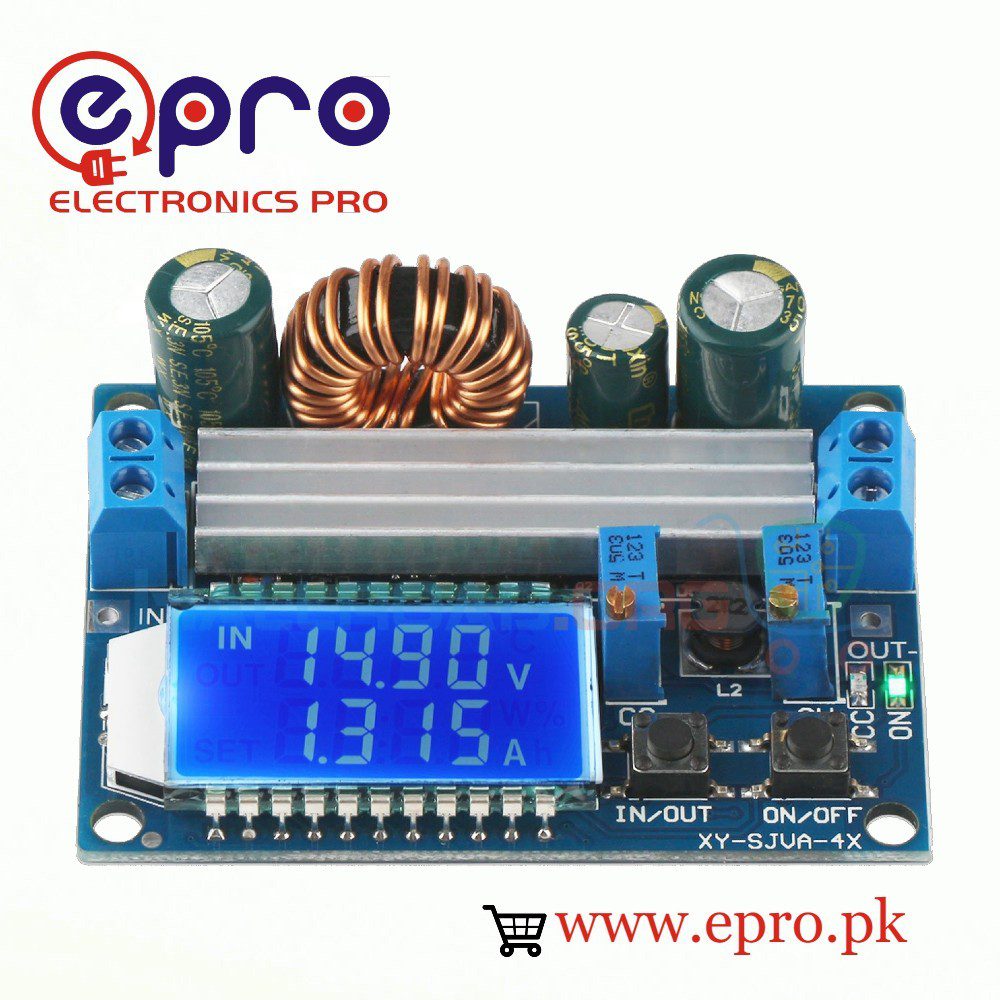
Epro’s buck-boost module with LCD — PKR 1,450 is a checked example of a listing in this category. Its name includes an advertised current value; verify continuous capability for your voltage ratio, cooling and enclosure before selecting it. Confirm the live listing, package contents and supported range before purchase.
When a simpler converter is better
If your source always stays comfortably above the needed output, a suitable buck converter may be simpler. See buck converter buying guide and LM2596 adjustment guide for step-down selection and setup. A buck-boost circuit is not inherently better for every project; choose the simplest topology that meets the real operating conditions.
Frequently asked questions
Can I make a power bank with any buck-boost board?
Not safely from voltage conversion alone. Cell protection, charging control, output regulation and mechanical safety all need a complete design.
Does constant output mean constant power capability?
No. Available current and thermal limits can change with input voltage. Check the operating curves or test data for the exact converter.