


DS1307 vs DS3231: 7 RTC Module Buying Checks

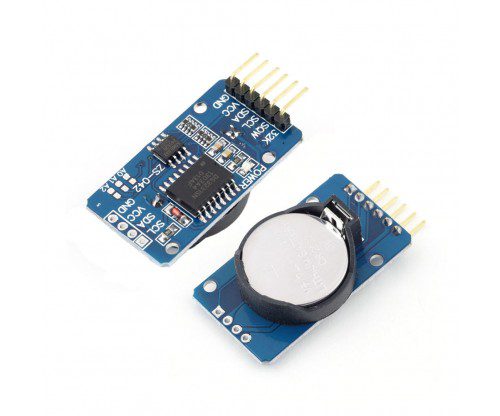
DS1307 vs DS3231 is a useful comparison when a project needs to keep calendar time without a continuous internet connection. Both families can provide real-time-clock functions, but the oscillator arrangement, electrical requirements and exact module design matter more than a similar-looking battery holder.
This guide compares Epro listings and selection principles. It does not claim that a supplied clock has been independently calibrated, or that every board sold under a broad DS3231 title contains the same chip variant.

DS1307 vs DS3231: compare modules, not just names
| Listed item | Price (PKR) | Selection note |
|---|---|---|
| RTC I2C Module DS1307 AT24C32 Real Time Clock Module in Pakistan | 150 | DS1307 RTC module listing |
| DS3231 Real Time Clock RTC Module in Pakistan | 370 | DS3231-labelled module; verify DS3231 or DS3231M marking |
| DS1307 PDIP-8 Real Time Calendar and Clock IC in Pakistan | 70 | DS1307 IC only, not a complete module |
Price snapshot: Epro product listings checked on 18 October 2026. Prices and availability can change. Confirm the live listing, delivery charges and supplied accessories before ordering; these figures are not a quotation or a claim of independent product testing.
A bare clock IC needs supporting hardware and is not a direct replacement for a ready-to-wire module. Also confirm the battery package separately: the DS1307 listing has inconsistent battery wording, while the DS3231 listing states that a battery is not included. Do not assume a pictured cell is supplied.
1. Understand the oscillator difference
A conventional DS1307 design uses an external clock crystal, and practical drift depends on that crystal and board implementation. The DS3231 integrates a temperature-compensated crystal oscillator. That can make the DS3231 attractive when keeping time across changing temperatures matters, but exact accuracy claims still belong to the exact chip and specified conditions.
The Analog Devices DS3231 datasheet documents its own specifications. Do not apply those numbers automatically to a different part merely because the module’s title is similar.
2. Check DS3231 versus DS3231M markings
The Epro DS3231 module listing also refers to DS3231M in its description. DS3231 and DS3231M are distinct variants with different oscillator technology and accuracy specifications. Ask for confirmation of the actual chip marking before making a precision claim or ordering a quantity.
If the project has a strict drift budget, select a documented part from a source that can confirm the supplied variant. A general hobby listing and an unverified photograph are not a calibration certificate.
3. Match supply and I2C signal levels
Verify the complete module’s supported voltage, not just the core IC’s capability. Supporting EEPROMs, resistors and pull-ups can affect compatibility. A module powered from 5 V may pull SDA and SCL up to 5 V, which should not be assumed safe for a 3.3 V-only controller.Newest in the store


A conventional Uno can be a convenient starting point for an appropriately rated module. An ESP32 or Raspberry Pi connection requires its own voltage review. A common I2C connector does not provide automatic level shifting.
4. Inspect the backup-battery circuit
A coin-cell holder does not prove that any cell of the same size is suitable. Some inexpensive modules include a charging path, while others are designed for a non-rechargeable backup cell. A primary CR2032 must not be charged. Verify the exact board circuit and approved battery chemistry before installing a cell.
The presence of both LIR2032 and CR2032 in a listing is not enough evidence of safe interchangeability. Start the bench test without a battery until compatibility is resolved. Do not modify an unfamiliar charging circuit as part of an introductory tutorial.
5. Check software support and first-time setting
Use a library matched to the actual RTC. Adafruit RTClib supports several clock families, but the class and initialization calls need to match the hardware. A clock chip does not automatically know the correct time when it is first powered.
Set the time deliberately and avoid resetting it to sketch compilation time on every restart. A successful I2C response proves communication, not that the stored date, year or time zone is correct.
6. Separate timekeeping from extra features
An onboard EEPROM is separate storage, not automatic logging. A spare temperature-sensor footprint is not proof that a sensor is fitted. RTC alarm outputs and square-wave pins also need explicit software and electrical configuration before they can perform a useful function.
7. Choose for the complete application
A classroom clock and a long-running data logger can have different accuracy and backup needs. Follow the DS3231 with Arduino setup guide for a modest serial-monitor test, and confirm the exact supplied variant before depending on a datasheet specification. Neither clock alone provides internet synchronization, timezone rules or tamper-resistant timestamps.