


NRF24L01 Radio: 7 Checks Before Buying

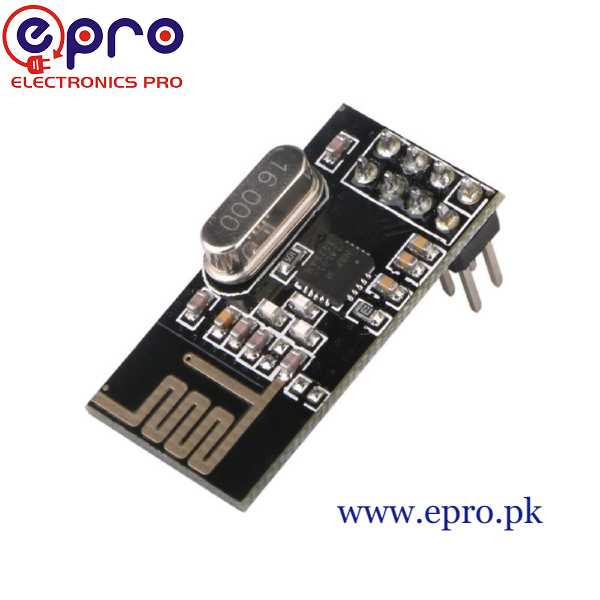
An NRF24L01 can provide a small packet-radio link between microcontroller projects. It operates in the 2.4 GHz band, but it is not a Wi-Fi adapter or a Bluetooth serial module that a phone can automatically discover.
The useful buying questions concern the radio variant, regulated supply, antenna and the second endpoint. This guide separates those requirements from optimistic distance claims and does not report an independently tested wireless range.

NRF24L01 prices and module packages
| Listed item | Price (PKR) | Project role |
|---|---|---|
| NRF24L01 Wireless Transceiver in Pakistan | 180 | Standard wireless transceiver module |
| 2.4GHz NRF24L01 + PA + LNA Wireless Modules with Antenna | 800 | PA/LNA antenna-equipped module |
| VCC Adapter Board for NRF24L01 5V 3.3V Wireless Module in Pakistan | 190 | Separate supply adapter board, not a radio by itself |
Price snapshot: Epro listings checked on 18 October 2026. Confirm the current price, availability, delivery charges and package quantity on the linked page before ordering. These are dated listing prices, not a quotation or an independent performance test.
The standard transceiver is a sensible starting package for a short bench link. The PA/LNA version adds RF circuitry and an external antenna arrangement. The supply adapter is a supporting power board; buying it alone does not provide the radio link.
1. Budget for two compatible endpoints
A simple demonstration needs a transmitter and a receiver, usually two controllers and two radios. A single transceiver is not a complete phone-compatible wireless connection. Each endpoint also needs its own wiring and a stable supply.
The radio can transmit and receive, but a starter application still defines when each endpoint listens or sends. Do not interpret six receive data pipes as six simultaneous independent RF channels or as a complete network protocol supplied automatically by the board.
2. Keep the radio supply in range
The Nordic product specification gives a 1.9–3.6 V supply range. The familiar bare module is normally used from a suitable regulated 3.3 V source, never directly from 5 V VCC.
Some documented radio inputs are 5 V tolerant under stated supply conditions. That does not make the power pin 5 V tolerant. Confirm the actual supplied device and module, and distinguish the regulator adapter’s input from the radio’s own supply connection.
3. Treat supply stability as part of communication
Short power wires and suitable local decoupling matter. A radio that initializes over SPI can still fail when transmitting or acknowledging packets if its supply is noisy. An indicator LED on a regulator board does not establish transient performance.
Newest in the store


The RF24 troubleshooting guide highlights this issue and discusses local capacitors. PA/LNA modules have greater peak-current demands than standard modules, so do not assume a controller’s small 3.3 V regulator can supply every version.
4. Choose antenna hardware for the installation
A compact PCB antenna and a module with a PA/LNA stage are different RF packages. More advertised transmit power does not remove interference, obstructions or a poor ground and power arrangement. Check antenna clearance and the intended enclosure.
Do not promise a kilometre through walls from an open-area catalog claim. Range depends on both endpoints, data rate, antennas and environment. Follow applicable local radio requirements and use an antenna appropriate for the actual module.
5. Match settings on both radios
Channel, on-air data rate, address, payload configuration and acknowledgment settings must agree appropriately. The controller’s Serial Monitor baud rate is separate from the radio’s on-air data rate; changing one does not configure the other.
A library returning success from local initialization proves only part of the path. A packet test should also confirm reception and acknowledgments. Treat repeated retries or lost packets as a fault to investigate, not as proof that the link is reliably delivering every application command.
6. Separate packet delivery from application safety
The driver does not automatically provide a secure command format, encryption policy or a safe response when the link disappears. A small counter demonstration is a better first project than remote control of a hazardous load.
Acknowledgment means the radio transaction completed under its configured protocol, not that a physical action was performed correctly. A finished controller needs validation, timeouts and an appropriate independent safety arrangement for the consequences involved.
7. Start with the standard module and a short test
Follow the NRF24L01 Arduino wiring and two-radio code guide before buying higher-power hardware to fix an unexplained failure. Prove wiring, supply and matching settings first, then test the intended installation with realistic interference and a suitable performance margin.