


MT3608 Boost Converter: Choosing a Module That Fits

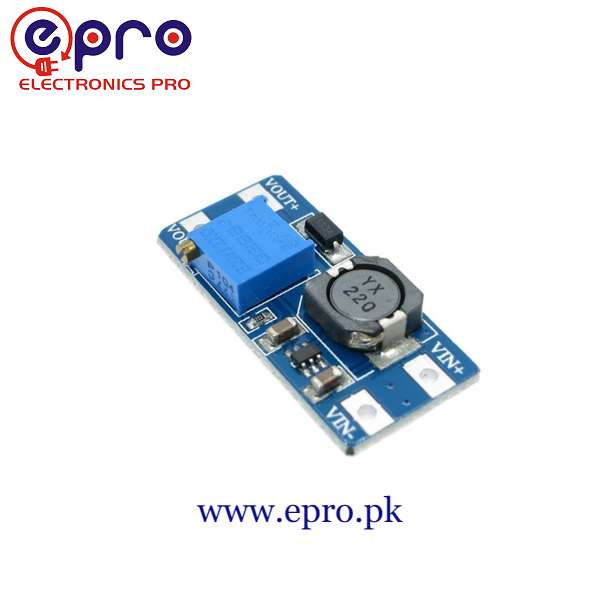
The MT3608 is a step-up converter IC commonly used on small adjustable power modules. It can raise a suitable DC input voltage, but the module’s size and an advertised current figure do not establish its continuous output capability. Use this selection guide before choosing one for sensors, a small display or another low-power electronic load.
Understand the job: step up, not automatically step down

A conventional MT3608 module is a boost converter. It is not the right choice when the source can rise above the required regulated output. For example, a source that varies both above and below a fixed output generally needs a suitable buck-boost solution. Check the actual module topology instead of assuming every adjustable DC converter can regulate in both directions.
Budget power before comparing amperes
Output power is output voltage multiplied by load current. The input must supply that power plus losses. As an illustrative calculation, a 9 V load drawing 100 mA needs 0.9 W. From a 5 V source at an assumed 85% efficiency, input current would be about 0.212 A. That efficiency is a planning assumption, not a measured result for the listed module. Startup peaks can be higher than the steady load.
The point is that input and output current are not interchangeable. Raising voltage normally requires more input current than the output current for the same power. Include wire and connector losses, source capability and the load’s startup behavior in the budget.
Read IC ratings and module limitations separately
The datasheet describes an IC under stated conditions. A finished low-cost board also depends on its inductor, diode, capacitors, copper area, assembly and airflow. A switching-current or marketing label must not be presented as a guaranteed continuous output rating. If the seller cannot provide a tested operating envelope, use conservative loads and validate your actual source, output setting and ambient conditions.
Match the source and the load
Choose an input within the documented range of the complete module and a target voltage within the ratings of every component and the load. Do not select a setting solely because a no-load meter can display it. Check the source’s current limit and the load’s minimum and maximum supply voltage. This module is not a substitute for a battery charger, battery protection circuit or an isolated power supply.
Plan adjustment before connection
Keep the load disconnected while setting output with a suitable voltmeter and current-limited bench source. Identify IN and OUT polarity from the actual board. Some trimmers require several turns before the meter changes; there is no universal clockwise direction across all board revisions. Adjust slowly, verify the voltage and disconnect input power before attaching the load.
Newest in the store


Inspect thermal and mechanical details
Allow space for airflow, secure the board so its underside cannot short to metal and use wiring appropriate to input current. A small module hanging from a solder joint is not a reliable final installation. Stop if the output becomes unstable, the source current limit is reached or a component heats abnormally. Reduce the load and investigate instead of treating a hot board as a successful full-power test.
Record a realistic acceptance check
Measure input and output voltage with the intended load operating, including startup if the equipment allows it. Compare the regulated output with the load specification and watch for resets or droop. A multimeter does not characterize fast ripple or transient peaks; sensitive analog or RF applications may need further filtering and appropriate measurements. Keep the result tied to the exact board, load and conditions rather than claiming it validates every MT3608 module.
Epro parts and availability
These are relevant Epro listings, not independent authenticity or performance certifications. Prices below were checked on 19 October 2026; they are a dated snapshot rather than a historical price implied by this article’s publication date. Confirm the exact variant, included accessories, stock and current checkout price before ordering.
| Listing | Checked price | Stock at check |
|---|---|---|
| MT3608 DC-DC Boost Converter Step Up Module in Pakistan | PKR 140 | In stock |
Frequently asked questions
Can a boost converter reduce 12 V to 5 V?
Not as a normal regulated step-down application. Choose a suitable buck converter for that job.
Does a 2 A label mean 2 A at every output voltage?
No. Input voltage, conversion ratio, component ratings, heating and module construction all limit the available output.
Related Epro guides
Technical references and verification
The guidance above is based on the manufacturer documentation linked here and the listed product information. Example procedures and sketches are provided for a controlled low-voltage bench setup; no independent hands-on test of your particular board or adapter is claimed. Check the markings and documentation for your actual revision.