


24LC256 EEPROM: Capacity, Page Writes and Endurance Planning

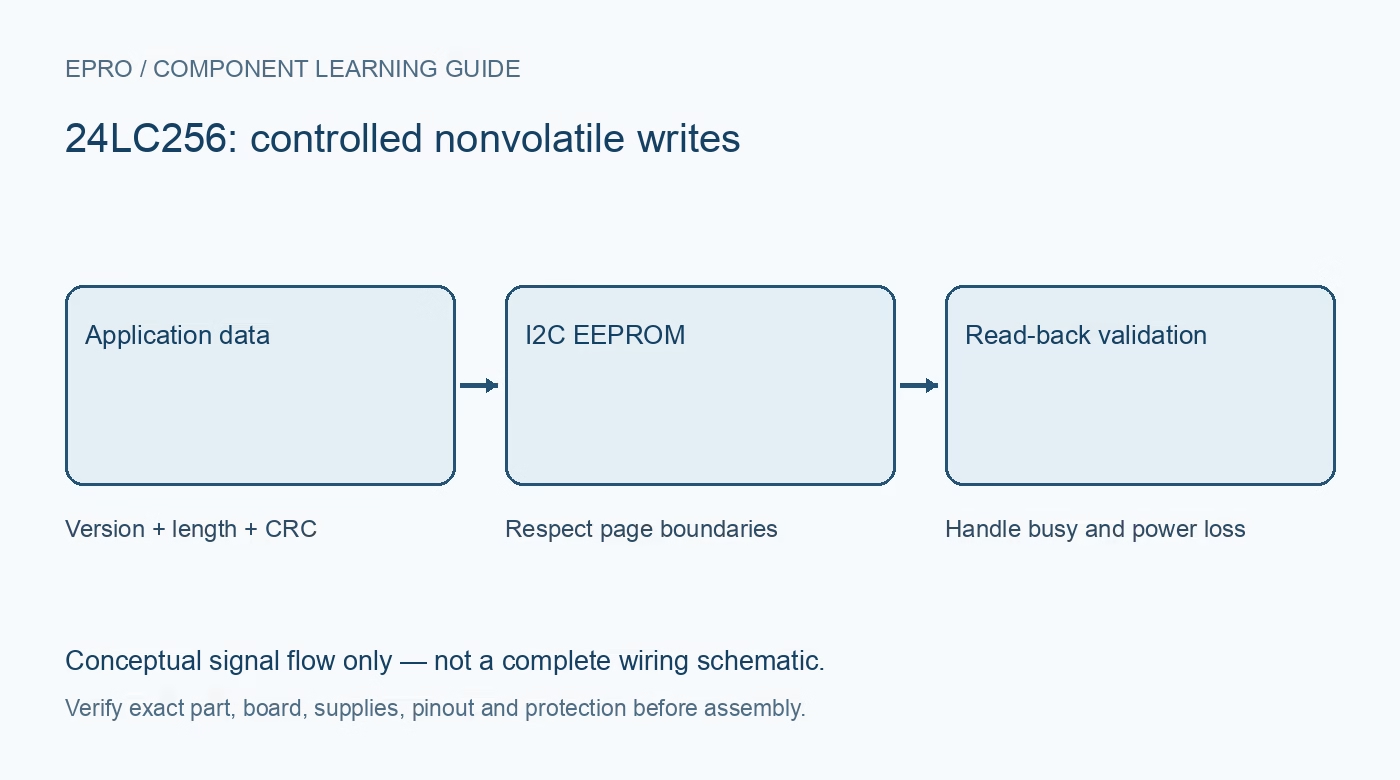
The 24LC256 is a nonvolatile I2C EEPROM, useful for configuration records and modest data storage. Its 256-kilobit name means 32,768 bytes, not 256 kilobytes. Capacity is only one part of selection: page boundaries, write completion, endurance and power-loss handling are equally important.
Distinguish the related device variants
The combined Microchip datasheet covers 24AA256, 24LC256 and 24FC256 with different voltage and timing conditions. Do not assign every family headline to the LC part. Check the actual suffix and package, then verify supply, bus speed, input thresholds and temperature range for that device.
Separate bus address from memory address
Address pins select the EEPROM’s I2C device address, while a separate two-byte word address selects a location in its storage array. These are different concepts. An address scan can find the chip without proving that software sends the correct memory address or reads the intended record.
Respect the 64-byte physical page
The device has a 64-byte page-write buffer. A page write must not cross the physical page boundary; crossing wraps within the current page and can overwrite earlier data. Split writes according to both the remaining space in the current page and the host library’s transfer-buffer limit. Merely limiting every write to 64 bytes is insufficient if it starts partway through a page.
Wait for the internal write cycle
A completed I2C transfer is not the same as completed nonvolatile storage. The datasheet specifies an internal write cycle and describes acknowledgment polling to detect completion. Use bounded polling or an appropriate documented delay with error handling. A busy device not acknowledging immediately after a write is different from a missing device at startup.
Budget writes rather than storing every loop
EEPROM endurance is finite and specified under conditions. The linked datasheet notes that a page is refreshed during a page write, so endurance planning must account for page activity. Save configuration only when it changes, use a deliberate commit policy and avoid treating EEPROM as an unlimited high-rate log or RAM replacement.
Design records for interrupted updates
Store a format version, length and integrity check when appropriate, and consider alternating records with sequence numbers so the application can reject incomplete updates. Define write-protect behavior and initialization defaults. Read-back verification is useful but is not a guarantee that an arbitrary power interruption is harmless. Do not store sensitive credentials casually without a suitable security design.Newest in the store


Availability and illustration note
No matching product was found in the checked Epro catalog for this topic on 19 October 2026. This article therefore does not quote an Epro price or claim stock. The original illustration shows conceptual signal flow only, not a complete circuit or a photograph of a supplied product. Obtain a documented component or carrier with a known pinout and electrical specification.
Frequently asked questions
Does 24LC256 hold 256 kilobytes?
No. It holds 256 kilobits, organized as 32,768 eight-bit bytes.
Is any write of 64 bytes safe across a page boundary?
No. Even a shorter write can wrap if it crosses a physical 64-byte page boundary.
Related Epro reading
Review breadboard connections before assembling a prototype. For controller expansion, the Mega 2560 pin guide explains why pin names and electrical limits must be checked together.
Technical references and test limitations
This guide uses the documentation linked below. The procedures are for a controlled, low-voltage learning setup; no independent hands-on test of the particular seller board is claimed. Record the actual part markings, wiring and firmware version before drawing conclusions from a test.