


BME280 Sensor: 7 Checks for Humidity and Pressure Projects

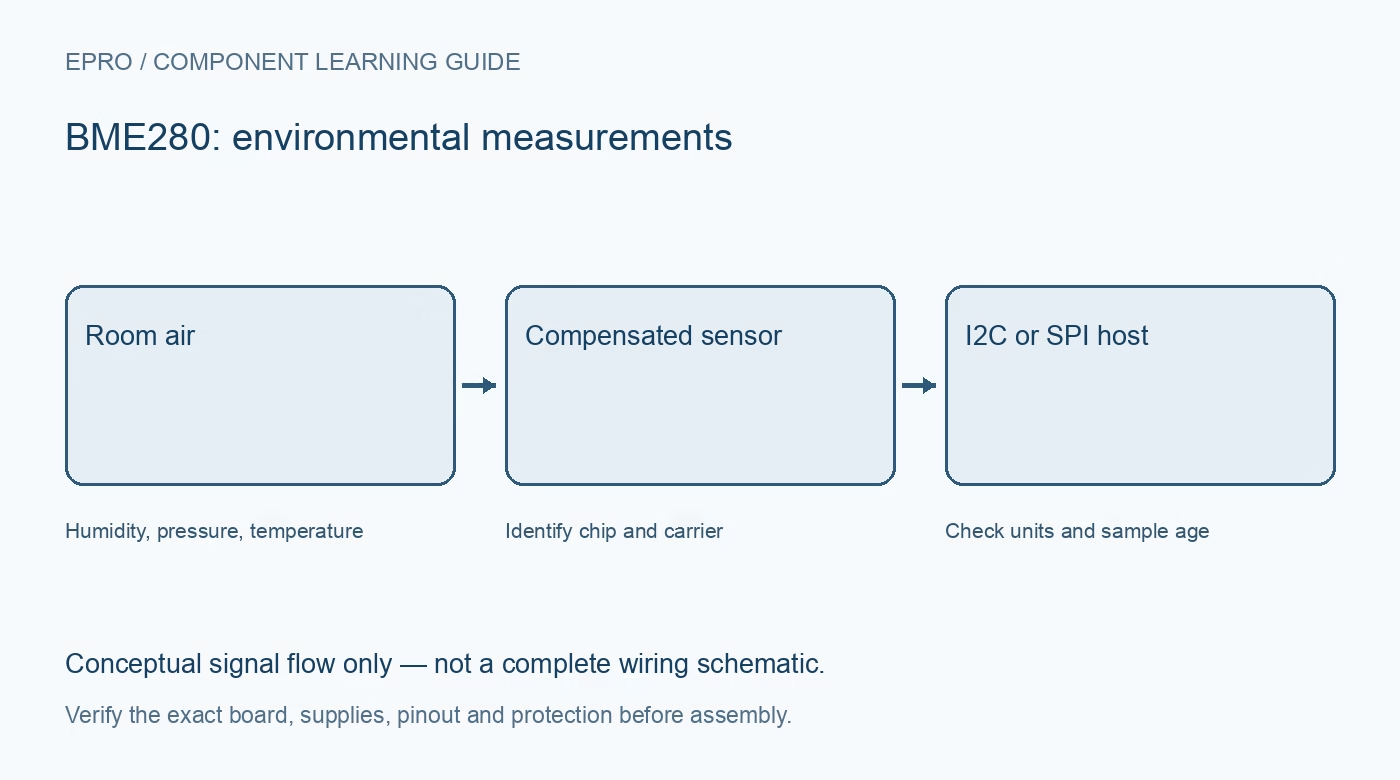
A BME280 combines humidity, pressure and temperature sensing, but a similar-looking breakout is not proof of the fitted chip. Start with the measurement you actually need, then check the carrier and documentation rather than treating every small metal-lid sensor as interchangeable.
Confirm BME280 rather than BMP280
Both names appear on inexpensive environmental boards. A BMP280 does not add humidity merely because the board listing mentions weather monitoring. The BME280 identification register at 0xD0 should read 0x60 after startup. Treat an unexpected identity as a reason to stop and identify the part, not to force a different driver until numbers appear.
Separate the chip supply from the board input
Bosch specifies VDD from 1.71 to 3.6 V and VDDIO from 1.2 to 3.6 V. A carrier may add a regulator, but that alone does not establish 5 V-tolerant data pins. Obtain the board schematic and inspect where SDA and SCL pull-ups connect. Use compatible low-voltage wiring for an initial test.
Choose I2C or SPI deliberately
The chip supports both buses, but a four-pin carrier may expose only I2C. Address selection and chip-select wiring depend on the chosen interface. Check header labels and solder links rather than copying a bare-chip pin number onto an unrelated breakout header.
Match sampling mode to the application
Forced mode takes one measurement sequence and returns to sleep; normal mode repeats measurement and standby periods. A slow room logger rarely needs the most aggressive oversampling settings. Compare latency, noise and power together, including the carrier regulator and indicator LED rather than only the sensor current.
Allow the sensor to see the environment
Keep the vent unobstructed and away from regulator heat, direct sunlight and liquid contact. An enclosure that protects electronics can also trap warm air. Temperature is used in compensation, but proximity to a warm controller can prevent the reading from representing room temperature.
Keep pressure units and altitude assumptions visible
Libraries may return pascals while weather reports use hectopascals. Dividing pascals by 100 changes the unit; it does not perform sea-level correction. Any altitude estimate depends on a reference pressure that changes with weather. Do not advertise this sensor as an absolute height instrument without explaining that assumption.
Newest in the store


Write an acceptance checklist before purchase
Require the exact chip identity, exposed bus, allowable supply, pull-up voltage and physical dimensions. For the first test, save raw observations and settings alongside compensated values. Agreement with another uncalibrated hobby sensor is a plausibility check, not a traceable calibration certificate.
Frequently asked questions
Does a BME280 measure gas concentration?
No. Its specified outputs are humidity, pressure and temperature. A gas-sensing product family is a different choice.
Does more oversampling guarantee better accuracy?
It can reduce random noise, but cannot correct a wrong chip, unsuitable enclosure, thermal bias or an incorrect reference pressure.
Availability and illustration note
No matching Epro product was returned by the catalog search on 19 October 2026. This learning guide does not assert stock, a selling price or compatibility of an unidentified substitute. The illustration is an original conceptual signal-flow diagram, not a product photograph or complete wiring schematic.
Related Epro reading
For a first bench setup, review breadboard connections and continuity checks and I2C voltage-level translation. These guides do not replace the exact module schematic.
Technical references and limitations
Source: Bosch BME280 datasheet. Electrical limits apply to the named part, not automatically to every carrier board. This is a documentation-based learning workflow, not a claim of independent hardware testing, traceable calibration or safety certification.