


Si7021 Arduino: 7 CRC and No-Hold Measurement Checks

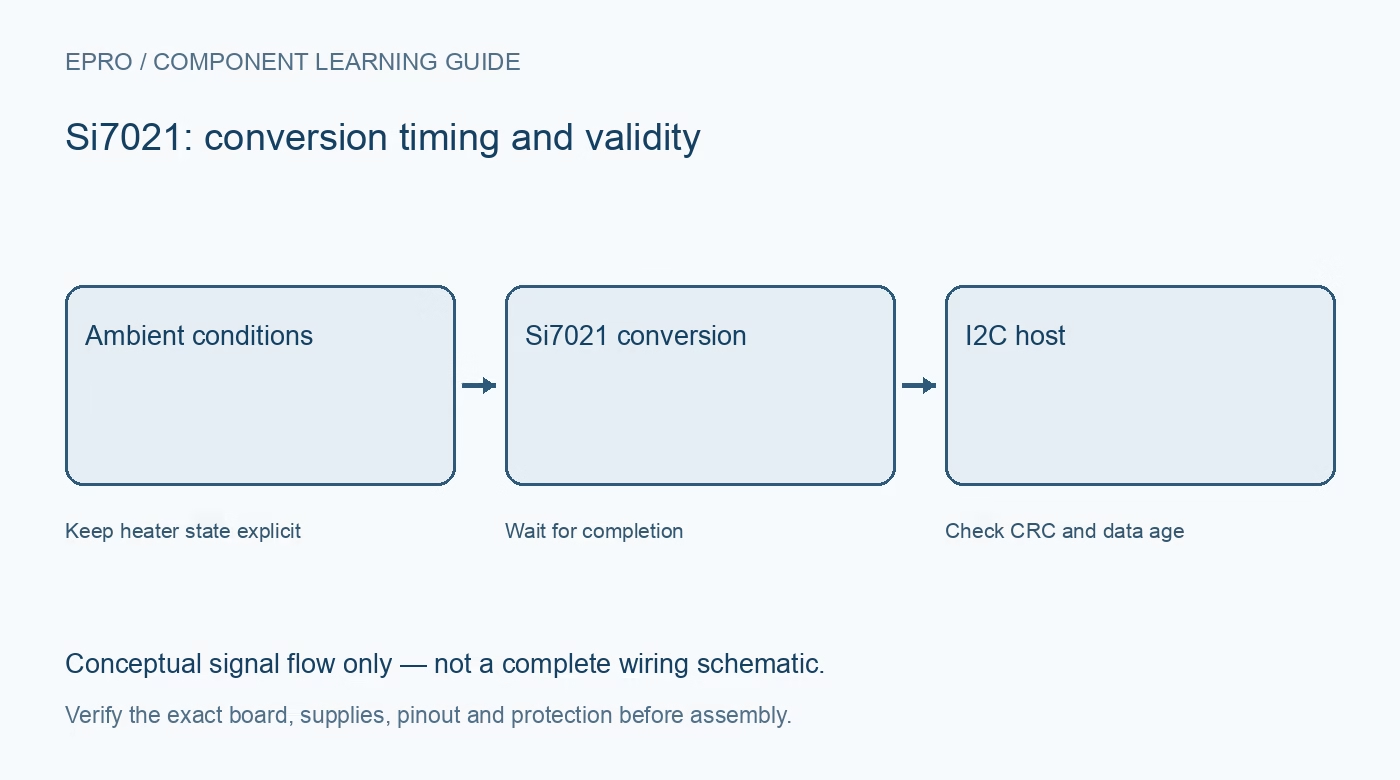
A Si7021 Arduino application should prove that a fresh, valid measurement was received before publishing it. The chip shares some command patterns with other humidity sensors, but copying every timing and CRC detail from a different family is not a reliable integration method.
Verify low-voltage compatibility first
Check the exact carrier schematic, host logic voltage and pull-up rail with power disconnected. The Si7021 IC is a 1.9 to 3.6 V part. Do not connect a 5 V bus merely because another module bearing the same sensor name advertised a 5 V input.
Check address and device identity separately
The base I2C address is 0x40. An acknowledgment proves only a responding peripheral, not its manufacturer or data format. Where supported, use the documented electronic identification commands and a known compatible library. Investigate unexpected identity rather than interpreting any two returned bytes as temperature.
Choose a supported conversion mode
The datasheet provides hold-master and no-hold-master commands. No-hold operation allows the host to use the bus while conversion progresses, but it still requires a bounded wait or retry strategy. At default resolution, humidity conversion can take up to 12 ms and temperature conversion up to 10.8 ms.
Validate transfer length and checksum
Read the expected measurement bytes and optional checksum as required by the chosen command. The documented CRC polynomial is 0x31 with initialization 0x00. This initialization differs from SHT31. Verify checksum before masking measurement status bits or performing scaling, following the datasheet and driver implementation.
Scale accepted raw words correctly
For direct implementation, humidity uses 125 × raw/65536 – 6 and temperature uses 175.72 × raw/65536 – 46.85 after the required status-bit handling. Follow the documented humidity limits and handling rather than silently treating a communication error as a saturated valid reading.
Track heater state and sample age
Keep the heater disabled for the ambient baseline. Record a timestamp only after a valid new measurement. If using the command that returns temperature from the previous humidity measurement, understand that the value belongs to that earlier conversion. Printing it again does not make it a new independent sample.
Newest in the store


Exercise the failure and recovery paths
Test a wrong address in software, confirm a clear unavailable status, and then restore the documented configuration. Count consecutive failures without blocking the application forever. Power down before physical rewiring, initialize after a normal power cycle, and preserve the last successful timestamp to make recovery visible in the log.
Frequently asked questions
Can I reuse the SHT31 CRC routine unchanged?
Not if it hard-codes initialization 0xFF. Si7021 uses initialization 0x00 for the documented measurement checksum.
Does a second printed temperature always mean a new conversion?
No. A previous-measurement command or cached library value must be associated with its actual acquisition time.
Availability and illustration note
No matching Epro product was returned by the catalog search on 19 October 2026. This learning guide does not assert stock, a selling price or compatibility of an unidentified substitute. The illustration is an original conceptual signal-flow diagram, not a product photograph or complete wiring schematic.
Related Epro reading
For a first bench setup, review breadboard connections and continuity checks and I2C voltage-level translation. These guides do not replace the exact module schematic.
Technical references and limitations
Source: Silicon Labs Si7021-A20 datasheet. Electrical limits apply to the named part, not automatically to every carrier board. This is a documentation-based learning workflow, not a claim of independent hardware testing, traceable calibration or safety certification.