


MAX31865 RTD Module: 7 PT100 and PT1000 Selection Checks

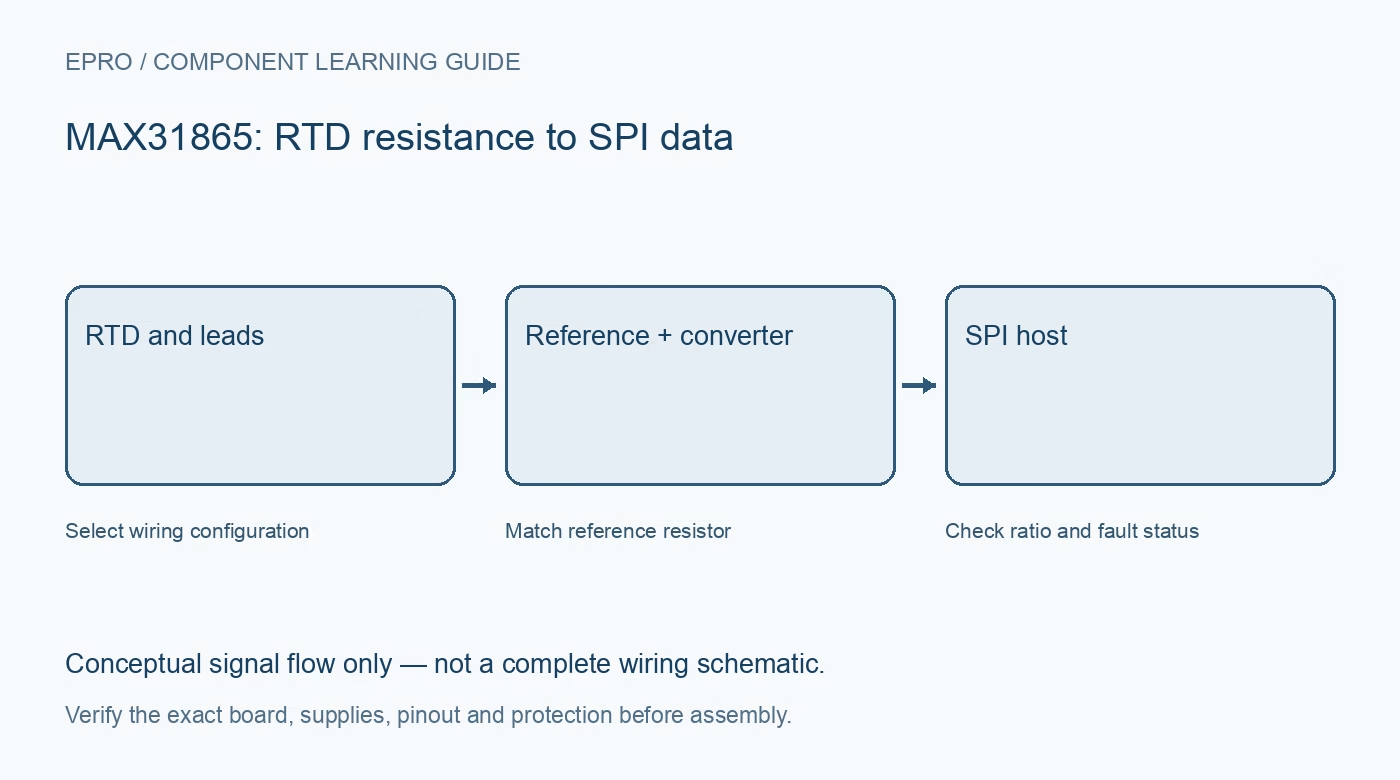
A MAX31865 converts an RTD resistance ratio into digital data. It is not interchangeable with a thermocouple amplifier, and a listing that mentions PT100 and PT1000 does not mean one unchanged board configuration measures both correctly.
Match the sensor technology
A PT100 is nominally 100 Ω at 0°C; a PT1000 is nominally 1,000 Ω at that reference temperature. A thermocouple or generic thermistor needs a different interpretation. Confirm the probe type and coefficient specification before choosing a module or configuring a library.
Identify the fitted reference resistor
The converter measures the ratio between the RTD and an external reference. The datasheet gives an optimum reference near four times the RTD’s zero-degree resistance. Real carriers may use values such as 430 Ω or 4.3 kΩ. Inspect the actual fitted component and enter its documented value, not a convenient number copied from another board.
Choose two, three or four wires deliberately
Two-wire measurements include lead resistance. Three-wire compensation assumes suitably matched leads and correct configuration. Four-wire sensing separates force and sense conductors to remove lead-drop error in the intended connection. Probe wire colours alone are insufficient evidence of terminal function; verify the probe documentation and continuity.
Check jumpers as well as firmware
A carrier can require physical solder links for its wiring mode. Software selection does not repair an incompatible terminal arrangement. Inspect the unpowered board and follow its own connection diagram. Preserve a photograph and written record of the jumper state before starting the first measurement.
Separate board supply from SPI levels
The MAX31865 IC uses 3.0 to 3.6 V supplies. A carrier might add a regulator or level translators, but verify them. The converter supports SPI modes 1 and 3. Ensure the host, chip-select arrangement and library match the board rather than assuming an I2C-style scanner can find it.
Consider faults and the complete error budget
The converter provides fault detection, but not every cable failure automatically produces an unambiguous alarm in every configuration. Reference-resistor tolerance, probe class, lead matching, thermal contact and self-heating all matter. Fine digital resolution is not the same as system accuracy.
Newest in the store


Start with a low-energy bench measurement
Use a known probe at room temperature or an appropriate precision test resistor and record the conversion settings. Keep the assembly away from mains, furnaces and energized process equipment during initial bring-up. The IC’s input-protection headline is not permission to wire a hobby module to a hazardous circuit or use it as a certified safety controller.
Frequently asked questions
Can firmware alone turn every PT100 board into a PT1000 board?
No. The physical reference resistor and other module configuration must match the intended sensor and measurement range.
Does a four-wire probe guarantee an accurate installed temperature?
It addresses lead resistance when connected correctly, but does not eliminate probe tolerance, thermal-contact error or reference-resistor uncertainty.
Availability and illustration note
The Epro MAX31865 listing was shown at PKR 1,500 and in stock when checked on 19 October 2026. This is a dated listing snapshot, not a historical price associated with this article’s publication timestamp. Confirm the fitted reference resistor, probe type and board jumpers before ordering. The illustration is an original conceptual signal-flow diagram, not a product photograph or complete wiring schematic.
Related Epro reading
For a first bench setup, review breadboard connections and continuity checks and I2C voltage-level translation. These guides do not replace the exact module schematic.
Technical references and limitations
Source: Analog Devices MAX31865 datasheet. Electrical limits apply to the named part, not automatically to every carrier board. This is a documentation-based learning workflow, not a claim of independent hardware testing, traceable calibration or safety certification.