


Waterproof Ultrasonic Sensor: 7 JSN-SR04T Checks

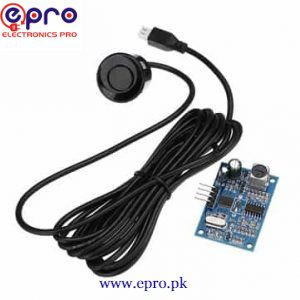
A waterproof ultrasonic sensor can be useful where a standard exposed distance module would be a poor mechanical choice. However, the word waterproof often applies to the probe, not every part of the assembly. The JSN-SR04T also has different close-range limitations from a small HC-SR04 board.
Use this checklist before buying or mounting a probe for a low-voltage distance or tank-headspace project. It is selection guidance, not certification for flood protection, drinking-water contact or industrial process control.

1. Identify exactly what is waterproof
The JSN-SR04T waterproof ultrasonic sensor listing includes a remote probe associated with a separate control board. Protect that board, connectors and power wiring from rain and condensation. A sealed sensing face does not establish an ingress-protection rating for your completed enclosure, and a cable joint may be the weakest point.
Do not drill, splice or extend a probe cable casually. Cable changes can affect sealing and signal behaviour. If a longer installation run is necessary, ask for the exact revision’s cable and interface requirements before purchasing.
2. Leave enough blind-distance clearance
The Epro listing describes a blind distance around 25 cm and a maximum distance around 4.5 m. Treat these as listing-specific nominal figures, not universal limits for every JSN-SR04T revision. A sensor mounted only a few centimetres above a tank’s full level may be unable to measure that level reliably.
Sketch the highest and lowest expected liquid surfaces before choosing a mounting point. Include the probe-to-full-surface clearance, tank depth and extra margin. If the required distance overlaps the blind zone, choose a different sensing method rather than trying to correct a fundamentally missing echo in software.
3. Verify the control-board revision and mode
Different revisions may support different operating modes or component settings. Some boards label interface pins with combined names such as Trig/RX and Echo/TX. Those markings do not mean every example sketch will work without checking the selected mode. Photograph the board markings and compare them with its own documentation.
A trigger/echo example is appropriate only when the board is configured for that interface. Serial-output or automatic modes need a different program. Avoid moving configuration resistors or solder bridges without an authoritative revision-specific procedure.
4. Check supply and logic levels separately
The current listing specifies a 5 V supply. Confirm the actual board’s requirements and output amplitude before connecting a controller. In particular, a 5 V Echo output is not a safe direct input for a 3.3 V-only GPIO. Use a properly designed interface where required and connect signal references as the exact circuit needs.Newest in the store


Test power polarity with the assembly disconnected. Put the controller and sensor on a stable supply rather than sharing a noisy motor line without suitable design measures. Random resets and timing errors are not necessarily evidence that the probe itself is defective.
5. Mount for a clear acoustic path
Point the sensing face toward the surface and keep tank walls, pipes and brackets out of its main view. A narrow opening can create unwanted echoes. Foam, heavy ripples, condensation or an angled surface may weaken the useful return signal. Confirm the actual geometry with repeated measurements at several known levels.
Waterproof air-ranging does not mean the sensor measures through water. Do not submerge the probe and expect an air-ranging distance formula to remain valid. Also avoid claiming compatibility with chemicals or potable water unless the manufacturer explicitly specifies the materials for that use.
6. Convert distance into level carefully
For a simple upright tank, level can be estimated from a calibrated reference height minus valid distance. That reference should be measured from the sensing face, not the enclosure lid. Height does not directly equal volume in an irregular or horizontal cylindrical tank; the tank geometry needs its own conversion.
Reject timeouts and out-of-range readings. Keep the previous valid reading clearly distinguished from a fresh measurement, and do not display a stale value as though it were current. Never rely on a single hobby module as the only overflow or pump-protection safeguard.
7. Compare total installation cost
| Listed item | Listed price (PKR) | Role |
|---|---|---|
| JSN SR04T Water Proof Ultrasonic Sensor in Pakistan | 1,350 | Remote-probe ultrasonic assembly |
| HC-SR04 Ultrasonic Sensor for Arduino in Pakistan | 195 | Indoor HC-SR04 comparison, not waterproof |
Price check: Epro listings checked on 18 October 2026. Prices are a dated snapshot, not a quotation. Confirm the current price, availability, delivery charges and package contents on the linked product page before ordering.
Include a suitable enclosure, controller interface and mounting hardware in the budget. Read the ultrasonic sensor buying comparison for the indoor alternative. The HC-SR04 Arduino example explains echo timing, but it is not a substitute for JSN-SR04T revision-specific wiring instructions.