


MAX31855 Thermocouple Module: 7 Cold-Junction Checks

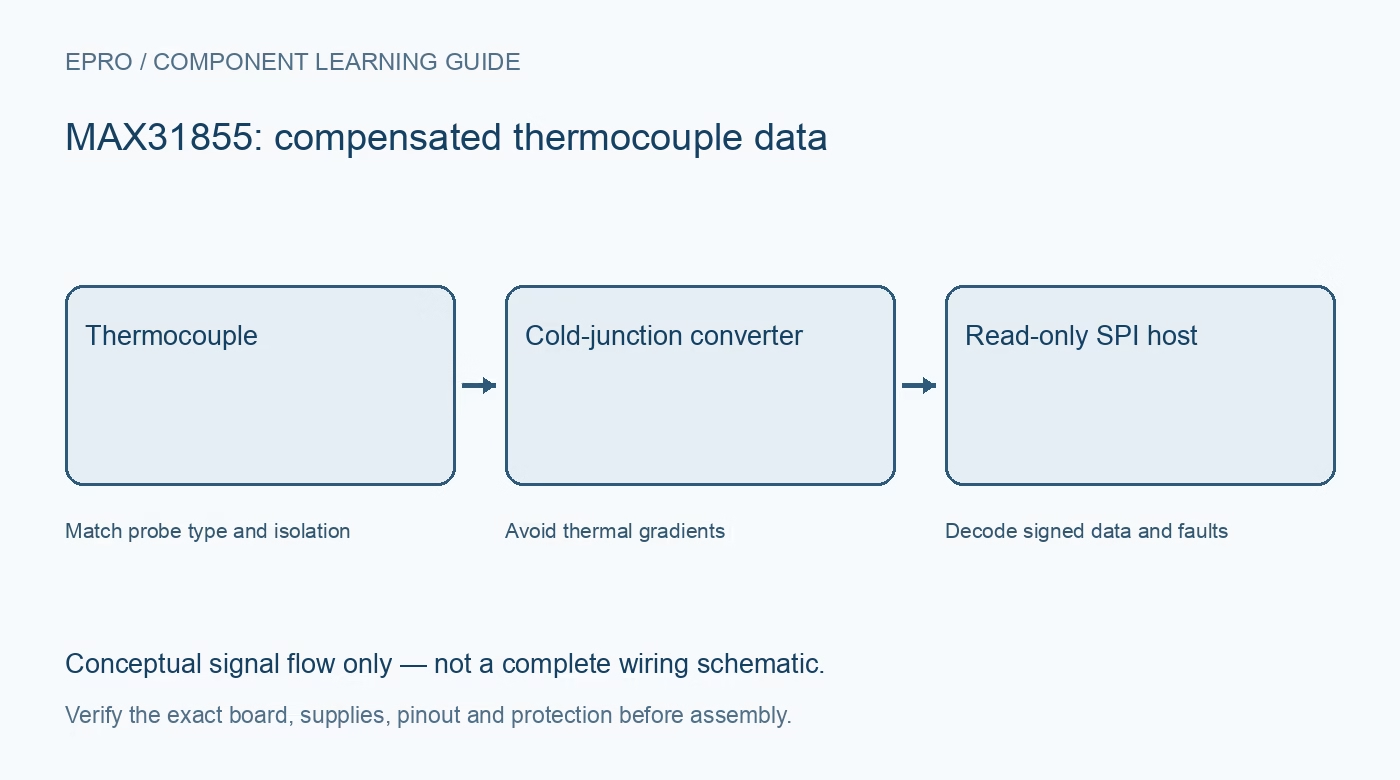
A MAX31855 reads a thermocouple and compensates for the reference-junction temperature. That makes module selection a thermal and electrical decision, not simply a choice of digital interface. Begin by matching the exact converter variant to the probe and intended installation.
Match the thermocouple type to the converter variant
The family includes variants for K, J, N, T, S, R and E thermocouples. One variant does not identify and convert all probe types automatically. Verify the complete part marking, supplier documentation and probe type before comparing temperature ranges or selecting a library.
Do not confuse this part with an RTD interface
A thermocouple produces a small voltage related to the temperature difference between junctions. A PT100 or PT1000 RTD instead requires resistance measurement and a suitable interface such as MAX31865. Similar module numbers and terminal blocks do not make the measurement methods interchangeable.
Keep the cold junction thermally representative
The converter’s internal temperature measurement is used for compensation. It must track the reference connection’s temperature closely. Locate the board away from regulators, hot processors and uneven airflow that create thermal gradients. A hot probe rating does not mean the converter board itself belongs in the hot environment.
Check the supply and digital interface
Confirm the carrier’s allowed supply and whether it translates host logic levels. The interface is SPI-compatible and read-only: the host clocks a result from the serial output rather than configuring measurement through MOSI. A bare sensor supply specification is not the same as a regulator-equipped carrier input rating.
Check grounding and probe isolation
The datasheet explicitly warns not to connect T- to ground. A grounded-junction probe attached to grounded machinery may violate this requirement or introduce unwanted electrical paths. Resolve isolation and installation suitability before connection. Never assume a low-cost module provides galvanic isolation or permission to measure an energized hazardous object.
Read accuracy separately from resolution
Thermocouple output resolution is 0.25°C; cold-junction output resolution is finer. Neither establishes the accuracy of the complete probe, connectors, extension cable and converter assembly. Thermocouple type, nonlinearity, thermal gradients and connection materials all contribute to the error budget.
Newest in the store


Require a visible fault response
The converter reports open-circuit and shorts to supply or ground. Make the application distinguish these from a valid temperature, and keep the timestamp of the last accepted conversion. Initial validation should use a safe room-temperature probe and normal low-voltage bench wiring, not a furnace, heater controller or live process installation.
Frequently asked questions
Does every MAX31855 board support every thermocouple?
No. The converter variant is selected for a thermocouple type; identify it before ordering a probe.
Is a grounded probe always acceptable?
No. The documented input-ground restrictions and the complete installation must be checked. A grounded junction can create an unsuitable connection.
Availability and illustration note
No matching Epro product was returned by the catalog search on 19 October 2026. This learning guide does not assert stock, a selling price or compatibility of an unidentified substitute. The illustration is an original conceptual signal-flow diagram, not a product photograph or complete wiring schematic.
Related Epro reading
For a first bench setup, review breadboard connections and continuity checks and I2C voltage-level translation. These guides do not replace the exact module schematic.
Technical references and limitations
Source: Analog Devices MAX31855 datasheet. Electrical limits apply to the named part, not automatically to every carrier board. This is a documentation-based learning workflow, not a claim of independent hardware testing, traceable calibration or safety certification.