


APDS9960 Gesture Sensor: 7 Optical and Interface Checks

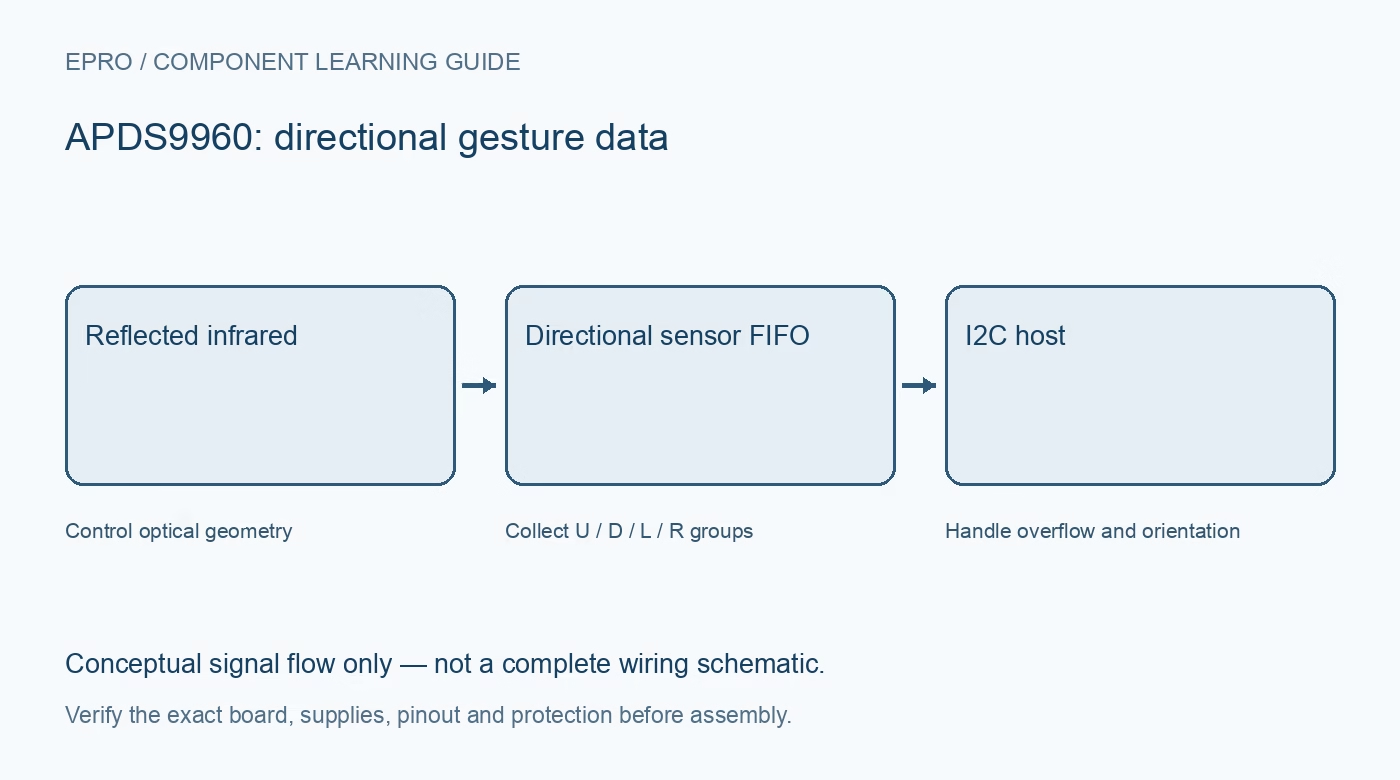
The APDS9960 combines proximity, colour, ambient-light and gesture functions. These functions share optical and timing resources, so choosing a module requires attention to both the carrier and the surrounding enclosure rather than assuming one library call creates dependable gesture control.
Identify the actual sensor and carrier
Confirm the APDS-9960 part and the module schematic. Similar-looking optical boards can use other sensors with different register maps. Inspect supply requirements, LED supply routing, pull-ups and any level translation. A header’s VCC label alone does not establish compatibility with every Arduino or ESP32 board.
Plan for its I2C address
The documented seven-bit slave address is 0x39. Check other peripherals on the same bus before purchase. An address collision is not solved by creating a second library instance with an invented address. Use compatible bus segmentation when the design requires independently addressable fixed-address devices.
Provide a suitable optical path
The emitter and directional detectors need a clear, consistent view. A dark window, adhesive edge or enclosure wall can change reflections and introduce crosstalk. Evaluate the intended cover material and spacing as part of the design, not only after the bare module has worked on an open bench.
Separate proximity counts from distance
Proximity response depends on reflectivity, geometry, ambient light and settings. A larger count is not a universal millimetre reading. Do not advertise a fixed detection distance or reliable obstacle clearance from an uncalibrated threshold tested on one hand or one cardboard target.
Record directional orientation
Gesture processing uses directional optical channels. Rotating a breakout changes how sensor directions map to the user interface. Mark the mounted orientation and decide which movement should mean up, down, left or right before interpreting software gesture names.
Choose a driver with bounded FIFO servicing
The gesture FIFO can hold 32 four-byte directional datasets. If the host does not service it fast enough, new data can be lost. Inspect overflow handling and scheduling, especially when a display, network task or lengthy debug output shares the microcontroller.
Newest in the store


Define acceptance beyond one successful wave
Test several users, deliberate slow and fast movements, different lighting and the final enclosure geometry. Include an unknown or no-gesture outcome rather than forcing every observation into a command. This component is suitable for a learning interface, not a certified protective sensor for people or machinery.
Frequently asked questions
Does the APDS9960 return accurate distance in centimetres?
Its proximity response is not a universal calibrated distance measurement. Target and optical conditions strongly influence counts.
Can the enclosure change gesture reliability?
Yes. Window transmission, reflections, spacing and orientation are part of the optical system and must be evaluated.
Availability and illustration note
No matching Epro product was returned by the catalog search on 19 October 2026. This learning guide does not assert stock, a selling price or compatibility of an unidentified substitute. The illustration is an original conceptual signal-flow diagram, not a product photograph or complete wiring schematic.
Related Epro reading
For a first bench setup, review breadboard connections and continuity checks and I2C voltage-level translation. These guides do not replace the exact module schematic.
Technical references and limitations
Source: Broadcom/Avago APDS-9960 datasheet. Electrical limits apply to the named part, not automatically to every carrier board. This is a documentation-based learning workflow, not a claim of independent hardware testing, traceable calibration or safety certification.