


DS1621 Temperature Sensor: 7 Conversion and Storage Checks

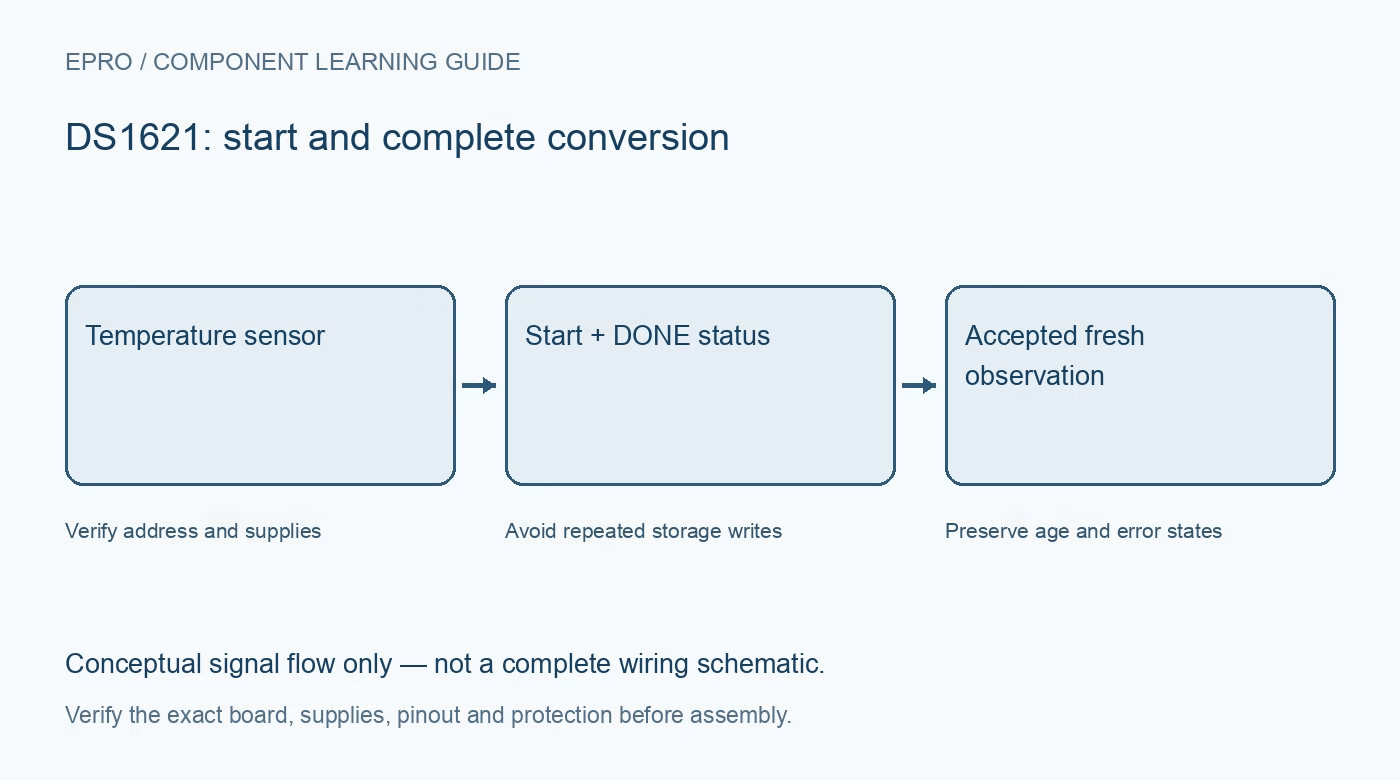
A DS1621 combines digital temperature measurement with thermostat-related settings, but its behaviour differs from always-running sensors. Understand conversion startup and retained nonvolatile configuration before choosing it for a simple logger or threshold demonstration.
Confirm the measurement requirement
The ordinary temperature result uses a signed half-degree Celsius step. That output format is not a guarantee of half-degree absolute accuracy in the assembled system. Compare the datasheet error limits and intended temperature interval with the application rather than selecting solely by displayed decimal places.
Expect an explicit conversion start
The device powers up in an idle state and requires the documented Start Convert T command. Continuous mode describes what happens after conversion starts; it does not mean merely applying power creates a stream of fresh results. Choose a driver that handles this distinction.
Plan one-shot or continuous operation
One-shot operation needs a trigger for each new acquisition, while continuous operation continues after a valid start. Consider latency, power and how the application determines completion. A readable temperature register may contain the previous completed result rather than the observation just requested.
Check address and electrical compatibility
Three address pins select within the documented 0x48 to 0x4F range, which overlaps other common temperature sensors. Verify supply and pull-up levels from the exact board schematic. A software address change cannot resolve two devices physically strapped to the same value.
Treat nonvolatile writes as occasional configuration
Configuration and thermostat limits involve nonvolatile storage with specified timing and endurance. They should not be rewritten in every sample loop. The datasheet also restricts the conditions for reliable nonvolatile programming; being able to measure a temperature does not imply writes are valid at that temperature.
Separate thermostat state from fresh data
The thermostat output can retain the state associated with the last valid conversion when acquisition is idle. That output is not a sample-ready indication. Historical high and low flags likewise need interpretation as latched events rather than a statement of the present temperature.
Newest in the store


Keep the first application low risk
Start with a room-temperature logger and a logic-only output demonstration. Do not drive motors or heaters directly from a sensor output, and do not treat this learning assembly as certified thermal protection. Document enclosure heating and settling before comparing it with a reference.
Frequently asked questions
Will applying power alone start continuous measurements?
No. The documented conversion-start command is required.
Should configuration be written before every temperature read?
No. Nonvolatile writes have timing and endurance requirements and belong in an intentional configuration stage.
Availability and illustration note
No matching Epro product was returned by the catalog search on 21 October 2026 UTC. This learning guide does not assert stock, a selling price or compatibility of an unidentified substitute. The illustration is an original conceptual signal-flow diagram, not a product photograph or complete wiring schematic.
Related Epro reading
For a first bench setup, review breadboard connections and continuity checks and I2C voltage-level translation. These guides do not replace the exact module schematic.
Technical references and limitations
Source: Analog Devices DS1621 datasheet. Electrical limits apply to the named part, not automatically to every carrier board. This is a documentation-based learning workflow, not a claim of independent hardware testing, traceable calibration or safety certification.