


MCP6002 Op Amp: 7 Gain and Rail-Headroom Checks

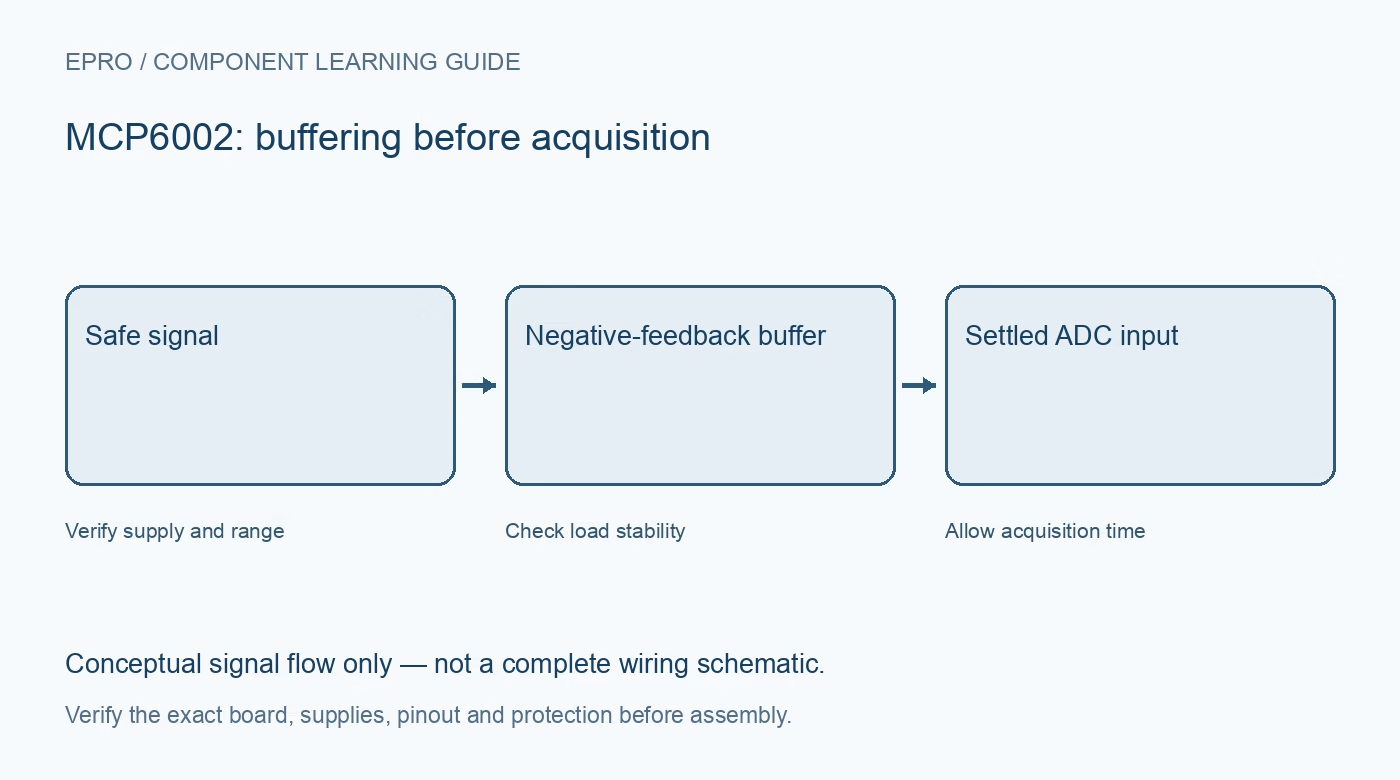
The MCP6002 is a dual general-purpose operational amplifier with rail-to-rail input and output capability. It can help buffer or amplify a small signal, but those labels do not guarantee perfect rail contact, unlimited bandwidth or stable operation with every cable and ADC load.
Match the supply to the exact part
The referenced Microchip family operates from a single supply of 1.8 to 6.0 V. Verify the actual device marking, package and carrier connections before applying power. Do not infer a board’s regulator, pin ordering or protection from another visually similar dual-op-amp module.
Separate rail-to-rail capability from ideal behaviour
Output swing depends on load and operating conditions; a real amplifier does not become an ideal zero-error voltage source at both rails. Leave suitable headroom for the required accuracy. Inputs near rail transitions can also have different linearity characteristics from a comfortable mid-supply operating point.
Plan gain and bandwidth together
The family’s typical gain-bandwidth product is 1 MHz, not a promise of full-amplitude one-megahertz performance at every gain. Higher closed-loop noise gain reduces usable bandwidth. Consider slew rate, settling and the required signal amplitude as well as the small-signal frequency response.
Include offset and resistor uncertainty
Input offset, bias effects, resistor tolerance and reference errors contribute to the completed circuit’s result. A nominal gain calculation is only one part of the accuracy budget. Do not label a buffered sensor calibrated merely because the chosen resistor ratio is a round number.
Check capacitive-load stability
Long wiring, filters and sampling inputs can present capacitance that reduces stability margin. Microchip discusses an output isolation resistor for appropriate capacitive loads. Follow the actual load and feedback arrangement instead of assuming a unity-gain buffer remains stable with any arbitrary output capacitor.
Define the unused amplifier
An unused channel should have a stable documented closed-loop configuration with a valid input bias, not floating inputs or an accidental positive-feedback connection. Check the package pin mapping before joining output to an input. Leave unused outputs unloaded unless their role has been intentionally designed.
Newest in the store


Use the amplifier as a signal component
The MCP6002 is not a substitute for a high-power output stage or a precision reference. Begin with a small safe signal and light measurement load. A documentation-based learning circuit does not establish medical accuracy, safety certification or protection for a connected battery, heater or mains-powered load.
Frequently asked questions
Does 1 MHz bandwidth mean any signal can be amplified at 1 MHz?
No. Gain, amplitude, slew rate, load and settling requirements all matter.
Is an output capacitor always helpful for noise?
No. It can affect feedback stability; use the manufacturer’s load guidance.
Availability and illustration note
No matching Epro product was returned by the catalog search on 21 October 2026 UTC. This learning guide does not assert stock, a selling price or compatibility of an unidentified substitute. The illustration is an original conceptual signal-flow diagram, not a product photograph or complete wiring schematic.
Related Epro reading
For a first bench setup, review breadboard connections and continuity checks and I2C voltage-level translation. These guides do not replace the exact module schematic.
Technical references and limitations
Source: Microchip MCP6001/2/4 operational amplifier datasheet. Electrical limits apply to the named part, not automatically to every carrier board. This is a documentation-based learning workflow, not a claim of independent hardware testing, traceable calibration or safety certification.