


DS3502 Arduino: 7 Volatile-Mode and Readback Checks

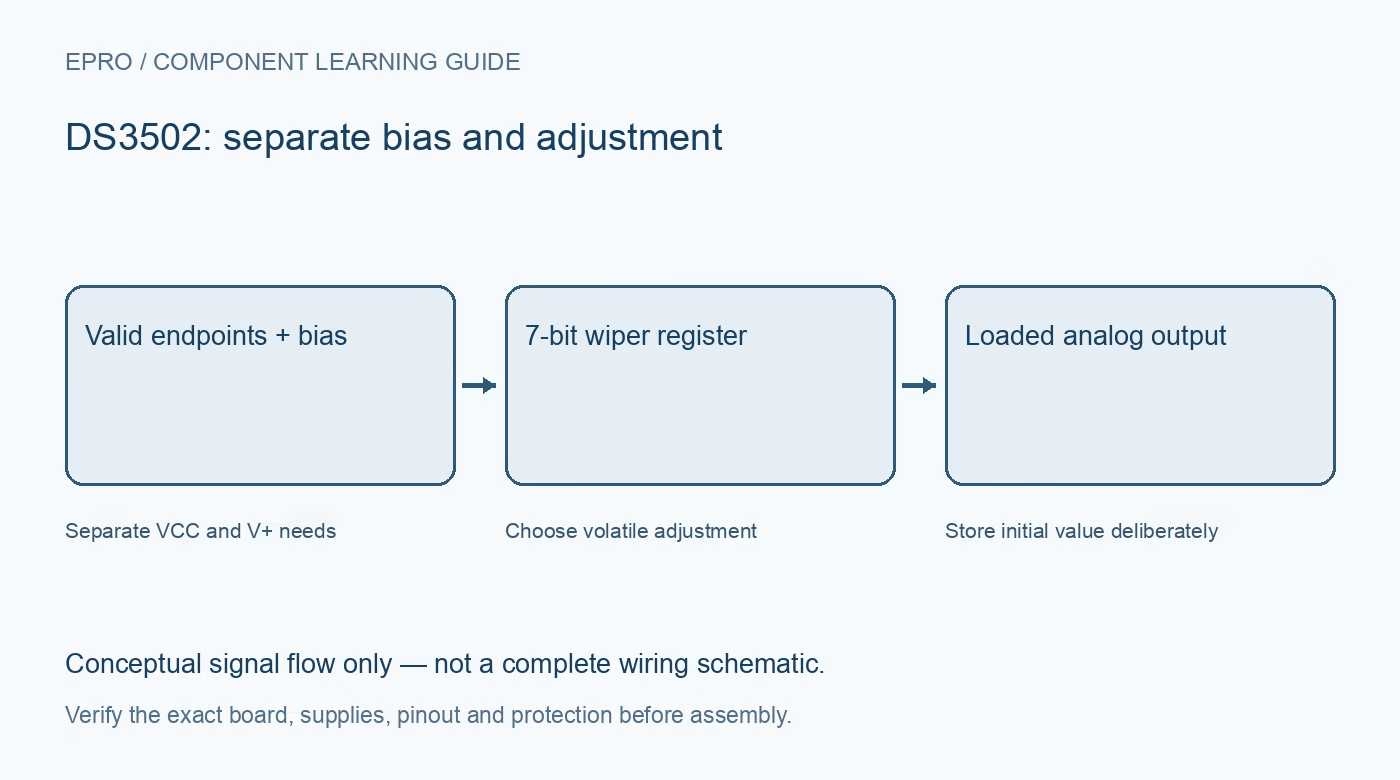
A DS3502 Arduino test should separate communication, active adjustment and persistent startup configuration. An I2C acknowledgement does not prove the analog bias or measured output is correct. Begin with a manufacturer-supported signal-level circuit and keep nonvolatile saves outside a repetitive adjustment loop.
Inspect the actual bias arrangement
Map VCC, V+, ground, RH, RL and RW from the exact board schematic. Confirm the separate bias requirement and control-level compatibility before powering the device. Do not assume a module’s logic connector safely provides all analog bias conditions, or that the wiper can drive a low-impedance load.
Verify address straps and register access
Set or inspect A0 and A1, use the resulting seven-bit address expected by the host library and check transactions. Distinguish seven-bit host addressing from an eight-bit address byte that includes the read/write bit. A scan identifies a response, not the complete analog configuration or a unique chip identity.
Select volatile-only adjustment explicitly
The MODE bit is in control register 02h. Setting it to the documented volatile-only state prevents routine writes at address 00h from also programming the initial-value EEPROM. The power-up default is the nonvolatile-writing mode, so do not rely on a prior boot having left the desired volatile state active.
Write a valid seven-bit setting
Use only the documented wiper-code range, zero through 127. Read back the active wiper register and compare the accepted value with the requested code. Register readback establishes digital state, not a calibrated analog voltage or proof that the physical endpoint supplies and output load are correct.
Measure the divider separately
With valid endpoint voltages and a high-impedance instrument, check a few modest settings and observe direction and approximate progression. Include wiper resistance and loading when interpreting deviations. Never attach a host ADC directly to a higher-voltage wiper output without an independently verified input-protection and scaling circuit.
Save the initial value only when intended
Use the documented mode and write sequence for a persistent preference. Allow EEPROM completion using bounded acknowledge polling or the specified maximum write interval, then return to volatile-only mode for repeated adjustments. Ordinary register reads return active wiper state, so a power-cycle test is a separate persistence check.
Newest in the store


Test faults without disguising them
Use explicit error handling for missing acknowledgements and readback mismatches. Restore an intentionally incorrect software address and confirm communication and safe output adjustment recover. Preserve the last-requested value separately from confirmed register state and measured voltage; a failed transaction is not a valid zero-position command.
Frequently asked questions
Why do repeated adjustments sometimes pause?
Check whether the device is still in the default mode that performs EEPROM writes and needs write-cycle completion.
Does readback prove the saved power-up value?
It reads the active wiper register. Verify intended persistence separately with the documented save and power-cycle procedure.
Availability and illustration note
No matching Epro product was returned by the catalog search on 21 October 2026 UTC. This learning guide does not assert stock, a selling price or compatibility of an unidentified substitute. The illustration is an original conceptual signal-flow diagram, not a product photograph or complete wiring schematic.
Related Epro reading
For a first bench setup, review breadboard connections and continuity checks and I2C voltage-level translation. These guides do not replace the exact module schematic.
Technical references and limitations
Source: Analog Devices DS3502 datasheet. Electrical limits apply to the named part, not automatically to every carrier board. This is a documentation-based learning workflow, not a claim of independent hardware testing, traceable calibration or safety certification.