


SHT31 Sensor: 7 Digital Humidity Module Selection Checks

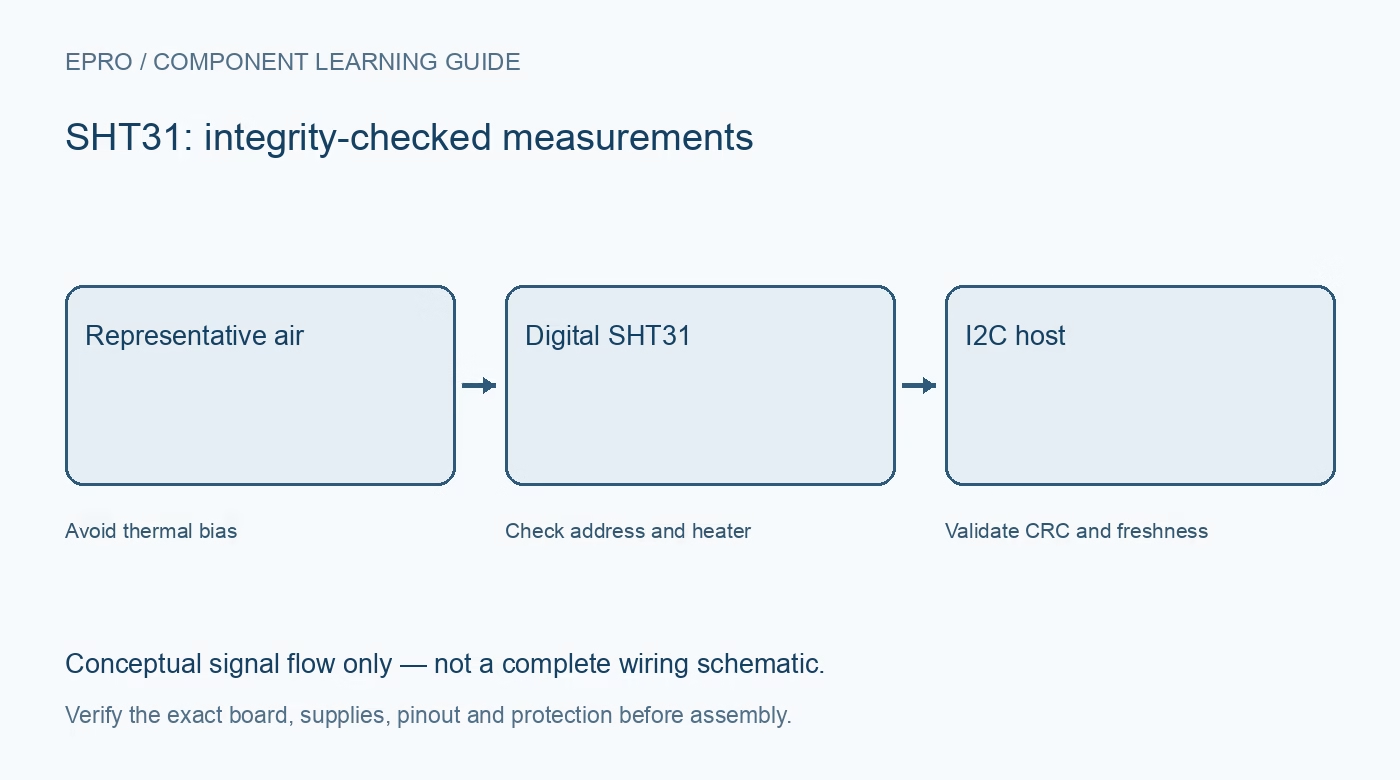
An SHT31 is useful for digital temperature and humidity monitoring, but the part suffix and carrier design matter. Choose the intended interface first, then compare electrical compatibility and placement instead of selecting solely by a quoted accuracy number.
Distinguish digital and analog families
This guide concerns SHT3x-DIS digital devices. The SHT3x-ARP family uses analog outputs and does not become an I2C peripheral through a library setting. Confirm the full device designation and the module documentation before comparing examples or allocating host pins.
Check supply and bus levels together
The referenced SHT3x-DIS datasheet specifies a 2.15 to 5.5 V supply range. That does not make a 5 V pull-up appropriate for a 3.3 V-only host. Find the actual pull-up rail and consider every participant on the bus. Power and logic compatibility are a system property, not a one-line product label.
Plan for two selectable I2C addresses
The normal addresses are 0x44 and 0x45, selected by ADDR. The pin must not float. Two modules can share a bus if each is correctly configured to a different address; more identical-address modules require a suitable bus architecture, such as a multiplexer, rather than an arbitrary software address.
Separate resolution, repeatability and accuracy
The device offers measurement commands with different repeatability settings and timing. More output digits do not prove the assembled system meets that many digits of accuracy. Include placement, thermal gradients, contamination, long-term drift and the intended humidity range in the measurement budget.
Treat the heater as a special operating condition
The internal heater is intended for plausibility checking. It warms the sensor and therefore changes the environment being measured locally. Do not leave it enabled and label the result ambient temperature or humidity. Check heater status and allow a suitable settling period after a diagnostic operation.
Preserve the integrity information
Digital communication can still fail. The SHT31 sends a CRC byte with each two-byte measurement word. A driver that checks these bytes can reject corrupted transfers rather than turning them into plausible numbers. Establish how errors are reported before building a display that assumes every returned number is valid.
Newest in the store


Choose packaging for real exposure
Keep the sensing opening exposed to representative air while protecting the assembly from splash, residues and unsuitable chemicals. A bare sensor module is not a certified outdoor instrument. Write down the acceptable enclosure, sampling interval, maximum data age and expected maintenance before deciding which board to buy.
Frequently asked questions
Is an SHT31 an air-quality sensor?
It measures temperature and relative humidity, not CO2, smoke or a comprehensive air-quality index.
Can two boards both remain at 0x44?
Not as independently addressable peripherals on the same unsegmented I2C bus. Configure one to 0x45 if the carrier allows it.
Availability and illustration note
No matching Epro product was returned by the catalog search on 19 October 2026. This learning guide does not assert stock, a selling price or compatibility of an unidentified substitute. The illustration is an original conceptual signal-flow diagram, not a product photograph or complete wiring schematic.
Related Epro reading
For a first bench setup, review breadboard connections and continuity checks and I2C voltage-level translation. These guides do not replace the exact module schematic.
Technical references and limitations
Source: Sensirion SHT3x-DIS datasheet. Electrical limits apply to the named part, not automatically to every carrier board. This is a documentation-based learning workflow, not a claim of independent hardware testing, traceable calibration or safety certification.