


TPS3839 Supervisor: 7 Checks for a Fixed Reset Policy

TPS3839 Supervisor: 7 Checks for a Fixed Reset Policy
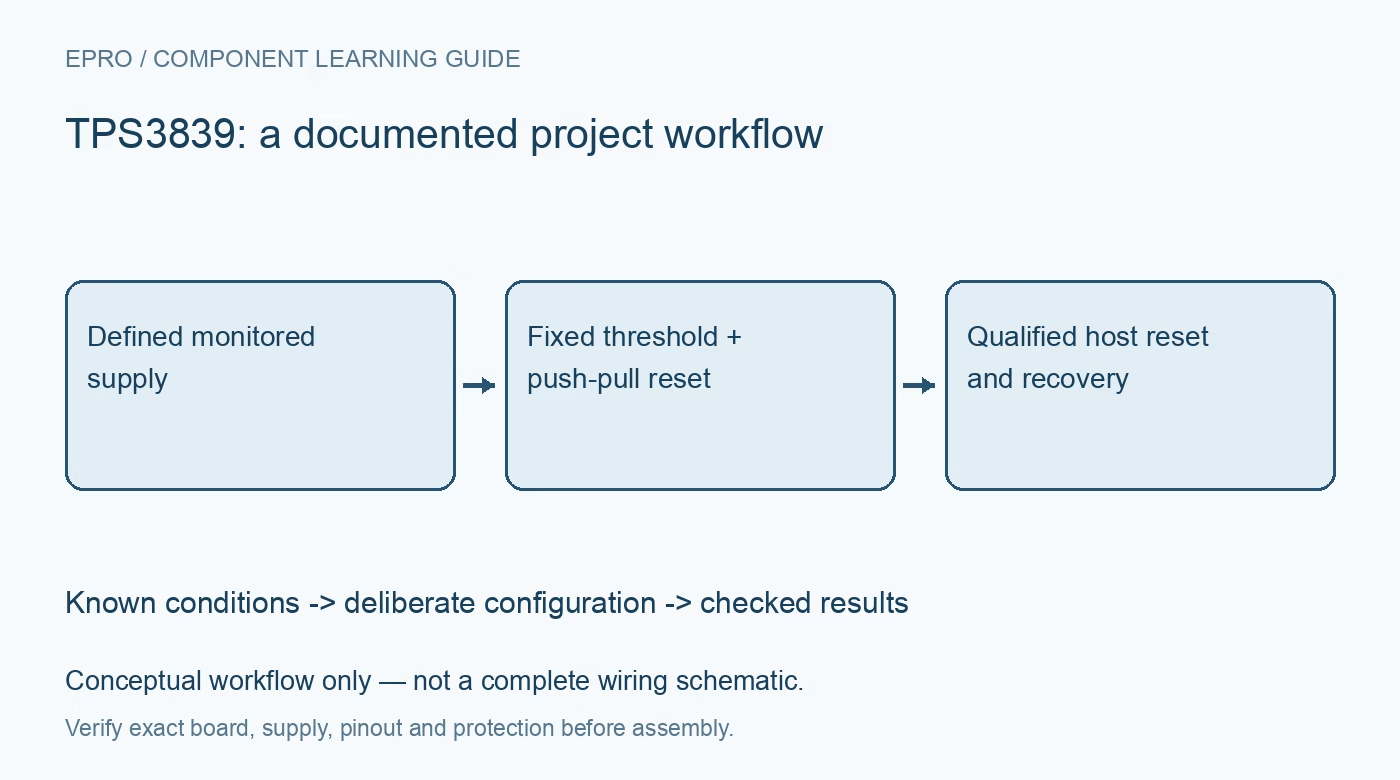
Choose a TPS3839 reset supervisor by its exact threshold and push-pull output, then check startup, hysteresis, release delay and host reset compatibility. This is a documentation-based planning guide, not a report of independent hands-on testing.
1. Choose the full threshold ordering code
The TPS3839 is a fixed-policy supply supervisor, so the exact threshold option is a design choice made when selecting the part. Compare the falling threshold and its specified tolerance with the host minimum operating voltage, supply tolerance and expected transients. Do not select a threshold solely because its nominal value resembles the rail name. Document the complete ordering code and confirm that the assembled board contains the intended option before interpreting reset behavior. Manufacturer documentation.
2. Do not import features from the family neighbor
The shared datasheet also describes TPS3831, which has a manual-reset feature not provided by TPS3839. Keep the schematic and firmware plan tied to the actual device. Similarly, the TPS3839 does not offer a timing-capacitor input for arbitrary release-delay programming. Its fixed reset-release delay is approximately two hundred milliseconds typical; use the full specified limits for timing decisions. A family heading is not evidence that every member exposes every function. Manufacturer documentation.
3. Treat RESET as an active driver
The active-low RESET output is push-pull, not an open-drain node that can automatically be wired together with other reset sources. Compare its output levels and drive behavior with the host reset pin and any debugger, connector or second supervisor attached to that net. Use an appropriate combining arrangement if several sources must control reset. Avoid assuming that adding a pull-up changes the electrical output type or makes contention harmless. Manufacturer documentation.
4. Separate operating supply from output validity
Check both the recommended supply range and the lower-voltage condition under which RESET is specified to remain valid. Those are different boundaries. The output is not guaranteed to act like a powered logic driver at zero supply. Analyze startup and power-down while the host, debugger or another domain may remain energized. Include back-power paths through connected pins in the review. A supervisor cannot create a valid host supply merely by asserting a reset signal. Manufacturer documentation.
Newest in the store


5. Test assertion and delayed release independently
Reset assertion follows the monitored supply falling below its threshold, while release requires recovery above the applicable hysteresis boundary and the reset-delay interval. Capture both directions with a controlled rail ramp. Repeat after a brief dip and after a longer undervoltage event. A host that restarts once during a bench demonstration has not established correct operation for slow ramps or marginal supplies. Check that reset remains asserted long enough for the actual host startup requirements. Manufacturer documentation.
6. Qualify transient behavior rather than promising immunity
The device can reject some short supply disturbances, but that does not mean every noise pulse is ignored or that every undervoltage event will have the same effect. Compare the documented transient behavior with measured rail events at the supervisor pins. Keep local decoupling and layout part of the analysis. Also distinguish very low typical supervisor current from the complete battery budget, which includes host leakage, dividers, connected interfaces and temperature-dependent maximum values. Manufacturer documentation.
7. Define what reset is expected to recover
Use this supervisor to support a documented supply-reset policy, not as a substitute for a watchdog, regulator, fuse or comprehensive safety controller. Verify that the host returns outputs to safe states during reset and reinitializes external devices on release. Save the measured rail, reset waveform and host recovery outcome together. Include a case where supply remains inadequate. Correct behavior may be to stay in reset, rather than repeatedly attempting an unstable application startup. Manufacturer documentation.
Related reading: TPS3840 Supervisor: 7 Checks for a Deliberate Reset Release.
Catalog note: The exact-part search did not return a matching Epro listing during preparation. Check the current catalog; this guide makes no price, availability or included-accessory claim.