


AS5600 Magnetic Encoder: Magnet Geometry and Angle-Sensor Selection

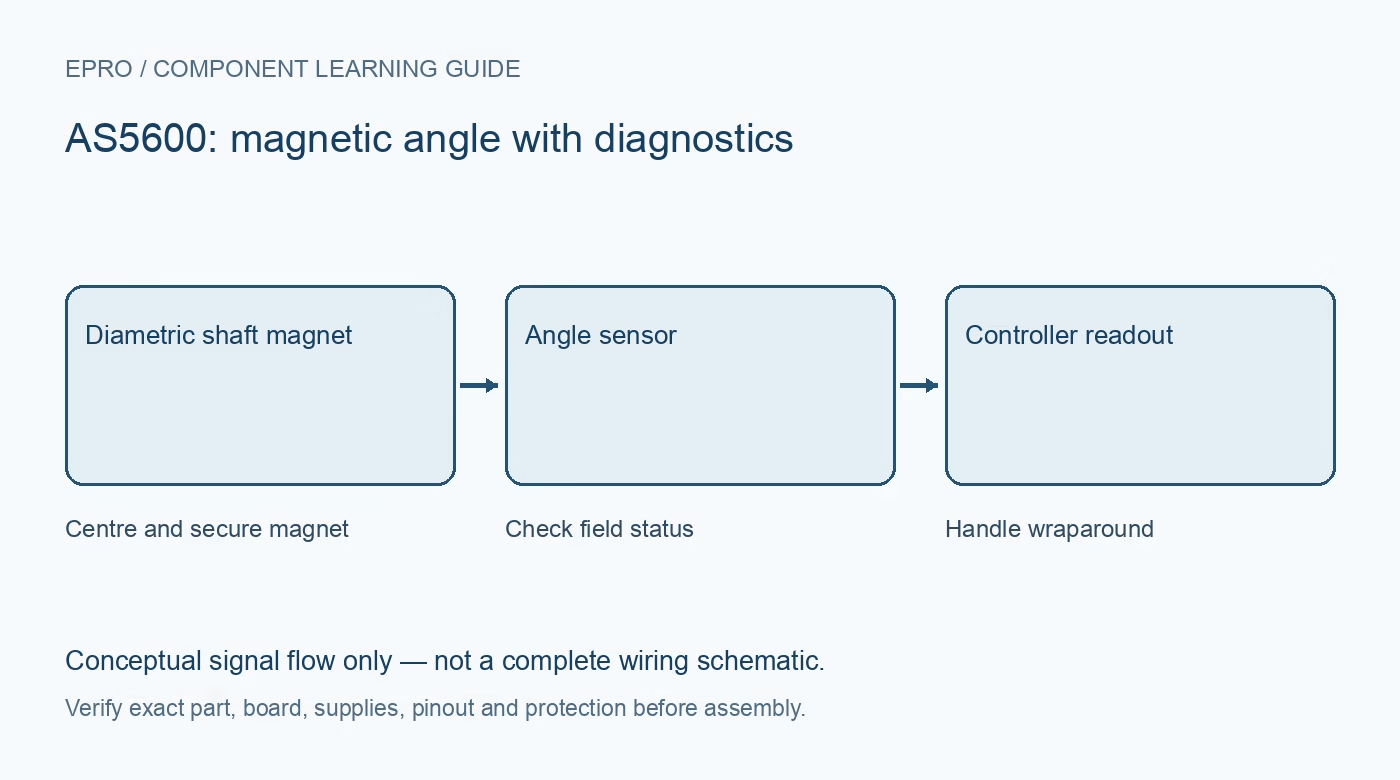
The AS5600 measures rotary angle from an appropriately positioned diametrically magnetized on-axis magnet. It is not a general compass or a multi-turn counter by itself. Magnet geometry, centering and diagnostic status matter as much as the nominal 12-bit output when selecting an encoder arrangement.
Use the specified magnetization geometry
The manufacturer describes a diametrically magnetized on-axis magnet. An arbitrary disc magnet with the wrong magnetization direction may not create the required rotating field. Position its rotation axis relative to the sensor as documented and keep it mechanically secure. Magnetic strength alone is not enough if alignment or geometry is wrong.
Distinguish resolution from mechanical accuracy
Twelve bits correspond to 4096 raw positions per full revolution, but that does not guarantee that the installed shaft angle is accurate to one count. Magnet offset, tilt, air gap, noise and device errors influence performance. Evaluate the assembly at known positions and across a complete revolution rather than converting the bit count directly into an accuracy claim.
Choose the required output interface
The device provides I2C access and configurable analog/PWM output behavior as documented. The default output arrangement and a carrier’s exposed pins are not necessarily the interface your software expects. Select the actual device variant, module and output mode together. Do not assume AS5600 and AS5600L have identical addressing and configuration behavior.
Read magnetic diagnostics
The status register identifies magnet detection and field conditions such as too weak or too strong. Check these alongside angle data, and observe the manufacturer’s diagnostic interpretation rather than treating any changing number as valid position. Mechanical adjustment may be needed before software filtering can produce a useful signal.
Keep permanent programming out of an initial test
The device includes nonvolatile programming facilities with specific conditions and limitations. Begin with read-only diagnostics and volatile settings where appropriate. Do not issue burn commands copied from a calibration example without understanding their permanence and allowed use. A software zero offset can be safer for early experiments than modifying the chip’s programmed endpoints.
Plan wraparound and power loss
A single-turn absolute angle wraps at the revolution boundary. Counting multiple turns requires an application strategy and a plan for missed updates and power interruptions; it is not automatically retained by the sensor. Define mechanical zero and direction explicitly. This educational encoder arrangement is not independently qualified as a safety-critical position feedback system.Newest in the store


Availability and illustration note
No matching product was found in the checked Epro catalog for this topic on 19 October 2026. This article therefore does not quote an Epro price or claim stock. The original illustration shows conceptual signal flow only, not a complete circuit or a photograph of a supplied product. Obtain a documented component or carrier with a known pinout and electrical specification.
Frequently asked questions
Can any strong round magnet be used?
No. Magnetization direction, centering, gap and field strength must meet the documented requirements.
Does a 12-bit output prove 0.088-degree installed accuracy?
No. That is approximately the full-turn code spacing, not a complete accuracy specification for the installed assembly.
Related Epro reading
Review breadboard connections before assembling a prototype. For controller expansion, the Mega 2560 pin guide explains why pin names and electrical limits must be checked together.
Technical references and test limitations
This guide uses the documentation linked below. The procedures are for a controlled, low-voltage learning setup; no independent hands-on test of the particular seller board is claimed. Record the actual part markings, wiring and firmware version before drawing conclusions from a test.