


Comprehensive Guide to Types of DC motor: Types and Applications

What are the main types of DC motor?
The main types of DC motor are brushed DC motors, brushless DC motors, permanent magnet DC motors, series-wound DC motors, shunt-wound DC motors, compound-wound DC motors, and separately excited DC motors. These categories overlap in practical motor classification because some names describe the construction, while others describe how the magnetic field is created and controlled. A clear classification of dc motor designs starts with one question: does the motor use brushes and a mechanical commutator, or does it use electronic commutation?
DC motors convert electrical energy into rotating mechanical energy using the interaction between magnetic fields and current-carrying conductors. The basic idea is simple, but the way each design creates torque, controls speed, and handles load can vary widely. That is why the phrase dc motor types covers more than one technical family.
DC motors in the broader family of electric motor types
Before looking closely at types of dc motor, it helps to place them among common electric motor types. Motors are often divided into DC motors and AC motors, with each group containing several subtypes. In a broader motor classification, engineers may also separate motors by supply voltage, commutation method, rotor design, magnetic field source, speed control method, and application environment.
This bigger picture matters because buyers often compare DC motors with AC induction motors, synchronous motors, stepper motors, and servo motors. Each option has a purpose. DC motors are often valued for controllable speed, strong starting torque, and compatibility with battery-powered systems. AC motors are often preferred for constant-speed industrial use, while stepper and servo systems are chosen when position control is the priority.
A practical motor types comparison should consider:
- Power source: DC supply, AC supply, battery, or electronic drive.
- Control needs: simple on/off operation, variable speed, torque control, or position control.
- Load behavior: constant load, variable load, frequent starts, or sudden torque demand.
- Maintenance expectations: brush replacement, bearing service, electronic drive support, and operating environment.
- Space and efficiency limits: compact devices often need different motor solutions than large machinery.
This context prevents a common mistake: treating all types of electric motors as interchangeable. They are not. The best motor is the one whose strengths match the workload.
Brushed DC motors remain simple and practical
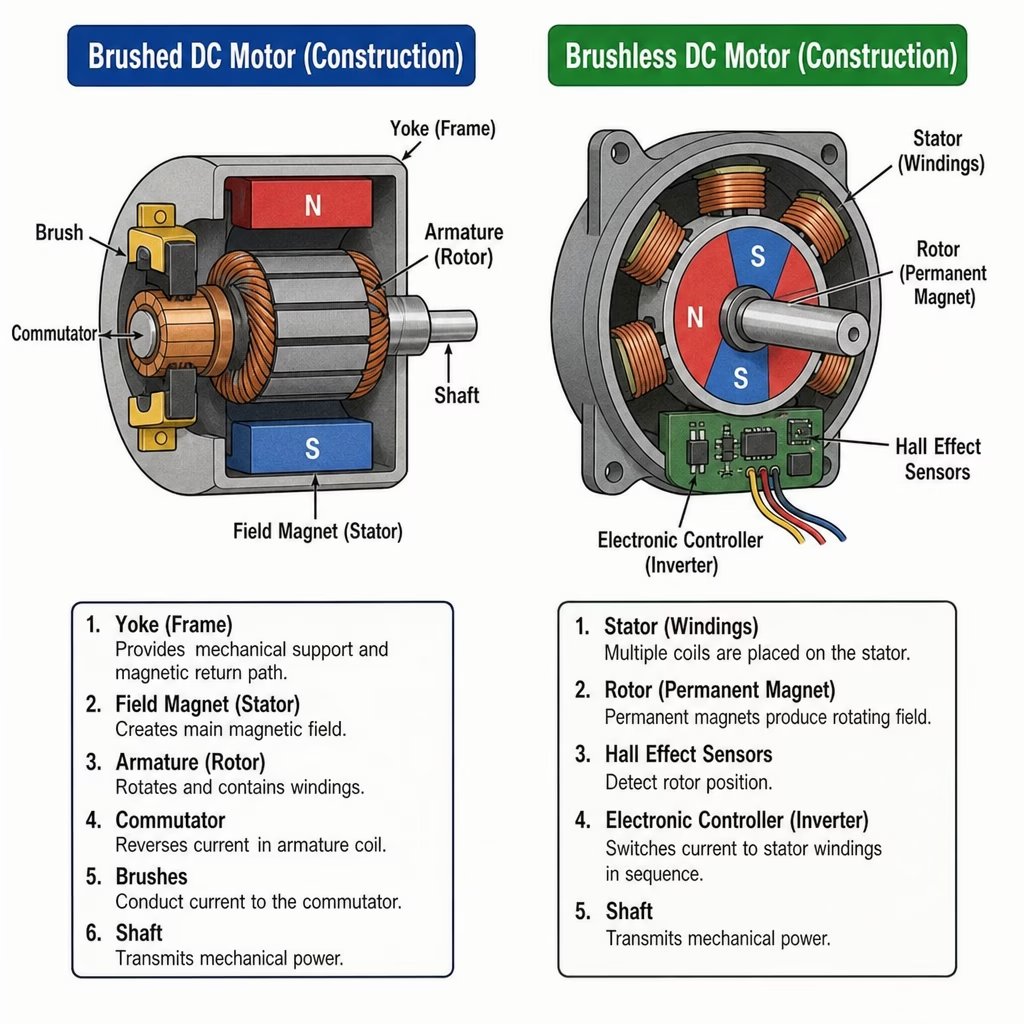
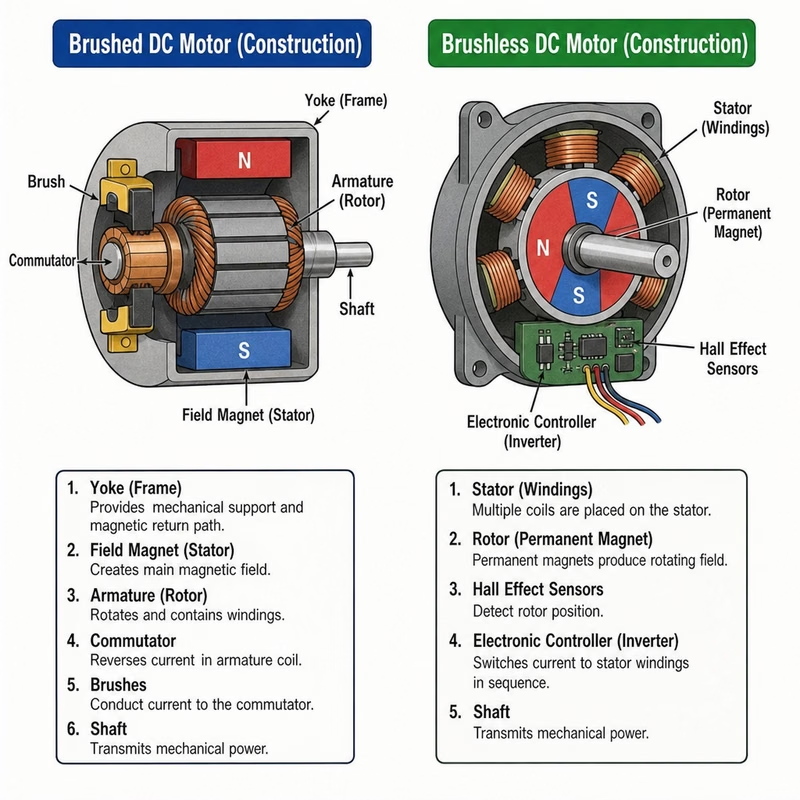
A brushed DC motor uses carbon brushes and a commutator to switch current through the rotor windings as the motor turns. This mechanical switching creates continuous rotation. The design is familiar, easy to control, and often economical, which is why brushed motors still appear in tools, toys, pumps, actuators, and small appliances.
The biggest advantage is simplicity. Speed can often be controlled by changing the applied voltage, and reversing direction can be as simple as reversing polarity. For applications where low cost and basic control matter more than long service life, brushed DC motors can be a smart choice.
The limitation is wear. Brushes create friction, electrical noise, and heat, and they eventually need replacement. The commutator can also wear over time. In dusty, cleanroom, high-duty-cycle, or hard-to-access equipment, this maintenance requirement may push designers toward brushless alternatives.
Brushless DC motors improve efficiency and service life
Brushless DC motors, often called BLDC motors, replace the mechanical brush-and-commutator system with electronic commutation. The rotor usually contains permanent magnets, while the stator contains windings controlled by an electronic driver. Sensors or sensorless control methods help the drive energize the correct windings at the right time.
The classification of brushless dc motor designs can be based on rotor position, sensing method, phase count, back-EMF waveform, and application style. For example, BLDC motors may be inrunner or outrunner designs. Inrunners often suit high-speed applications, while outrunners can provide strong torque in compact packages. Sensor-based BLDC motors are useful when reliable starting and low-speed control matter, while sensorless versions can reduce wiring and cost in suitable applications.
BLDC motors are common in drones, fans, electric vehicles, robotics, medical devices, computer cooling systems, and precision equipment. Their benefits include reduced maintenance, better efficiency, quieter operation in many applications, and longer service life because there are no brushes to wear out.
The tradeoff is complexity. A BLDC motor needs an electronic controller, and selecting the right controller is as important as selecting the motor. If the drive is undersized, poorly tuned, or mismatched to the load, the system may not deliver the expected performance.
How does the classification of DC motor designs work?
The classification of dc motor designs usually works by identifying how the motor’s magnetic field is produced, how current is switched, and how speed or torque changes under load. In traditional DC machines, the major field-based groups are permanent magnet, series, shunt, compound, and separately excited motors. In modern motion systems, brushed versus brushless construction is often the first distinction.
This layered approach is useful because different users care about different things. A maintenance team may focus on brushed versus brushless construction. A design engineer may focus on torque-speed curves, field excitation, thermal performance, and drive compatibility. A student preparing a classification of dc motor ppt or looking for a classification of dc motor pdf may need the textbook categories first, then examples that show how each one behaves in real equipment.
Permanent magnet DC motors
Permanent magnet DC motors use magnets to create the field instead of field windings. This makes the design compact and efficient for many small and medium-duty applications. Because no field current is required, the motor can be relatively simple and responsive.
These motors are widely used where size, weight, and straightforward speed control matter. However, permanent magnets can limit performance at high temperatures or in applications that require very large power ratings. They are a strong fit for many compact motion systems, but not every heavy industrial load.Newest in the store


Series-wound DC motors
A series DC motor has field windings connected in series with the armature. Because the same current flows through both, torque can be very high at startup. This makes series motors useful for applications that need strong starting force, such as traction-style loads and heavy starting conditions.
The key caution is speed behavior. A series motor can run too fast under light load or no load, so it must be applied carefully. It is best suited to systems where the load remains connected and the design accounts for safe operating limits.
Shunt-wound DC motors
A shunt DC motor has field windings connected in parallel with the armature. This arrangement gives more stable speed under changing load compared with a series motor. Shunt motors are useful when reasonably constant speed is important.
They may not provide the same extreme starting torque as a series motor, but they offer predictable performance. This makes them suitable for conveyors, machine tools, and other applications where steady operation is more important than maximum startup pull.
Compound-wound DC motors
Compound DC motors combine series and shunt field windings. The goal is to balance high starting torque with better speed regulation. Depending on the winding arrangement, the motor can be designed to emphasize torque, speed stability, or a compromise between the two.
This category is useful when neither a pure series motor nor a pure shunt motor gives the desired behavior. Compound motors are part of traditional types of dc machines and remain important for understanding how field design affects performance.
Separately excited DC motors
A separately excited DC motor uses an independent power supply for the field winding. This gives more control over the magnetic field and, therefore, motor behavior. It is useful in systems where precise speed control and adjustable performance are required.
The added control comes with added complexity. The motor needs appropriate supplies and controls, so it is normally selected when the performance benefit justifies the extra system design.
Comparing common DC motor types
A simple motor types comparison can make selection easier. No chart can replace a full engineering review, but the following guide shows how the main choices differ in everyday terms.
| Motor type | Main strength | Main limitation | Common fit |
|---|---|---|---|
| Brushed DC | Simple control and low entry cost | Brush wear and electrical noise | Basic devices, tools, actuators |
| Brushless DC | Low maintenance and efficient operation | Requires electronic controller | Fans, drones, robotics, EV subsystems |
| Permanent magnet DC | Compact and responsive | Magnet and temperature limits | Small machines, portable equipment |
| Series DC | Very high starting torque | Unsafe overspeed risk with no load | Heavy starting loads |
| Shunt DC | Stable speed behavior | Lower starting torque than series | Constant-speed applications |
| Compound DC | Balanced torque and speed regulation | More complex winding design | Loads needing mixed performance |
| Separately excited DC | Flexible control | Needs separate field supply | Adjustable-speed systems |
Use this table as a starting point, not a final specification. Real-world selection also depends on duty cycle, enclosure, cooling, gearbox needs, control electronics, mounting, noise, and safety requirements.
What should you consider before choosing a DC motor?
You should choose a DC motor by matching the motor’s torque, speed, control method, duty cycle, environment, and maintenance needs to the application. The right answer is rarely “the strongest motor” or “the cheapest motor.” It is the motor that performs reliably within the limits of the system.
A useful selection checklist includes:
- Define the load clearly. Identify starting torque, running torque, peak torque, and whether the load changes during operation.
- Set the speed range. Decide whether the motor runs at one speed, several speeds, or continuously variable speed.
- Choose the control method. A brushed motor may need a simple controller, while a BLDC motor requires a compatible electronic drive.
- Check the duty cycle. Motors used continuously need different thermal planning than motors used briefly.
- Review the environment. Dust, moisture, vibration, heat, and access for service can change the best choice.
- Plan for maintenance. Brushes may be acceptable in accessible equipment but unsuitable in sealed or high-use systems.
- Consider the full system. Power supply, wiring, controller, gearbox, sensors, and mounting can matter as much as the motor itself.
This approach keeps the focus on performance in context. A motor that looks ideal on paper may disappoint if the controller is wrong, the cooling is inadequate, or the mechanical load is misunderstood.
Better motor knowledge leads to better decisions
Understanding types of dc motor designs makes it easier to compare options with confidence. Brushed motors offer simplicity, brushless motors offer long-life electronic control, and traditional field-based categories explain why torque and speed behavior vary so much. When you understand the classification of dc motor choices, the selection process becomes less about memorizing names and more about matching behavior to a real workload.
Whether you are studying types of dc machines, preparing learning materials, or choosing between different types of electric motors for a project, start with the application. Define the load, control needs, environment, and maintenance expectations first. From there, the right DC motor type becomes much easier to identify.