


DS18B20 Temperature Sensor: 7 Buying Checks

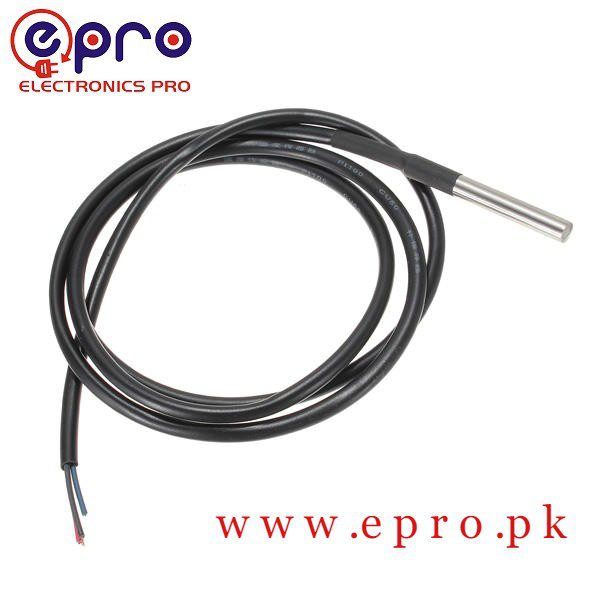
A DS18B20 temperature sensor can be a practical choice for a low-voltage project that needs a digital temperature reading. The important buying decision is not simply whether the listing says waterproof. Package construction, cable limits, interface voltage and the intended measurement environment all need checking.
This guide compares Epro’s sensor-module and sealed-probe listings. It distinguishes the sensor chip’s documented capabilities from claims that would require testing the complete supplied assembly.

DS18B20 temperature sensor prices and packages
| Listed item | Price (PKR) | Project role |
|---|---|---|
| DS18B20 Temperature Sensor Module | 240 | Temperature sensor module listing |
| DS18B20 Waterproof Temperature Sensor in Pakistan | 290 | Sealed, pre-wired temperature probe listing |
Price snapshot: Epro listings checked on 18 October 2026. Confirm the current price, availability, delivery charges and package quantity on the linked page before ordering. These are dated listing prices, not a quotation or an independent performance test.
The DS18B20 module can suit a dry bench demonstration, while the sealed temperature probe places the sensing element inside a protective tube. Check connector type, cable length and supplied accessories before comparing their prices as complete project costs.
1. Confirm 1-Wire, not I2C
The DS18B20 uses the Dallas/Maxim 1-Wire protocol. It is not an I2C device, even if a catalog description groups those terms together. A typical externally powered setup needs supply, ground and a data connection, plus an appropriate data-line pull-up.
The phrase 1-Wire describes the communication arrangement, not a promise that a complete practical circuit uses only one physical wire. A conventional I2C scanner will not discover the sensor. Choose software support for the actual protocol.
2. Match both supply and data voltage
The Analog Devices DS18B20 datasheet specifies a 3.0–5.5 V local-power range for the chip. Check the supplied module or probe separately, including any onboard components. A controller’s GPIO must not receive an unsafe pull-up voltage.
A conventional Uno can use a properly rated 5 V arrangement. A 3.3 V-only controller needs the data line pulled to an appropriate logic supply. Do not treat a sensor’s upper supply rating as permission to apply that voltage to every connected controller.
3. Budget for the pull-up and a sensible bus
A 4.7-kilohm data pull-up is a common starting point for a short bench circuit, consistent with the reference datasheet. Confirm whether a module already includes one before adding parallel resistors. Cable length, topology and the number of devices can change the electrical behaviour.Newest in the store


Do not repeat a broad claim that digital signalling guarantees unlimited cable distance without degradation. Long runs need a deliberate bus design and validation. Start with a short, stable connection before extending the installation.
4. Separate resolution from accuracy
The chip provides selectable 9- to 12-bit temperature conversion. More displayed decimal places do not create the same amount of measurement accuracy. Accuracy specifications apply over stated temperature ranges and conditions, and should not be assumed to prove the performance of an unidentified sensor or finished probe.
Conversion also takes time. The datasheet gives a maximum conversion time of 750 ms at 12-bit resolution. If a project needs fast changes, consider conversion timing and the probe’s physical thermal response rather than only the numeric resolution.
5. Check what the probe sealing actually covers
A sealed metal tip does not establish that the connector, cable splice or controller board can be submerged. Verify the installation instructions and the full assembly’s temperature and environmental limits. The chip’s maximum operating range is not automatically the safe rating of every cable or seal.
Do not assume food-contact, medical, chemical or pressure-vessel suitability from a stainless-steel-looking tube. Those applications need appropriate materials, documentation and system-level safeguards. A hobby probe is not a substitute for a certified instrument where consequences matter.
6. Plan multiple sensors deliberately
Each DS18B20 has an address that can identify it on a shared bus. Software should associate a known address with a physical location when several probes are used. Reading index zero alone is convenient for one sensor but is not a robust location-mapping strategy for a larger installation.
7. Start with a simple temperature log
Follow the DS18B20 Arduino wiring and code guide before adding relays or heaters. Check readings against a suitable reference at several stable conditions, and handle missing data separately from valid temperatures. The guide’s starter code is not a tested temperature controller or independent safety cutoff.