


Essential Guide to Resistor Types

Essential Guide to Resistor Types
Resistors are small, inexpensive components, but they do a big job: they control current, divide voltage, protect sensitive parts, and help circuits behave predictably. Whether you are repairing electronics, building Arduino projects, or stocking a workbench, understanding resistor types and resistor values makes it easier to choose the right part with confidence. This guide explains the most common electronic resistors, when to use them, and what to look for in a practical resistor assortment.
What do resistors actually do in a circuit?
A resistor limits the flow of electrical current and creates a controlled voltage drop. In real projects, that means it can protect an LED, set the gain of an amplifier, pull a signal line high or low, or help a sensor produce a usable reading. Good resistor selection is not only about matching the ohm value; it also includes power rating, tolerance, temperature behavior, size, and the environment where the circuit will operate.
For beginners, resistors can seem interchangeable because many look similar. In practice, a tiny signal resistor, a 1 watt resistor, and a precision resistor may all have the same resistance value but perform very differently under load. Choosing the correct resistor components helps prevent overheating, unstable readings, and premature circuit failure.

The main resistor types you will encounter
Most projects use a handful of common resistor types. Each one has strengths, tradeoffs, and typical use cases.
Carbon film resistors
Carbon film resistors are affordable, widely available, and useful for general low-power circuits. They are often found in older equipment, hobby kits, and simple prototypes. Their tolerance and noise performance are usually not as strong as metal film options, but they remain practical when extreme precision is not required.
Metal film resistors
Metal film resistors are a popular choice for modern electronics because they offer better accuracy, lower noise, and more stable performance than many carbon film parts. If you are buying a resistors starter kit for general breadboarding, metal film parts are often the most versatile option. They are useful for signal circuits, microcontroller work, audio projects, and measurement applications where consistency matters.
Wirewound resistors
Wirewound resistors are built by winding resistance wire around a core. They are commonly used when a circuit must handle more power or dissipate more heat. A 1 watt resistors kit may include parts suitable for heavier loads than the small quarter-watt resistors typically used on breadboards, but you should still check the rating before using them in power applications.
Thick film and thin film resistors
Thick film and thin film resistors are often used in surface-mount electronics. Thick film resistors are common and cost-effective, while thin film resistors generally provide better precision and stability. You will see these resistor types on compact circuit boards in consumer electronics, development boards, and production devices.
Variable resistors and potentiometers
Variable resistors allow resistance to be adjusted manually or mechanically. Potentiometers are common in volume controls, dimmers, calibration circuits, and sensor adjustments. They are not always included in a basic resistor set, but they are useful additions if you experiment with analog circuits.
Understanding resistor values, tolerance, and power
Resistor values are measured in ohms, often written as Ω, kΩ, or MΩ. A 220 Ω resistor might be used with an LED, while 10 kΩ is common for pull-up or pull-down resistors in microcontroller circuits. The correct value depends on the voltage, current, and behavior the circuit requires.
Tolerance tells you how close the actual resistance is likely to be to the marked value. A 5% resistor may vary more than a 1% resistor, which can matter in timing, filtering, sensing, and reference circuits. Power rating tells you how much heat the resistor can safely dissipate, and exceeding it can cause drift, damage, or failure.Newest in the store


A simple selection checklist:
- Resistance value: Match the circuit requirement, not just the closest part on hand.
- Tolerance: Use tighter tolerance when accuracy affects performance.
- Power rating: Choose a rating comfortably above the calculated power dissipation.
- Package size: Make sure it fits the breadboard, PCB, enclosure, or repair space.
- Temperature stability: Consider this for sensors, automotive circuits, and outdoor devices.
- Availability: Keep common values stocked so small projects do not stall.
Which resistor kit should beginners choose?
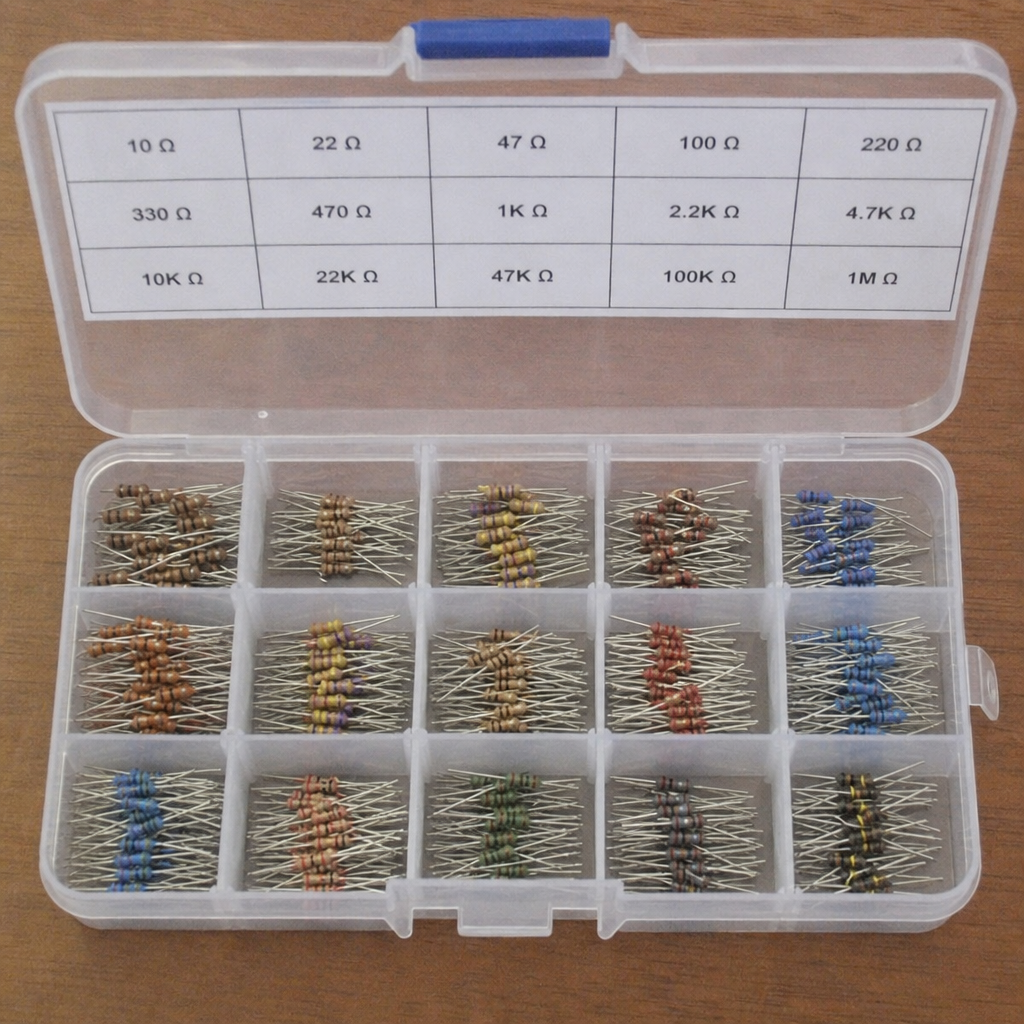
A beginner should choose a resistor assortment that includes common values, clear labeling, and enough quantity for repeated experiments. A good resistors kit saves time because you can test ideas immediately instead of ordering one value at a time. For Arduino, robotics, LED, and sensor projects, a broad resistors assortment kit with quarter-watt metal film resistors is usually a practical starting point.
If you are buying arduino starter kit resistors, look for values commonly used with LEDs, buttons, displays, and sensors, such as 220 Ω, 330 Ω, 1 kΩ, 4.7 kΩ, and 10 kΩ. Many arduino kit resistors are intended for low-voltage breadboard circuits, so they may not be suitable for high-power loads. A resistor pack with organized labels is especially helpful because beginners spend less time reading color bands and more time building.
Some shoppers search for very specific kits, such as a gm vats bypass resistor kit 15 resistors, which is aimed at a specialized automotive use rather than general electronics learning. Others may see listings described as resistors kit set 5, which can mean a small multi-pack or a compact selection of values. Read the description carefully so you know whether you are getting a broad resistor assortment or a narrow set for one task.
Practical uses for a resistor assortment
Keeping a resistor set nearby is useful for more than textbook circuits. In day-to-day electronics work, resistors solve small problems quickly and safely.
Common uses include:
- LED current limiting: Prevents LEDs from drawing too much current.
- Pull-up and pull-down circuits: Keeps digital input pins from floating.
- Voltage dividers: Scales a voltage to a safer or more useful level.
- Signal conditioning: Helps sensors and analog circuits produce stable readings.
- Repairs and replacements: Provides close matches for damaged resistor components.
- Prototyping: Lets you test different resistor values before finalizing a design.
A well-labeled resistor pack also helps you compare circuit behavior. For example, changing an LED resistor from 220 Ω to 1 kΩ reduces brightness and current draw. Swapping values in a voltage divider changes the output voltage. Those hands-on experiments make theory easier to understand.
Smart storage and handling habits
Resistors are durable, but organization matters. Store them by value range, tolerance, and power rating so you can find the right part quickly. If your resistors kit comes in tape strips, keep the labels attached until you transfer them into drawers, envelopes, or a compartment box.
It is also worth separating high-power resistors from standard signal resistors. Mixing them together can lead to mistakes when two parts share the same resistance but not the same wattage. For frequent prototyping, keep your most-used values in a small desktop organizer and store less common electronic resistors in a larger parts box.
Final takeaway
Resistors may be basic components, but choosing them well improves safety, reliability, and circuit performance. Learn the common resistor types, understand resistor values and power ratings, and keep a practical resistor assortment on hand for experiments and repairs. Whether you are using a general resistors kit, a focused resistor set, or a specialized pack, the right selection makes every electronics project easier to build and troubleshoot.