


INA3221 Monitor: 7 Checks for Three Separate Current Channels

INA3221 Monitor: 7 Checks for Three Separate Current Channels
Use INA3221 channels with verified external shunts, correct sign decoding and scan timing while distinguishing bus voltage, current and calculated power. This is a documentation-based bench-planning guide, not a claim of independent hands-on testing.
1. Define three INA3221 measurement paths
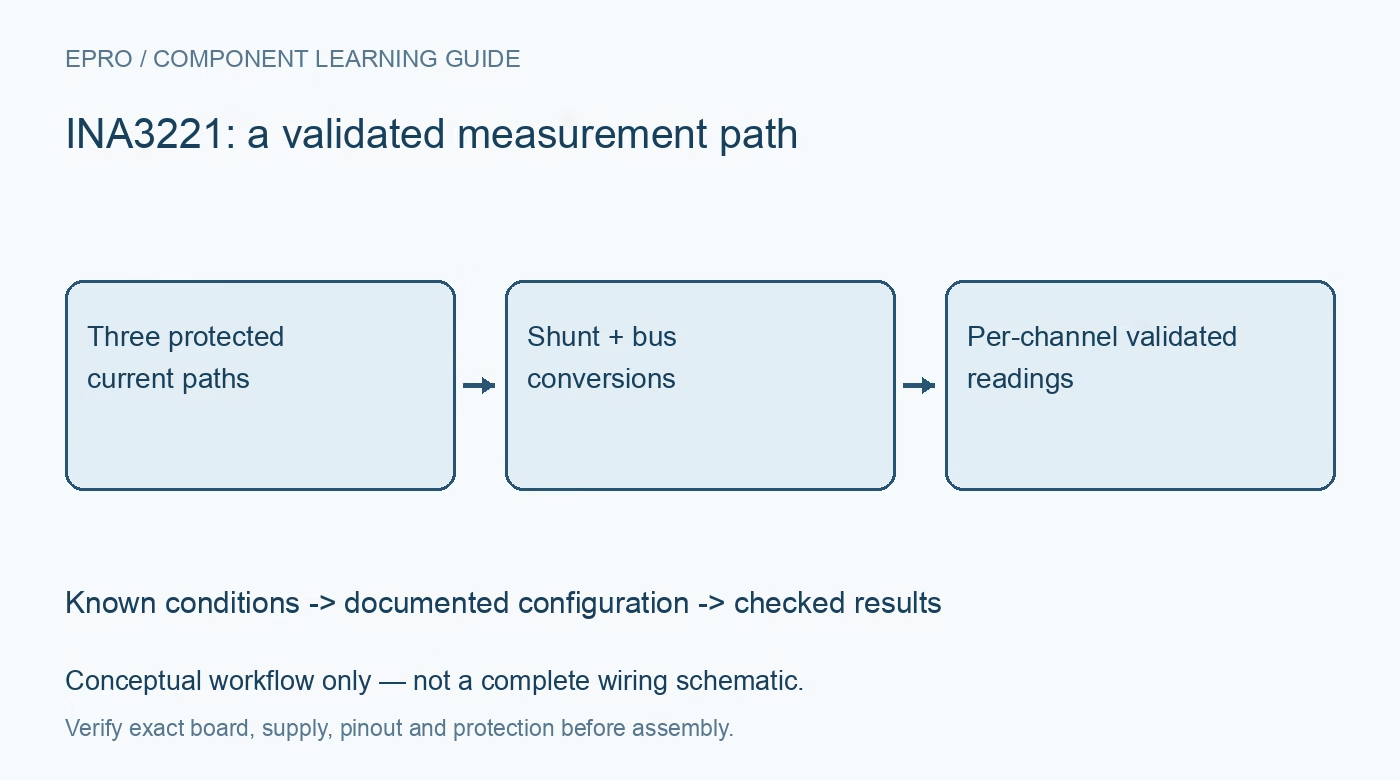
The INA3221 monitors shunt voltage and bus voltage for three channels through an I2C-compatible interface. It does not contain three universal plug-in ammeters. Each channel needs an understood external current-sense arrangement. Sketch the source, shunt and load for every path before selecting a carrier. Texas Instruments describes configurable conversion timing, averaging and alerts; those features are useful only when firmware preserves which channel and configuration produced each result. Manufacturer documentation.
2. Identify every external shunt
Inspect the resistor marking and, preferably, the carrier schematic or bill of materials. Current is calculated from measured shunt voltage divided by the actual shunt resistance. Using a library default for a different board can scale all readings incorrectly while leaving the displayed voltages plausible. Include resistor tolerance, temperature coefficient and permissible dissipation in the design. A small resistor package can overheat before an optimistic advertised current value is reached.
3. Verify voltage and ground requirements
The device senses bus voltages from 0 V to 26 V and operates from a separate 2.7 V to 5.5 V supply according to TI. Check the exact channel connections and bus pull-ups against the host logic level. Do not connect unrelated floating supplies without analyzing their ground relationships. Three channels are not three isolated inputs, and a digital interface does not make unknown high-voltage measurements safe. Manufacturer documentation.
4. Decode signed shunt data correctly
The shunt and bus registers have their own documented formats and scaling. Decode sign and reserved or unused bits before applying the datasheet conversion factors. Do not treat an entire received word as an unsigned current value. With power removed, verify polarity; then use a small protected low-voltage load to check the expected direction. Keep raw register values available so a suspicious negative reading can be investigated rather than silently forced positive.Newest in the store


5. Budget scan time across channels
Enabled channels, shunt and bus conversion times, and averaging determine the measurement cycle. Three readings obtained in one software loop are not necessarily simultaneous. Record acquisition order and freshness when comparing changing loads. Disable unused channels deliberately if the application and driver support it. Test a controlled change on one load and observe which channel updates, catching both wiring mistakes and software array-index errors early.
6. Calculate power and thresholds deliberately
When calculating channel power, pair the relevant bus voltage and current with an understood timing relationship. Compare alert thresholds in the units and register format specified by the device, not simply in a display library unit. Critical and warning signals report configured conditions; they are not rated circuit breakers. Use suitable fuses and independent protection for the actual source. Test threshold behavior at a small harmless load first. Manufacturer documentation.
7. Document the INA3221 channel map
Store channel label, shunt value, connection polarity, raw readings, converted values and measurement configuration together. Verify one channel at a time against a reference instrument, then repeat with all enabled. The existing INA226 shunt-selection guide provides useful background but has different registers and calibration behavior. A reliable INA3221 installation depends on three verified physical paths and three correctly labeled data records, not on copying a generic board current rating.
Related reading: INA226 Datasheet: Shunt Choice, Bus Voltage and Calibration. For current listings, check the Epro catalog; a matching item was not returned by the exact-part catalog search on 22 October 2026. No price, stock or included-accessory claim is made here.