


RFID Card Reader: 7 Frequency and Buying Checks

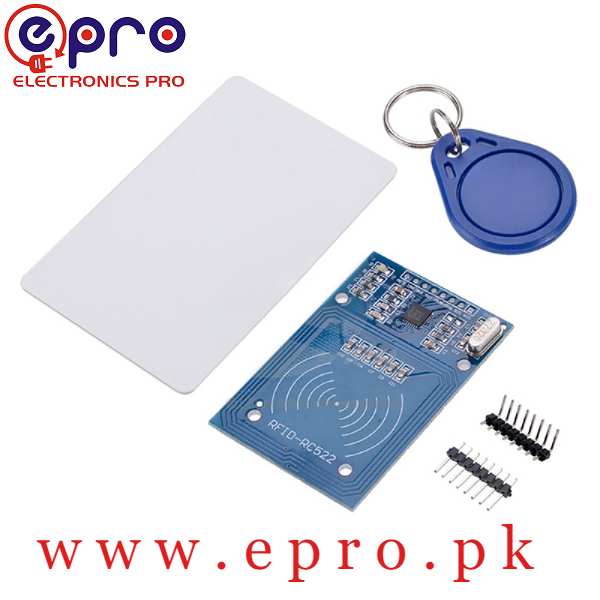
An RFID card reader must match the tag’s frequency and protocol before price or read distance becomes useful. A 125 kHz tag is not interchangeable with a 13.56 MHz card, and a reader that reports an identifier is not automatically a secure access-control system.
This guide compares Epro reader listings for low-voltage electronics projects. It explains compatibility checks rather than promising that a module will read every office card, payment card or NFC device.

RFID card reader prices and module types
| Listed item | Price (PKR) | Selection note |
|---|---|---|
| MFRC522 RC522 Card Read RFID Reader Writer Module in Pakistan | 380 | RC522: 13.56 MHz SPI reader/writer module |
| RFID Card Reader Module RDM6300 in Pakistan | 680 | RDM6300: 125 kHz serial reader |
| EM18 RFID Long Range Module in Pakistan | 1,580 | EM18: 125 kHz reader listing |
| 125KHz RFID Tag Key Chain in Pakistan | 130 | 125 kHz key-chain tag; not a reader |
Price snapshot: Epro product listings checked on 18 October 2026. Prices and availability can change. Confirm the live listing, delivery charges and supplied accessories before ordering; these figures are not a quotation or a claim of independent product testing.
The tag row is included to distinguish an accessory from a reader module. Confirm the exact package: the RC522 listing describes a compatible blank card and key-chain tag, while other listings may have different contents. Do not infer compatibility from the shape or colour of a key fob.
1. Match frequency and supported tag family
The RC522 listing uses 13.56 MHz and an MFRC522-family interface. The RDM6300 and EM18 listings describe 125 kHz operation. Matching frequency is necessary but not sufficient: the reader and library must also support the tag’s communication protocol and intended operation.
For a beginner, use a documented compatible blank tag supplied for experimentation. A card from an existing building system may use a different technology or protected application. Ask the issuer for authorized integration requirements rather than assuming a hobby reader can replace the original system.
2. Check the controller interface
The common RC522 breakout uses SPI, which needs clock, data and chip-select connections. RDM6300 reports supported card data through a serial interface. An EM18 listing can mention several output arrangements; check which one the exact board exposes and whether voltage translation is required.
TTL serial is not the same electrical interface as RS-232. Never connect an RS-232-level output directly to a microcontroller GPIO. Select an appropriate interface circuit and verify the actual pin labels before applying power.
3. Respect supply and signal voltage
The RC522 product page explicitly specifies a 3.3 V supply and warns against 5 V power. Its SPI inputs should also be treated as 3.3 V logic, not assumed tolerant of an Uno’s 5 V outputs. A native 3.3 V controller can simplify that part of a demonstration, but still requires correct pin selection and grounding.Newest in the store


Other reader modules may use 5 V supplies or different signal levels. A single colour-coded wiring diagram cannot safely cover every reader family. Check supply voltage separately from the output or input voltage limits.
4. Treat range claims as conditional
Read distance depends on antenna geometry, tag size, orientation, power and nearby materials. Metal can significantly change the behaviour of an antenna arrangement. A nominal range from one product listing is not a reliable basis for a doorway design or a promise that a tag will read through every enclosure.
Test the actual reader and tag in the intended mechanical arrangement before ordering a quantity. Start with a short, uncomplicated wiring setup so electrical faults do not become confused with radio-frequency limitations.
5. Distinguish reading a UID from secure authentication
The MFRC522 library’s own documentation warns that a card UID is not a secure identity credential and that Crypto1 is not suitable protection for security-sensitive systems. A successful identifier printout should not be promoted into a secure door lock, attendance proof or payment mechanism.
Use a properly designed, supported authentication system when security matters. This buying guide does not provide instructions to copy protected cards or bypass an existing access system.
6. Check software support before purchase
Confirm a maintained library supports your controller architecture, reader interface and tag type. Reader/writer capability does not mean every application area on every card is readable or writable. Avoid changing unknown card data during an initial wiring test.
7. Build a modest first demonstration
The RFID RC522 ESP32 guide reads the UID of a compatible tag you own without controlling a lock. Consult the MFRC522 library documentation for supported operations and explicit security limitations. Choose the reader for the documented requirement, not the broadest marketing phrase on its packaging.