


XL6009 Boost Converter: What to Check Before Buying

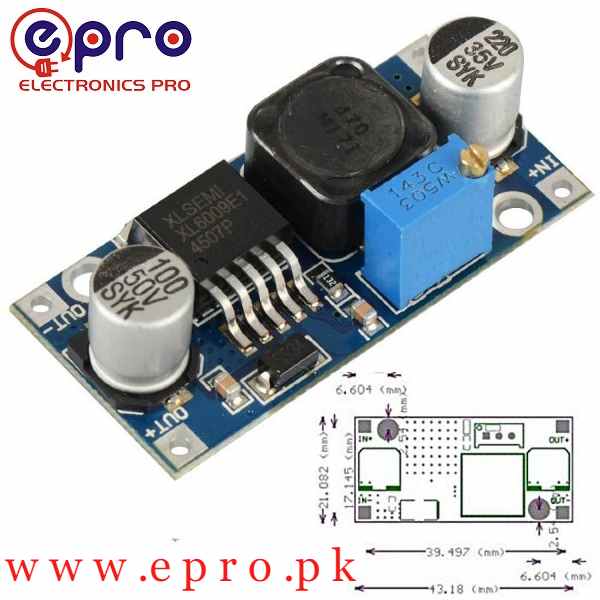
An XL6009 boost converter module is commonly chosen to raise a low-voltage DC supply. The XL6009 controller can be used in more than one circuit topology, so a chip name alone does not prove that a particular board is buck-boost. Start with the module’s actual circuit and load requirement, then compare the checked Epro listing below.
Confirm what the module actually does

A standard step-up module is intended for an output above the input. A board advertised as buck-boost needs a topology that genuinely supports that behavior; a single adjustable output does not establish it. Compare the PCB photo, schematic and supplier description. If your source crosses the target output voltage, choose a documented buck-boost converter rather than relying on an ambiguous listing title.
Specify input range and output tolerance
Write down the minimum and maximum source voltage, not only its nominal label. Then record the output voltage range the load can tolerate. Source variation, startup and cable drop matter. Check those requirements against the complete module’s documentation, including capacitor and diode ratings, rather than using an IC datasheet maximum as a blanket board specification.
Convert the load requirement into power
A 12 V load drawing 100 mA requires 1.2 W at its terminals. The input must provide more than 1.2 W because conversion is not lossless. From a 5 V source, input current therefore exceeds the ideal 0.24 A; the real value depends on efficiency and operating conditions. This is an illustrative power calculation, not a tested result for the listed board.
A motor, radio transmitter or other pulsed load may need a much larger startup or burst allowance. Avoid choosing a converter merely because its headline ampere value is numerically greater than the load’s output current.
Read the current label cautiously
A regulator’s switch-current limit differs from a guaranteed continuous output-current specification. Module construction, inductor saturation, diode heating, capacitor ripple and airflow all affect usable performance. Ask for a supported input/output operating point and derating information when reliability matters. Without that information, keep the application conservative and verify the exact board under its real load.
Include adjustment and protection in the design
Set and verify output with the load disconnected before connecting sensitive electronics. Use an appropriate input fuse or current limit as the system design requires. A basic boost module is not automatically protected against reverse polarity, every short-circuit condition or output overvoltage. It is not a battery charger or a substitute for an approved mains adapter.
Newest in the store


Check wiring, mounting and temperature
Use short, secure connections suited to the input current. Mount the PCB on an insulating support so exposed solder joints cannot contact a conductive enclosure. Allow airflow and stop if a component becomes abnormally hot or regulation is lost. A module that can briefly display the correct voltage at no load may still be unsuitable for the intended continuous operating point.
Choose the entire supply chain, not just the converter
The original DC source, connector, wire and converter must all support the load. A weak USB source can collapse during startup even when the converter is functioning. Measure input at the module as well as output at the load when diagnosing resets. For sensitive analog equipment, evaluate ripple and transients with suitable instrumentation; a stable multimeter reading is not a complete noise measurement.
Epro parts and availability
These are relevant Epro listings, not independent authenticity or performance certifications. Prices below were checked on 19 October 2026; they are a dated snapshot rather than a historical price implied by this article’s publication date. Confirm the exact variant, included accessories, stock and current checkout price before ordering.
| Listing | Checked price | Stock at check |
|---|---|---|
| XL6009 DC to DC Boost Converter Voltage Booster in Pakistan | PKR 220 | In stock |
Frequently asked questions
Is every XL6009 module buck-boost?
No. The controller can be used in different arrangements; verify the actual board topology.
Can I use the output to charge a lithium cell directly?
Do not treat a general adjustable boost module as a battery charger. Use a charger designed for the cell chemistry and a suitable protected system.
Related Epro guides
Technical references and verification
The guidance above is based on the manufacturer documentation linked here and the listed product information. Example procedures and sketches are provided for a controlled low-voltage bench setup; no independent hands-on test of your particular board or adapter is claimed. Check the markings and documentation for your actual revision.